
By Chloe Spencer
The Partisan is happy to share an article from the Working People’s Press in Charlotte on slum conditions imposed by local real estate capitalists on struggling families in need of housing. Exposing local reactionaries and capitalists to the masses is a vital task of all revolutionaries-in-formation, in particular their revolutionary publications. We encourage all comrades to conduct this kind of deep investigation into their local conditions, including their local class enemies and notorious reactionaries, and create articles, make plans, and organize actions in a sequence of mass work.
Charlotte has a severe shortage of housing. The 2024 Charlotte-Mecklenburg State of Housing and Homelessness report showed that over 61% of moderate-income earners face the burden of housing that is too expensive (over 30% of their income is spent on housing alone). Simultaneously, apartment buildings are springing up like weeds all over the city, with landlords refusing to offer housing at a price that’s lower than “fair market rate.”
The majority of Charlotte’s city council members’ campaigns are furnished by real-estate firms. The Real Estate and Building Industry Coalition (REBIC) is a local political force whose priorities rest in lobbying for a “business-friendly” environment in Charlotte. Their self-described aim is to keep seats of power for the ruling class, in a clear demonstration of how politicians and capitalists work together against the working class.
Capitalist society does not allow for an equitable distribution of housing for everyone. With the current standard of for-profit or commodified housing, the only options for safe, healthy housing are likely unaffordable; and the rapidly decreasing amount of affordable housing is often unsafe.
In 2023, the City awarded four nonprofits a total of $6.5 million in Housing Support Grants. This money came from the American Rescue Plan Act, dedicated for the aid of people facing homelessness due to the COVID-19 pandemic. ARPA funding has since been exhausted. HEAL Charlotte was awarded $2.25 million in the HSG.
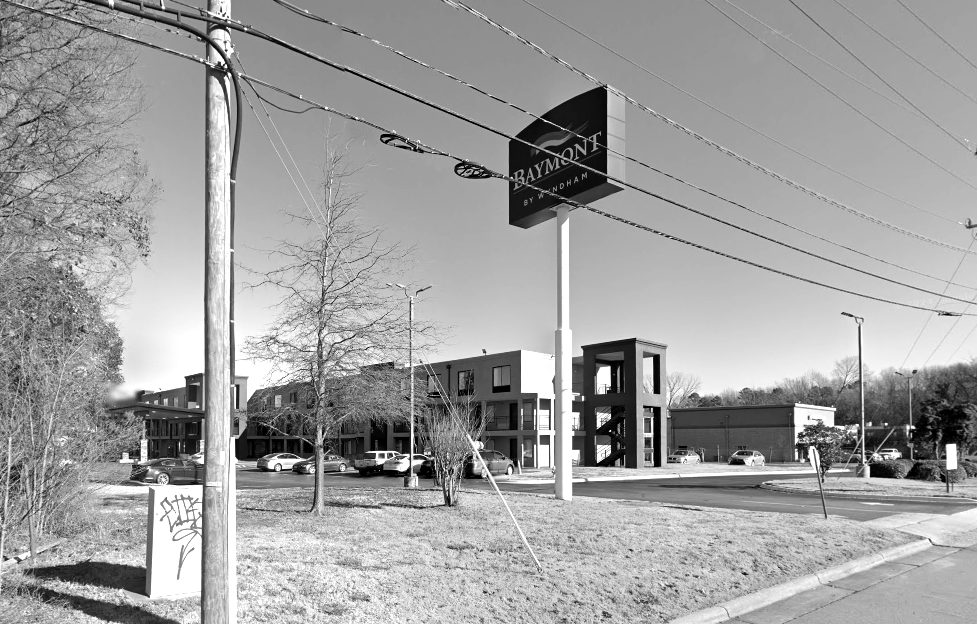
HEAL Charlotte then used HSG funds to lease the Baymont by Wyndham last year, located at 5415 Equipment Drive in the Sugar Creek Corridor. The property is owned by North Corridor, LLC, and was last assessed to have a value of $5.9 million.
Community members and homeowners in the Sugar Creek Corridor have faced years of disinvestment due to the legacy of redlining – the financial practice of devaluing properties in predominantly Black neighborhoods.
HEAL Charlotte, run by CEO Greg Jackson, would provide 90-day emergency assistance housing, while case managers worked to provide in what was called the Heal A Home Program. From the HEAL website:
“Heal Charlotte partnered with Baymont by Wyndham to house families at a discounted rate per night. Heal Charlotte covered the housing cost, which allowed families to save money to transition into permanent housing. During the first year, Heal Charlotte housed a total of 85 people; 7 individually housed and 21 families housed.”
Sugar Creek is an area known for issues from violence and theft to sex and drug trafficking, stemming from systemic disinvestment and Charlotte’s legacy of redlining and discriminatory housing practices. Residents in the area are forced to choose between two difficult options: either increase police presence and investment to “clean up” those areas, which would inevitably raise property values and could lead to displacement; or build affordable housing in the area, which would perpetuate the issues of “concentrated poverty.”
Last year, Jysenya, who was pregnant, was desperate to escape domestic violence with her two children. A community member referred her to Jackson, who told her to meet him that day at the Baymont over a quick phone call.
Soon after signing a contract with an organization called “Commonwealth Charlotte,” Jysenya’s family finally had a key in her hand and a roof over their heads.
She knew that the hotel wasn’t a good environment for her and her family – other tenants were in similarly precarious situations due to substance dependency, being involved in gangs, or sex trafficking – but she knew it’d only be temporary.
She expected to meet with a case manager for the financial literacy classes, access to services like food assistance and other partner organizations, and that her children would receive care and go on field trips – all things mentioned in the contract. However, she had to continuously seek out HEAL Charlotte case managers to ask about a housing placement.
An Axios article praising the Heal A Home program mentions a rate of $750 for single bedrooms and free emergency lodging, as well as the requirement that all participants have children. However, the contract Jysenya signed mentioned nothing about a nightly rate. Further down, the article says that there are also “hotel-style rooms” that “People visiting Charlotte, typically for nonprofit or related work, can stay there for $77 a night.”
One day, Jysenya and her neighbors had a meeting in one of their rooms to discuss the lackluster assistance they were getting. To her dismay, she found out that the amounts Jackson was charging tenants, which he acquired through Cashapp payments, varied widely; and were not actually a flat rate of $750. From that day on, she and others decided to stop paying Jackson.
In April, Jysenya and all other residents were informed that HEAL Charlotte’s lease had ended, and would be required to vacate the Baymont within a week. A statement by HEAL Charlotte claiming that it “fulfilled every obligation in its contract” appeared in a WFAE article.
Earlier this year, WCCB published an article with a statement from a “city spokesperson” that “the one-year master lease [of the Baymont] consisted of $2 million lease expense, $65,000 housekeeping, plus Heal Charlotte’s responsibility for all utilities and other related expenses.” Jackson provided a statement that, “while our one-year master lease has ended, we are still fully operational and currently supporting 35 to 40 families who remain on-site.”
Multiple newspaper outlets mention different estimates of how many people remained housed at the Baymont following HEAL Charlotte’s exodus. Days later, Cedric Dean, CEO of Heal Empower Love Protect (HELP) Charlotte and Cedric Dean Homes, took over the lease of the Baymont. Said Dean in a recent Queen City Nerve article, “it became more and more evident that they didn’t have a plan. Greg didn’t even have a plan.”
Jysenya, in a panic, was comforted when Dean reassured her that she and her family – now with four children under ten, including one newborn – would be allowed to remain at the hotel while Medicaid covered expenses. Her relief didn’t last long. Under the new HEAL program, tenants seeking treatment for substance abuse disorder were housed alongside remaining families with children. Dean offered remaining HEAL Charlotte families a payment of $1,000 to vacate the premises.
Jysenya also noticed there were charges for hospital visits in her daughter’s name for appointments she never made or attended. She has found charges on her credit report that she also never made. It is unclear how Dean got funding from Medicaid for tenants, or whether anybody received substance abuse disorder treatment at all.
In early June, one of Jysenya’s friends and neighbors, Shannon Solomon, and her infant son, were found dead in their hotel room. Records from the Mecklenburg County medical examiner’s office and the North Carolina Medical Examiner determine Solomon’s cause of death was “morbid obesity.” At the time of her death, Shannon was 36 years old and had cardiomegaly, an enlarged heart due to strain on the circulatory system. Records did not indicate cardiac arrest or otherwise.
By June, Dean announced his withdrawal from the Baymont due to “concerns over safety.” In the press, Dean alleged that the Charlotte-Mecklenburg Police Department refused to remove “drug dealers” from the property. On May 12, Dean was arrested for forcefully entering the room of a tenant, whom he no longer wanted living there due to having children.
It is unclear how many people remain housed at the Baymont. Who owns it? Who is paying its costs?
Jysenya has since found new, safer lodging – but it is all still temporary. She is hoping to continue pursuing a degree at Central Piedmont Community College for child psychology. But she still wants answers. What happened to her friend, Shannon Solomon, and her son? What about all of the property that she and others left behind at the hotel? Will she ever be reimbursed for the money she was unfairly charged by Jackson?
For many people like Jysenya, the motels of the Sugar Creek corridor are the last frontier of affordable housing in Charlotte. At the same time, Charlotte leaders, who have known public relationships with both Greg Jackson and Cedric Dean, pushed the responsibility of housing people at risk of homelessness onto their non-profits.
In imperialist society, there is no alternative route. The masses will always be disposable to the ruling class of landlords, capitalists, and politicians. Either displacement happens due to rising property taxes, or the “concentration of poverty” through affordable housing construction would lead to disinvestment and cyclical poverty. Someone is always going to be sacrificed for more money in the ruling class’s pockets.
Elected officials know about Jackson and Dean’s business operations. In late February of 2022, Cedric Dean opened “Cedric Dean Homes” a halfway house facility in Shelby, NC. At a Shelby town council hearing to rezone the property, Charlotte City Council member Tiawanna Brown spoke on Dean’s behalf. Ultimately, the public hearing devolved into Dean and his supporters trying to attest to his character, rather than providing justification for the specific choice of zoning category being requested.
After owners of businesses neighboring Cedric Dean Homes found garbage containing mail belonging to tenants, Dean attempted to “pay compensation” for the trash, and refused to personally remove the garbage himself.
All working people have a human right to safe, healthy, and stable housing. The families who have been tossed aside by the city, county, Dean, and Jackson did not deserve being taken advantage of. This process of displacement and homelessness is systemic, being the result of the actions of the ruling class. It is a national problem. These problems will never go away unless we collectively organize to eliminate them at their root. Together, tenants can unite to withhold rent until their demands for no more rent hikes and for maintained, safe, and clean housing are met. By building independent working class neighborhood organizations, we can put pressure on the ruling class where it hurts them the most, take power into our own hands and away from capitalists, and ensure everybody gets what we know is a human right: housing.