In the dominant language you encounter in the media, the word “state”, when its not used to refer to the literal 50 “states” which make up the United States, often has a nationalistic or “patriotic” meaning. For example, the French or American or Egyptian “state” usually means their administrative apparatus, representative of the “civil service” or bureaucracy of that country. While it does sometimes also have a negative, “oppressive”, connotation given to it, this usually has something to do with whether or not a given country’s State is friendly or not to the United States. Countries deemed allies of the United States have “governments” which lead their state apparatuses, which are usually democratic and good, while countries who are enemies of the United States have “regimes”, which are violent and oppressive.
According to the theory that guides our revolutionary working-class movement, the word “State” has a very different definition. For us, the State is an instrument of violence through which the exploiting class or classes exercises its dictatorship over the oppressed and exploited classes.
Marxism argues that the state is not eternal but emerged at a specific stage in human development. It is not an external force, but rather arises from internal social contradictions. Historical materialism holds that human history is driven by two kinds of production: the production of necessities (food, tools) and the reproduction of human life itself.
In primitive societies, low productivity meant people were united by family ties. Social order was maintained through customs and moral norms, not through force. Public decisions were made by councils where everyone participated. This is known as the clan system, which was fundamentally different from the state. As productivity grew, especially with major divisions of labor, family bonds weakened. New economic relationships based on production began to form. Surplus goods led to private property, which created social classes and conflict. The old clan system could no longer hold society together.
Social structure, meaning the positions people hold in the economy, determines the social system. When the productive forces develop, the social structure changes, and the old system must be replaced. Since primitive production was low, only the clan system was possible. But when it could no longer handle new social realities, it was replaced by a new form of organization: the State.
For example, for centuries there were a variety of feudal States, through which the feudal landowning class oppressed and controlled the peasantry. Following the era of capitalist revolutions and overthrow of feudalism, in imperialist countries like the United States the State has become the instrument by which the capitalist class violently oppresses and suppresses the modern working-class, or “proletariat”. All States are products of what revolutionaries call the “irreconcilability of class antagonisms”, which in simple terms means that States are a product of when two classes are in conflict with one another and their interests cannot be reconciled peacefully. Because of this “irreconcilability”, an organ of violent class rule then emerges (the State) out of this struggle to oppress the ruling class’ opposing class, in our case for the capitalist class to oppress the working-class. The capitalists claim that the State stands above social conflicts as a neutral party; the reality is quite the opposite. The role of the State is to mitigate conflicts and defend the current social and production relations ruled by the exploiting class. Therefore, the State is nothing but a centralized organization of force, an organization of violence.
The existence of capitalist democracy does not change the violent nature of the State in class society, or as Lenin explains: “To decide once every few years which members of the ruling class are to repress and crush the people through parliament–this is the real essence of bourgeois parliamentarism, not only in parliamentary- constitutional monarchies, but also in the most democratic republics.”
Today, as we have entered the era of imperialism and proletarian revolution, capitalism, along with its State, has long become rotten and obsolete. They are long overdue to be overthrown by the proletariat. Because of this, we call the State of the exploiters the “Old State”. The political Power wielded by the capitalists in this State is called the “Old Power”. The future State led and ruled by the working-class will be referred to as the “New State”, and the political Power they wield referred to as the “New Power”.
It is through socialist revolution that the workers and their vanguard political Party can flip this contradiction on its head, and the State can become an instrument by which the working-class can suppress and repress the capitalist class, until a society without classes (communism) is achieved and the State apparatus itself withers away because there is no longer the social force of class struggle to produce and re-produce it.
Lenin said: “The overthrow of the bourgeoisie can be achieved only by the proletariat becoming the ruling class, capable of crushing the inevitable and desperate resistance of the bourgeoisie, and of organizing all the working and exploited people for the new economic system. The proletariat needs state power, a centralized organization of force, an organization of violence, both to crush the resistance of the exploiters and to lead the enormous mass of the population — the peasants, the petty bourgeoisie, and semi-proletarians — in the work of organizing a socialist economy.” State Power is central to the socialist revolution.
In addition to the universal characteristics of capitalist class society, each country’s State also has its own particular characteristics that stem from its history and national conditions. The United States is no exception to this rule, although many on the “left” demonstrate a profound ignorance of the structures and aspects of our Old State.
The first important characteristic is that the American State is a bourgeois State, and plays a major role in violently oppressing and controlling workers and oppressed peoples around the globe. To maintain its status as the most powerful superpower, the Old State maintains a vast military force at home and overseas, has created a sophisticated set of bodies and systems to dominate the world’s financial systems and markets, and has established a vast international network of espionage, political patronage, and bribery to keep the ruling classes of the oppressed nations and weaker imperialist nations under American influence. The American State has also developed an expansive and powerful parallel domestic system of bribery and patronage wherein the spoils of imperialist plunder are distributed to segments of the masses to buy them off as pacified agents of the oppressor class. The modern bourgeois State and the corporate cartels which sustain it also exercise significant control over the market and economic systems, as part of the entrenchment of monopoly capitalism and the trend towards the socialization of production in class society noted by Lenin.
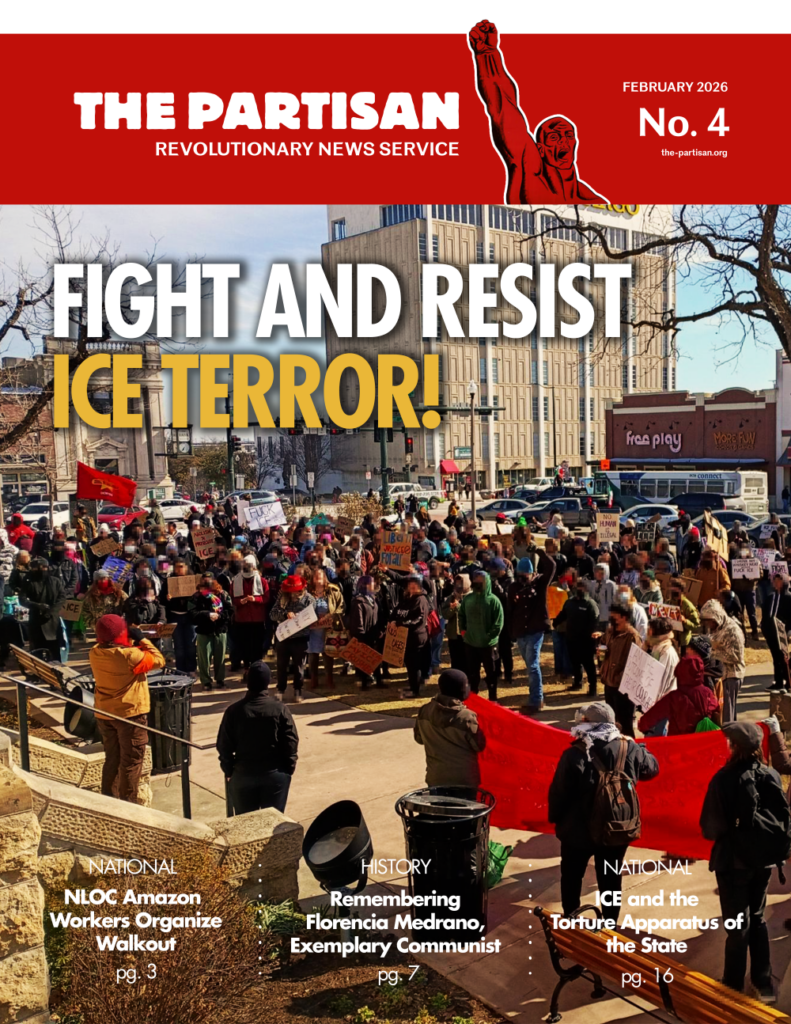
The United States is also a prison-house of nations, with the oppressor nation being America and the oppressed nations and national minorities being the Black/New Afrikan, Puerto Rican/Boricua, Indigenous, Chicano and Pacific Islander peoples. This reality provides our State with a set of specific characteristics that it uses to oppress these peoples internally. The most obvious aspect that stems from this is the extensive use of racial and linguistic discrimination by the American State to organize national oppression. It is against this systematic discrimination that the nationally oppressed and immigrant masses often rise up in spontaneous rebellion, in particular against the work of the police and other federal agents like ICE in carrying out American national oppression.
Unlike many capitalist countries, who either have a parliamentary multi-party system or a one-party system, the United States has had the same peculiar “two-party system” since the 1850s. Thus, for two-hundred years the federal, state and local governments in the United States have been ruled by the same two reactionary capitalist parties: the Democratic and Republican parties. Even though these parties are on paper “private” or “independent” institutions from the literal federal bureaucracy, it would be a mistake to view them as in reality separate from the bourgeois State. In Lenin’s words, the US “parliament and elections are marionettes, puppets” of the monopoly big bourgeoisie.
After centuries of rule, the Democratic and Republican parties are interwoven with the American bourgeois State at all levels, and neither is ever truly “out of Power”. While the party which holds the presidency might swap every 4 or 8 years between the two, within the federal bureaucracy, among the states, within the legislature and judicial systems, among the legal code itself; interwoven between every governmental body is a balance and cohabitation between the Democratic and Republican parties going back centuries. The Democratic and Republican parties are the political representatives of American Imperialism, of the ruling class of the American oppressor nation, and through the “two-party system” are an intrinsic part of the function and composition of its Old State.
Related to the above, our bourgeois State is also particularly reactionary and repressive, possessing an incredibly developed and brutal system of violence it uses against the masses in our country, despite the US supposedly representing the highest development of the bourgeois-democratic State in some circles.
“Our” police and federal agents regularly execute unarmed civilians with legal impunity. We are surveilled constantly, at work, at home, online, on the streets, by an immense web of agencies and corporations. Our basic democratic rights are heavily curtailed and controlled, including freedom of assembly, speech, and press. Chauvinism and discrimination against the workers and oppressed masses are sanctioned and encouraged by those in the halls of Power. Corruption is ubiquitous and normalized. Truly in the United States there is one life for the rich and powerful, and another for the rest of us; the exploited and oppressed workers who make up the majority of the country.
Lenin described the United States like this, more than 100 years ago: “Nowhere does capital rule so cynically and ruthlessly, and nowhere is it so clearly apparent, as in these countries, although they are democratic republics, no matter how prettily they are painted and notwithstanding all the talk about labour democracy and the equality of all citizens. The fact is that in Switzerland and the United States capital dominates, and every attempt of the workers to achieve the slightest real improvement in their condition is immediately met by civil war.”
Furthermore, the Old State is in the process of being even more repressive and anti-democratic as part of the broader tendency towards fascism that can be observed throughout the entire globe imperialist system. Chairman Gonzalo said: “The bourgeois system, in order to defend itself from the new insurgent class, had to renounce the rights and liberties it considered yesterday unrenounceable, thus giving itself the most resounding lie to its own principles… this would eventually give rise to fascism and Nazism, as a defensive wall of bourgeois interests threatened with death, but no longer the individual interests of yesterday but those of the great financial monopolies that hold the world firmly and sinisterly in their grip. At this stage the State is only an instrument at the service of reaction and a machine of oppression and subjugation.” Today, both Parties – representatives of the monopoly big bourgeoisie – are part of one process to centralize the State in the executive branch, pushing corporatization and reorganization of society and economy (“setting up of the state based on corporations, which implies the negation of parliamentarism”), and justifying these measures with an eclectic ideological offensive against the masses. As US imperialism sinks deeper into its grave, it takes away more aspects of the so-called liberal democracy that it has once prided itself and speeds up the tendency towards fascism in order to temporarily suppress the working-class.
The modern bourgeois State in imperialist countries is expansive, a trend that was noted by Lenin and other leaders of the international working-class movement. With the rise of monopoly capitalism and the modern imperialist system, the Old State has grown beyond the narrow confines of the military, the courts, the state-supported religious institutions, and literal offices of the executive and the legislature. There has developed a vast array of organizations and structures tied to the State, its legal apparatus, its system of patronage, and, in the United States, the two historical parties of Power. It would be an error to underestimate the American bourgeois State and the schemes of our capitalist class.
Imperialism is a paper tiger, it will fall eventually at the hands of the international working-class and oppressed peoples of the world; this is a historic truth. However this truth does not negate the real power of the corporatist methods of counter-insurgency the modern bourgeois State has developed. From the Communist Party, USA to the Black Panthers, the leaders of major revolutionary organizations in the history of our country – those who weren’t murdered, deported, or imprisoned for life – have all eventually taken the path of reformism and capitalist co-optation, because of their own internal errors and due to external pressure and bribery from the bourgeois State itself. The American democratic-liberal State has perfected the practice of corrupting and pacifying organizers and activists, and we must do everything possible to fight and defeat this path. We must do this while not isolating ourselves from the working masses, because it is precisely through corruption and repression that the bourgeois State works to defeat the work of revolutionaries among the masses and impose its own counter-revolutionary mass work.
The obvious question then arises: how should activists approach the problem of the struggle for necessary reforms in the course of our daily work among the workers, in the neighborhoods, on the campuses, with the struggling families, etc., without abandoning the revolutionary road? The solution lies in mobilizing, politicizing and organizing the masses in struggles for their demands through a wide variety of tactics and platforms, but avoiding through a few key practices. First, the revolutionary working-class forces should lead in a self-reliant and independent manner, creating principled coalitions and united fronts, but never depending on support from or alliances with opportunists as the deciding factor and never losing its independence. Second, revolutionary organizations must always expose class enemies and educate the masses politically when engaging in the struggle for reforms; if there is a struggle for demands without a good exposure of the class enemies and agents/schemes of the bourgeois State, and systematic political education of the masses before, during and after the struggle, it is likely to fall into rightism and reformism. Third, the masses must be encouraged to go beyond the limits imposed on them by the bourgeois State, and should be educated in the needs for the working-class to seize political Power itself and how there is no “State with two aspects” (one side good and another side bad); all structures of the bourgeois State have a negative class character from the point of view of the working-class. For example, a revolutionary organization might fight against school privatization, but it should thoroughly expose the class forces at play through its practice, literature, and political education and should never fall into the trap of thinking that Old State structures like the Department of Education are positive and good institutions that serve our class.
To summarize, the American bourgeois State has the following essential basic aspects:
- It is an instrument of violence by which one class, the capitalist class, oppresses another class, the modern working-class.
- It is the repressive apparatus of the most powerful imperialist superpower, the United States, making it an enemy and oppressor of billions of workers and people around the world as it uses its military and influence to maintain colonial relations, secure resources, and dominate markets.
- In our case it is also an instrument of national oppression by which the American nation controls and dominates oppressed nations and national minorities such as the Black/New Afrikan, Puerto Rican/Boricua, Indigenous, Chicano and Pacific Islander peoples. To do this the Old State relies heavily on racial and linguistic chauvinism/discrimination to organize its national oppression.
- It is a particularly reactionary and repressive liberal-democratic republic which is structured around two historical parties of Power, the Democratic and Republican parties (the “two-party” or “bipartisan” system).
- It has a vast and extensive set of bodies and institutions under its umbrella which make up a broader “order” that “legalizes and perpetuates [class] oppression by moderating the conflict between classes”. This includes institutions like the modern welfare state, state unionism, the so-called “NGO-industrial complex”, and all other forms of institutionalized reformism, pacifism, and corporatism.
- It is in a profound process of decay as a function of the broader decay of international imperialism, and becomes more and more fascistic, reactionary, dysfunctional, and repressive each day. We refer to this process as “fascistization” or the “tendency towards fascism” that can be observed in capitalist democracies the world over.
For further reading, we recommend:
- State and Revolution, Vladimir Lenin
- On the Bourgeois-Democratic State, Chairman Gonzalo
- The Origin of the Family, Private Property and the State, Fredrick Engels
- The State: A Lecture Delivered at the Sverdlov University, Vladimir Lenin