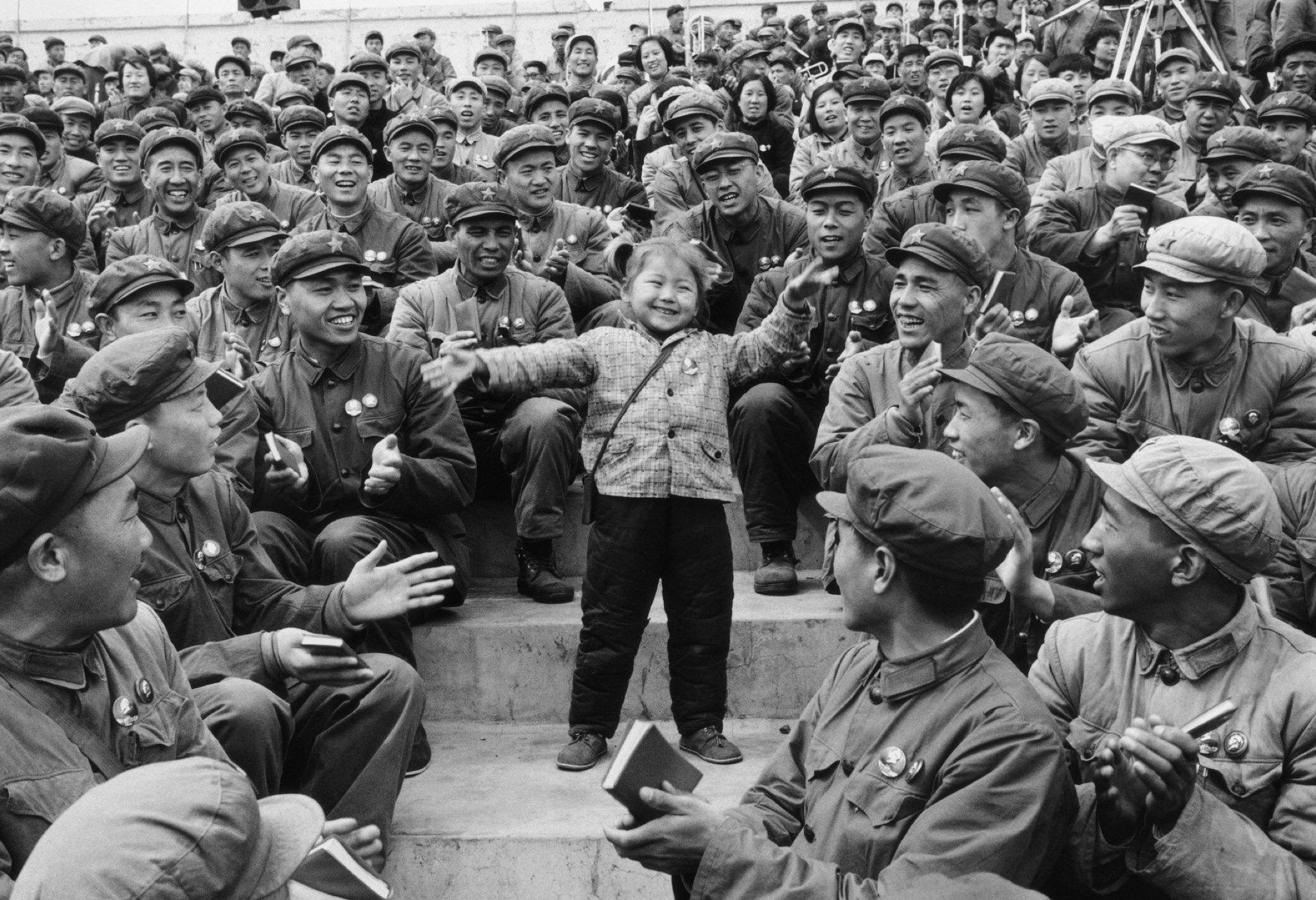
[Editorial Note: The Partisan is publishing an original translation of a document from the People’s Daily from 1965, written in honor of International Children’s Day. We publish it on June 1 as this day traditionally marks the celebration of International Children’s Day in the revolutionary camp. While the article is specific to the youth sector, we find there to be a lot of universal content in its messages and themes, in particular as it relates to questions of constructing a new socialist society, education, the role of the youth, training successors, and having a firm class outlook in all things. We hope our readers are interested in such translations and find them useful.]
Fostering Strong Revolutionary Successors
—Written for Beijing Review
By Soong Ching-ling
An incident took place on the grasslands of D’arkhan, Inner Mongolia, on February 9, 1964. A fierce snowstorm suddenly struck the region. Two sisters, Longmei (aged 11) and Yuyong (aged 9), bravely battled the blizzard to protect the flock of sheep under their care. After a full day and night, they were found frozen stiff, yet proud—because they had safeguarded every sheep.
Their heroic act of self-sacrifice for the public good was praised across the country. They were honored with the title “Heroic Sisters of the Grasslands.” Today in China, this is only one among many stories that reflect the new spirit of our children. Born on a heroic land, our children are nurtured with meticulous care by the Communist Party of China and the People’s Government from the day they are born. During their childhood, both society and parents take an active role in fostering their growth and character, helping them become a new generation with strong will and determination.
“Study well and make progress every day.” Chinese children often keep Chairman Mao’s instruction in their hearts, and they consciously strive to become revolutionary fighters capable of withstanding any storm and bearing any responsibility that life may assign them.
Carrying the Revolution Through to the End
Under the leadership of the Communist Party of China and Chairman Mao, the Chinese people, after enduring countless hardships and struggles, overthrew imperialism, feudalism, and bureaucratic capitalism, and won their liberation, establishing the People’s Republic of China. As Chairman Mao said at the time, “The seizure of national victory is only the first step in a long march of ten thousand li.” Today, as we complete the socialist revolution and engage in socialist construction to rebuild our country, a longer and more arduous path lies ahead. Raising and educating our children is an essential part of both the socialist revolution and socialist construction.
To ensure that children can inherit the revolutionary cause and safeguard the fruits of socialism, we must arm them both spiritually and physically so they can withstand the tests ahead. Only by doing so can we block the road to capitalist restoration and ensure that future generations—five or even ten generations down the line—possess the revolutionary ideals and spirit necessary to advance China toward communism.
After all the sacrifices our working people made to gain power, it is unimaginable that we would allow that power to slip away by failing to educate our children about how it was won. If we only think about their current happiness—letting them live solely under “the sunshine of peace” and “a clear blue sky”—we are in fact harming their future well-being. Such thinking paves the way for the return of all the evils of the old society. This is revisionist ideology. As these young people grow up, such thinking will bring them endless harm and suffering.
This is not to say we do not hope for peace and blue skies for our children. But the objective reality is that dark clouds cast by imperialists and reactionaries around the world continue to obscure that sunshine and sky. Confronted with this reality, we can only draw one conclusion: it is absolutely necessary to educate our children to recognize present dangers, to stand firm, and to drive away those dark clouds.
Proletarian Education
Children’s education is class-based. Modern revisionists claim: “All mothers around the world think alike.” “All mothers wish the same things for their children.” A closer analysis reveals that this is completely false! In a society where classes and class struggle still exist, mothers from different classes have very different views of their children.
A revolutionary mother wants her child to become a warrior who dedicates everything to the people’s cause. For example, the wife of an ordinary herder on the Inner Mongolian grasslands hopes her child will follow Chairman Mao’s teachings, cherish the people’s commune, and fight selflessly for the collective good. On the other hand, a landlord’s wife might take her child into the fields and tell them which lands used to belong to their family before land reform, instilling feelings of revenge and class hatred.
How can we believe that a mother’s thoughts are unaffected by her class background? We know full well that although those who once owned the means of production have now lost them, their way of life and worldview still exert influence. They are determined to use those remnants to regain power and live off others’ labor. Every class educates its youth in its own way. We must remain vigilant, as the exploiting classes are constantly seeking ways to poison the minds of our youth—while we are the ones who must hand over the sacred banner of revolution and the interests of our country and people to those same youth.
Learning from Lei Feng
The working people must educate their children from the standpoint of the working class. Our youth must learn to view everything through the lens of class struggle, so they can determine for themselves what to love and what to hate, and use revolutionary viewpoints and fighting spirit to defend and promote the interests of the people.
Today, even very young children in China know the story of Lei Feng and understand the meaning of his life. They aspire to follow “Uncle Lei Feng’s” example. This is class education. Lei Feng came from the working people, and his entire life was dedicated to them.
Our children know that before liberation, Lei Feng was born into a poor peasant family. His father was tortured to death by the Kuomintang and Japanese invaders. A year later, both his brother and younger sibling died—his brother died from lung disease after working as a child laborer in a factory. His mother, driven to despair, committed suicide. Lei Feng was only seven years old. He had to cut firewood in the mountains to survive. He bore three deep scars on his hands from when a landlord’s wife attacked him with a knife. At liberation, Lei Feng was just nine years old. The people’s government gave him food and clothes and medical treatment. It was the first time he ever had decent clothes. Though still a child, his tragic experiences made him acutely aware of the changes around him.
During the land reform period, he participated in the struggle against landlords, aired his grievances, and received a share of the goods taken from the landlords. He was then helped to attend school. Later, Lei Feng wrote in his diary: “Revolutionary predecessors saved me with their blood and lives. The great Communist Party and Chairman Mao saved me! I will always follow the Party and never forget the past. I vow to dedicate my whole life to the cause of communism.”
Under the Party’s leadership, Lei Feng became a great class warrior. Children across China now study Lei Feng’s clear class stance, his communist spirit of self-sacrifice, and his dedication to serving the Chinese people and all the people of the world. Inspired by Lei Feng’s example, countless children have done many good deeds.
In Datong City, Shanxi Province, a Young Pioneer named Wang Jinzhu rescued a four-year-old child from the railway tracks just as a train was speeding toward them. He refused any praise for his actions, saying, “Rescuing a child is what I should do. If you do good just for recognition, then it’s not truly helping others!” Later, when the Beijing Railway Bureau Youth League Committee awarded him a certificate and gifts, he still held this view and quoted Lei Feng: “Honor comes from the collective. So the honor should go to the collective.” With that spirit, he handed everything he had received to his Young Pioneer team.
Another example: two children in Shanghai found a bankbook on the floor of a branch of the People’s Bank. They turned it in and left quietly. The bank eventually found the owner, but when the owner tried to thank the children, he couldn’t find them. When he asked local schools, the only answer he received was: “All the children are learning from Lei Feng now. This kind of thing happens all the time. No one advertises the good things they do, so we can’t tell you who they were.”
A Part of a Great Whole
These things show how deeply class education has entered the consciousness of our children. They strive to become what Lei Feng called “screws that never rust.” The more such “screws” we have, the faster the revolutionary locomotive can charge forward, and the more solid the foundation of the revolution will be.
Some people mock us for comparing people to screws. But we should recognize the nature of this ridicule: it is slander by modern revisionists against the revolutionary people. In reality, this mockery comes from a bourgeois worldview that fears the very concepts of collective effort, collective interests, and especially the collective ownership of the means of production. We must point out that in the very places where such ridicule is loudest, young people and children are being corrupted by the worst aspects of the so-called “American way of life” and by revisionist ideas. There, immediate material interests and personal pleasure are prioritized, resulting in moral degeneration. Compared to our “never-rusting screws,” such youth run the risk of becoming nothing more than scrap metal!
However, the blame does not lie with the children. It is the adults who open the way to them with revisionist ideas—adults who fail to forge young people into top-quality steel: useful for any task, capable of withstanding any test, and never rusting.
Love for Labor and the Working People
The goal of the Chinese Communist Party’s education policy is to cultivate laborers who are knowledgeable and have socialist consciousness. This stands in complete opposition to bourgeois education, whose ultimate outcome is the separation of knowledge from labor. In that system, those lucky enough to receive education only study books. In doing so, they become intellectuals and cease to engage in manual labor. The aim of bourgeois education is to train a group of spiritual aristocrats who lord over the working people, monopolizing culture and knowledge to serve bourgeois politics.
Our goal is to prepare for the building of communism. To achieve this, knowledge and labor must be integrated; working people must become educated, and intellectuals must become workers with strong proletarian consciousness. Only by cultivating this new kind of person can we gradually eliminate the divide between mental and manual labor.
Because of this vision, we educate our children from the earliest stages to love labor and the working people, and to form habits of labor. For them, living off the labor of others is considered shameful. Not participating in labor and looking down on working people is regarded as a sign of ingratitude. This is how we can avoid the emergence of a privileged class in our society, because such a class would lay the social foundation for revisionism and create conditions for the peaceful transformation of socialism into capitalism.
From the lowest grades, our students participate in age-appropriate and physically suitable amounts of labor. Through labor, they learn to translate the ideas of changing society and nature into practice. In the course of manual labor, students are trained both physically and ideologically and come into contact with real life. This gives them a new and healthy outlook.
One student who had participated in agricultural labor wrote in his diary:
“I’m prepared to stay in the countryside for life, to work here, and to do revolution… Labor will always be my lifeline, and the masses will always be my mother. I will train myself to be a laborer with dark skin, iron bones, and a heart as red as fire.”
Western newspapers have claimed that we are “forcing” young people to labor. They accuse us of imposing “a compulsory obligation” by sending large numbers of university and secondary school students to the countryside. This completely distorts the truth. Our youth view going to the countryside and the mountains as an opportunity to create a new world with their own hands and revolutionary will. The only obligation they fulfill is a social obligation, carried out consciously as an expression of their revolutionary spirit.
To these critics, their bourgeois lifestyle is “fragrant,” and the sweat and scent of labor are “foul.” But we see things differently. What they consider “fragrant,” we see as rotten. What they consider “foul,” we see as a contribution to the development of our country. Our differences are not just a matter of language, but of worldview.
While we educate intellectuals to blend with the working people, we are also carrying out a cultural revolution to bring knowledge to the working masses—on the basis of the Great Leap Forward in production—thus realizing the other half of our educational policy. Now that the working people have taken political power into their own hands, they also hope to become masters of culture. Generations of poor peasants who had never stepped into a classroom now see their children going to school. For them, this is a revolutionary change.
In Wangjialiang, a small village in Yangyuan County, Hebei Province, located at 3,000 meters above sea level and home to only 24 households, no one had ever attended school before because the entire population consisted of poor and lower-middle peasants. After liberation, during the early days of agricultural collectivization, there was no one who could even record work points, so they had to tie knots in hemp rope, just like people did thousands of years ago.
In 1960, with the encouragement of the local party branch and the active support of the villagers, a primary school was finally established. Now, the students in this school can assist the production team with all of its accounting. The villagers say:
“The kids are learning farm knowledge and agricultural characters. Our mountain village no longer needs to worry about having no literate people!”
During the busy farming season, older students split their time between school and labor—studying in the morning, working in the afternoon. This arrangement suits both parents and children. The villagers say:
“The kids study and still get their work done.”
The transformation of Wangjialiang reflects the strong desire of peasants for a comprehensive cultural revolution. This is what is happening all over the Chinese countryside, where millions of knowledgeable laborers with socialist consciousness are emerging. This is the act of returning culture to its true creators—the working people. Through their hands and minds, a new, radiant, and glorious socialist culture will be created to illuminate the entire country.
The Spirit of Internationalism
Finally, we teach our children to understand their connection with the rest of the world—especially their close bond with working people everywhere and with those fighting against oppression. Our children know that two-thirds of humanity is still not liberated. They often see and hear real stories of how these people live, and they understand their responsibility to support the ongoing struggles for national independence, social progress, and world peace with all their strength. Songs like Children of Havana, My Motherland is in Black Africa, and Workers of the World, Unite! are among their favorites.
Recently, a class in a junior middle school in Shanghai, while preparing for a drama performance, chose “The Roar of Black People” as their theme. One girl recited a poem titled A Murdered Black Girl in America. She was moved to tears while reading it. The children’s hearts were filled with fury; they stood up and shouted:
“Down with U.S. imperialism!”
“Support our Black brothers and sisters!”
Yet these children clearly distinguish between friends and enemies. On one occasion, when an American guest asked them, “What do you think of the United States?” they replied:
“U.S. imperialism is wicked, but the American people are our friends.”
The Communist Party and Chairman Mao have always cared about the education and upbringing of our children. We hope each new generation will surpass the one before. As early as 1942, Chairman Mao raised the slogan:
“Children, unite and learn to be the new masters of New China!”
We educate the present generation in this same spirit. As a result, they are not “greenhouse flowers.” Through study and labor, they are becoming strong warriors—daring to make revolution, daring to struggle, and daring to win. They are not content to sit and enjoy the fruits of past victories. They earnestly long to shoulder their own responsibilities, to make selfless contributions to collective work and collective interests, and to carry the revolution through to the end.
The imperialists and revisionists hope to influence this generation and, through them, snatch away the gains of the Chinese Revolution. But this is doomed to total failure. We are confident that our children will never do anything to disgrace the heroic Chinese people. We are equally confident that they will carry forward the torch of revolution and become the reliable successors to the great proletarian cause.