“The Communists are further reproached with desiring to abolish countries and nationality.
The working men have no country. We cannot take from them what they have not got.”
– The Communist Manifesto
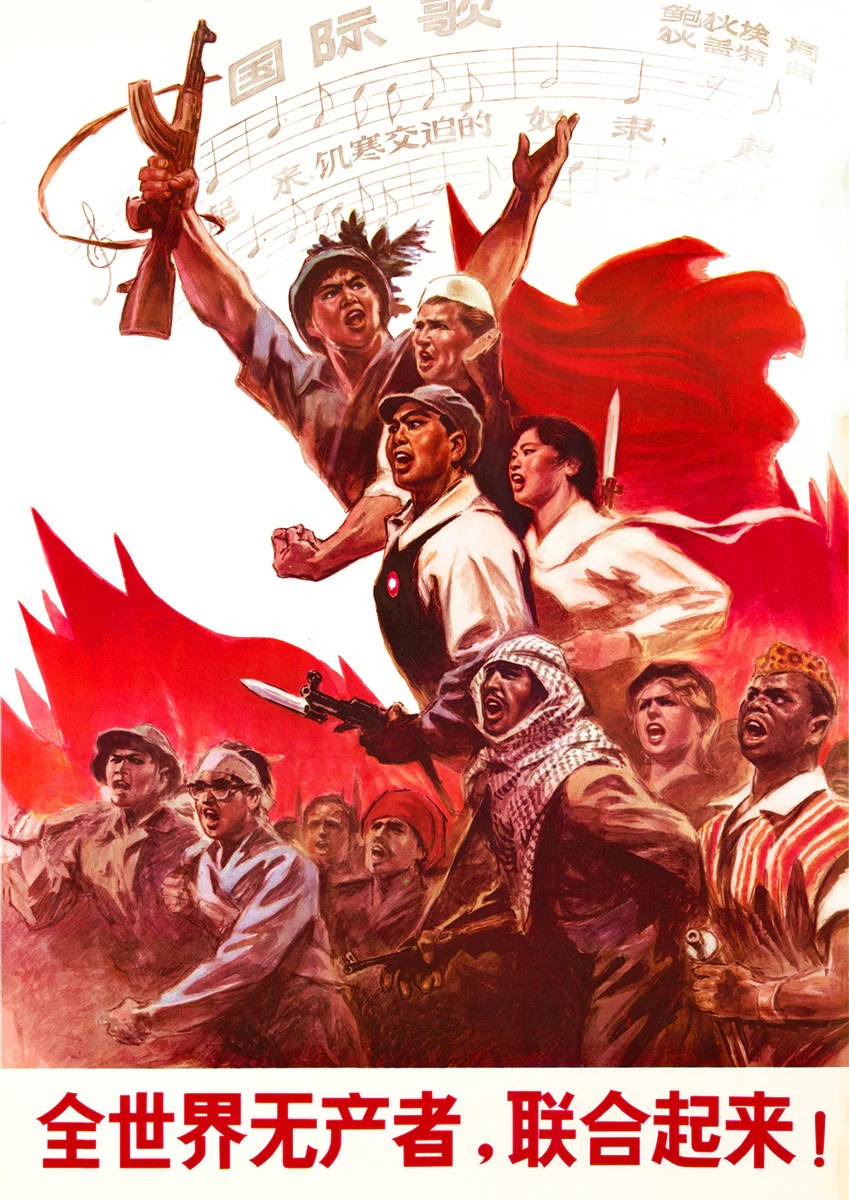
The most famous slogan of the International Communist Movement is almost certainly Workers of the World Unite! Likewise the word “international” can be found everywhere in revolutionary writings, from the previously mentioned International Communist Movement (ICM), to constant references to the “international proletariat” or the “oppressed nations of the world”. Why is this? Why is it that Communists and revolutionaries for hundreds of years, in almost every possible context, always emphasize the global aspect of our class and our movement?
To answer this question we have to go back to the beginning, and remind ourselves what is the proletariat, the final class in history? The proletariat is that class of people who do not own the means of production (factories, warehouses, productive land, mines, offices, etc.) and instead rely on selling their ability to do work (labor power) to the capitalists, the class which only survives by exploiting the labor power of the proletarians they employ. Unlike the peasants before them, the modern working class (the proletariat) is not tied to any given piece of land or lord, but rather is forged by the global capitalist system. It is in this sense that the proletariat is a truly international class which stretches across borders, across nations, and which in its political aims seeks the liberation of all exploited workers and oppressed peoples, regardless of where they were born or what their nationality is.
Because the proletariat is a product of international capitalism (this is why Marx said the capitalists have produced their own gravediggers), by definition the modern working class and its political movement can only defeat international capitalism through a similarly international struggle that seeks to establish communism in every nation across the globe. This is why we raise the slogan of World Proletarian Revolution, and this is also why the principle of proletarian internationalism is so dear to our class and our movement and must be conscious upheld and practiced by anyone who considers themselves a revolutionary or class-conscious activist. For us proletarian internationalists, a crime committed against the workers in one country is a crime against all workers, and an attack on one nation’s revolutionary movement is an attack on all revolutionaries. To the proletarian internationalist, the struggle for self-determination and liberation for all nations, especially the colonial and semi-colonial nations, is our common responsibility, particularly as revolutionaries in a country like the United States which is the primary oppressor of those nations.
Today the majority of the world’s population reside in colonial or semi-colonial nations that are oppressed by imperialism, and the main contradiction in the whole world is between imperialism and the oppressed nations. The imperialists plunder the oppressed nations’ resources, control their national economy, and brutally rule over them, either directly as a colony or indirectly as semi-colonies which are formally independent but in practice subjugated by the great imperialist powers. Because of the oppression and exploitation the Third World nations suffer, and because they serve as the “weakest link” of imperialist domination (compared to the imperialist powers’ own countries), they are considered the “storm centers of imperialism”, countries where the oppressed peoples constantly rise up against imperialism for their own self-determination and independence. In this way, it is the sworn duty of all proletarian internationalists to wholeheartedly support the revolutionary struggles of the oppressed nations around the globe and defeat exploitation and oppression at home or wherever it might be.
Having established a little bit on the background of why proletarian internationalism is an important principle for the modern revolutionary, it is worth exploring some basic ways this principle can and should be upheld and applied in practice.
The first and primary duty of a proletarian internationalist is to make revolution in their own country, and in this way expand and strengthen the World Proletarian Revolution. A second task of a proletarian internationalist is to understand how the ideology of the proletariat is also global and universal, and is the most powerful tool of the International Communist Movement that must be studied, propagated, and grasped within their particular national conditions. The third basic way we must practice proletarian internationalism is by attacking bourgeois nationalist and chauvinist tendencies in all sectors of our work, tendencies which undermine the solidarity between workers and divide our class and movement. A fourth task is to understand the contradictions that exist within the international imperialist system, and how they affect our work here in the sole hegemonic imperialist superpower, the United States, who by extracting super-profits from the colonial and semi-colonial nations has developed a large section of labor aristocrats and petty-bourgeoisie who benefit from these profits. And finally, a fifth duty for US proletarian internationalists is to provide aid to, raise awareness for, and coordinate with the forces of all genuinely revolutionary and anti-imperialist struggles and organizations internationally whenever possible, especially for those struggles and organizations which exist in the storm centers of the world revolution.
One of the best outlines of what correct and principled proletarian internationalism looks like can be found in a quote from Chairman Gonzalo of the Communist Party of Peru, in his Interview with El Diario, which will also helps lead us into next week’s principle of self-reliance:
“… in the International Communist Movement it became the habit to obey commands. Khrushchev was a champion at issuing commands, as is Gorbachev today, or that sinister character Deng. Independence, because each Communist Party must decide for itself since it is responsible for its own revolution, not in order to separate it from the world revolution, but precisely in order to serve it. This allows us to make our own decisions, to decide for ourselves. Chairman Mao said it like this: we were given a lot of advice, some good, some bad. We accepted the good and rejected the bad. But if we had accepted some erroneous principle, the responsibility would not have belonged to those who gave the advice, but to us. Why? Because we make our own decisions. That comes with independence, and it leads to self-sufficiency, to self-reliance.
Does this mean that we don’t recognize proletarian internationalism? No, on the contrary, we are fervent and consistent practitioners of proletarian internationalism. And we are confident that we have the support of the international proletariat, the oppressed nations, the peoples of the world, the parties or organizations that remain loyal to Marxism whatever their degree of development, and we recognize that the first thing that they give us, their primary support, is their own struggle. The propaganda or celebrations that they carry out are a form of support that is creating favorable public opinion and this is an expression of proletarian internationalism. Proletarian internationalism also underlies the advice they give us and the opinions they express. But, I insist, we are the ones who must decide whether we accept these or not. If they are correct, we welcome them, obviously, because between Parties we have the obligation to help each other, especially in such difficult and complex times.
Then, to reiterate, all the struggles waged by the proletariat, the oppressed nations, the peoples of the world, the parties and organizations steadfast and loyal to Marxism – all that struggle is the primary concrete form of proletarian internationalist help. Nevertheless, the greatest assistance we have is undying Marxism-Leninism-Maoism, the ideology of the international proletariat, which has been generated by the working class through long decades and thousands of struggles all over the world.”
We hope comrades find this article useful, and as mentioned in the post announcing this new series, this article is meant only as a brief primer on the subject of proletarian internationalism. We encourage study and struggle over our articles, especially as a new publication, and for any questions or feedback please feel free to reach out to our email, which can be found in the Contact Us page. For further reading on the topic of proletarian internationalism we suggest: