The central question that confronts all revolutionaries-in-formation in the United States is, “what are we fighting for?” Depending on who you ask, different people might give a variety of answers to this question: from higher wages, to defunding the police, to an arms embargo on Israel, et cetera.
At a glance, there seems to be a myriad of things people fight for and against, and a myriad of ways to achieve those different objectives. Some argue for a legislative path within the Old State: attempting to elect “pro-people”, “progressive” candidates in local and national elections. Others rely on the courts, lawyer-mediated negotiations and other methods encouraged by the legal order to achieve their aims, while others still stress the importance of building “people power” or “dual power”, by forming charities and “mutual aid” organizations to resolve the immediate needs of the people without directly challenging the current system.
These single-issue answers and reformist methods forget an important reality: no gains for the working class will be permanent if they are not tied to the struggle for political Power. That is, tied to the struggle to destroy the entire Old Society and to replace it by a new one controlled by the working class through its class dictatorship; the “dictatorship of the proletariat” in comparison to the current “dictatorship of the bourgeoisie”.
The word “power” has often been misused in activist spaces. People often talk about Power as if it is something that we already have, or something we can build peacefully outside of the existing social structure. In part this is due a confusion of terms: there is the everyday use of the word “power”, as in the power to do or achieve something, and then there is also the use of the term “Power” (usually written with a capital-“P”) when discussing a revolutionary political process. So, for example, there is the workers’ everyday power to withhold their labor (strike), organize themselves, achieve their demands etc., and then there is the workers’ Power in terms of the establishment and construction of their New State.
In reality, political Power is something very concrete: it is the Power of one class to rule over the other through violence. Today, it is the capitalists and their Old State that have the Power in our society: they use their police, legal system, economic control, and their military to enforce their rule, cracking down on anyone who might pose a threat, and using all other forms of State organs, from schools to media, to help facilitate this rule.
Today, the international working class and the oppressed peoples of the world do not have Power anywhere despite having produced the commodities, built the buildings, extracted the raw materials, and run the logistics chains within all societies across the globe. The prison system, the military-industrial complex, and the police are just parts of the same capitalist State, who extends its reach to every facet of our society. For every minute of our work and even our existence, we are exploited and oppressed by the modern capitalist system also known as imperialism. There is no power vacuum that we can build on: every gain, no matter how small, is a gain that we need to seize from the hands of the class enemy through struggle.
When we speak of struggling for demands without connecting it to the struggle for Power, it means we are ignoring the root cause of our issues, imperialism, which is constantly creating more misery and pain for the working class and will eventually take away the gains of the working class if it is not overthrown and there is not coordinated struggle against it. Worse, when we don’t connect the day-to-day demands to the struggle for political Power for the working class, we end up defending the imperialist system and standing on the side of counter-revolution, telling the masses and ourselves that change can be done without destroying this rotten Old order.
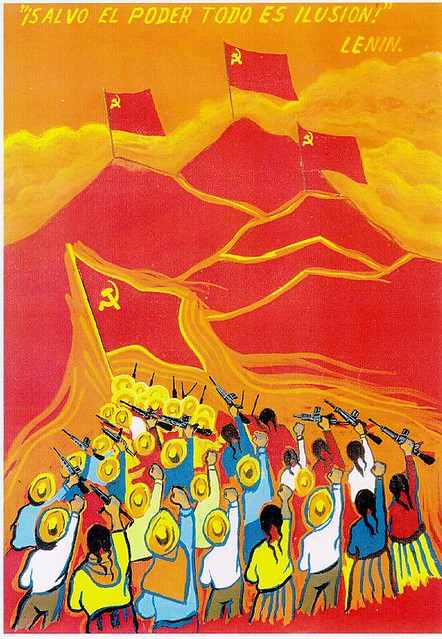
This is why, Lenin, leader of the Russian Revolution, put it like this: “All is illusory without Power.” In all of our struggles, whether big or small, it is imperative for us to link and raise them to the central question: the fight to seize political Power for the modern working class, the proletariat. Even in a struggle for better working conditions, or a struggle for democratic demands such as the right to abortion, activists need to highlight these issues are just a part of the overall capitalist system that we live under, and use the method of mass struggle and militant organization – instead of reformism or collaboration – to demonstrate the collective strength of the masses to make history.
The centrality of the struggle to seize political Power for the workers plays out differently at the different levels of work. On the highest level, Communists-in-formation must carry out the central task of reconstituting our Communist Party, doing so in a correct way which combats opportunism and revisionism at every turn, and that struggles to provide leadership to the revolutionaries-in-formation and masses in the United States. On the lowest level, that of the mass movement, revolutionaries-in-formation must work to mobilize, politicize, and organize the masses through class struggle, a task which, when done and lead correctly, serves the conquest of political Power for the US multinational proletariat.
Chairman Gonzalo of the Communist Party of Peru said it well: “Organize the masses so that they can go beyond what is permitted by the existing legal order, so that they struggle to destroy the old order and not to maintain it.” What’s the most important for us is not to operate within the legal order so that we can achieve short-term gains, but instead to unite the masses in class struggle, to make them realize they themselves alone, with their conscious action, are the motor force of history. Just as we together will win a small demand, with unity, struggle, and organization, our class can overthrow this bloodthirsty system once and for all through socialist revolution, and establish a new world without exploitation of man by man.
For further reading and study we suggest:
- General Political Line of the Communist Party of Peru, Section 1 – Fundamental Documents and Section 6 – Mass Line
- What Is To Be Done?, Chapters 2, 3 & 4 – Lenin
- Why Is It That Red Political Power Can Exist in China? – Chairman Mao