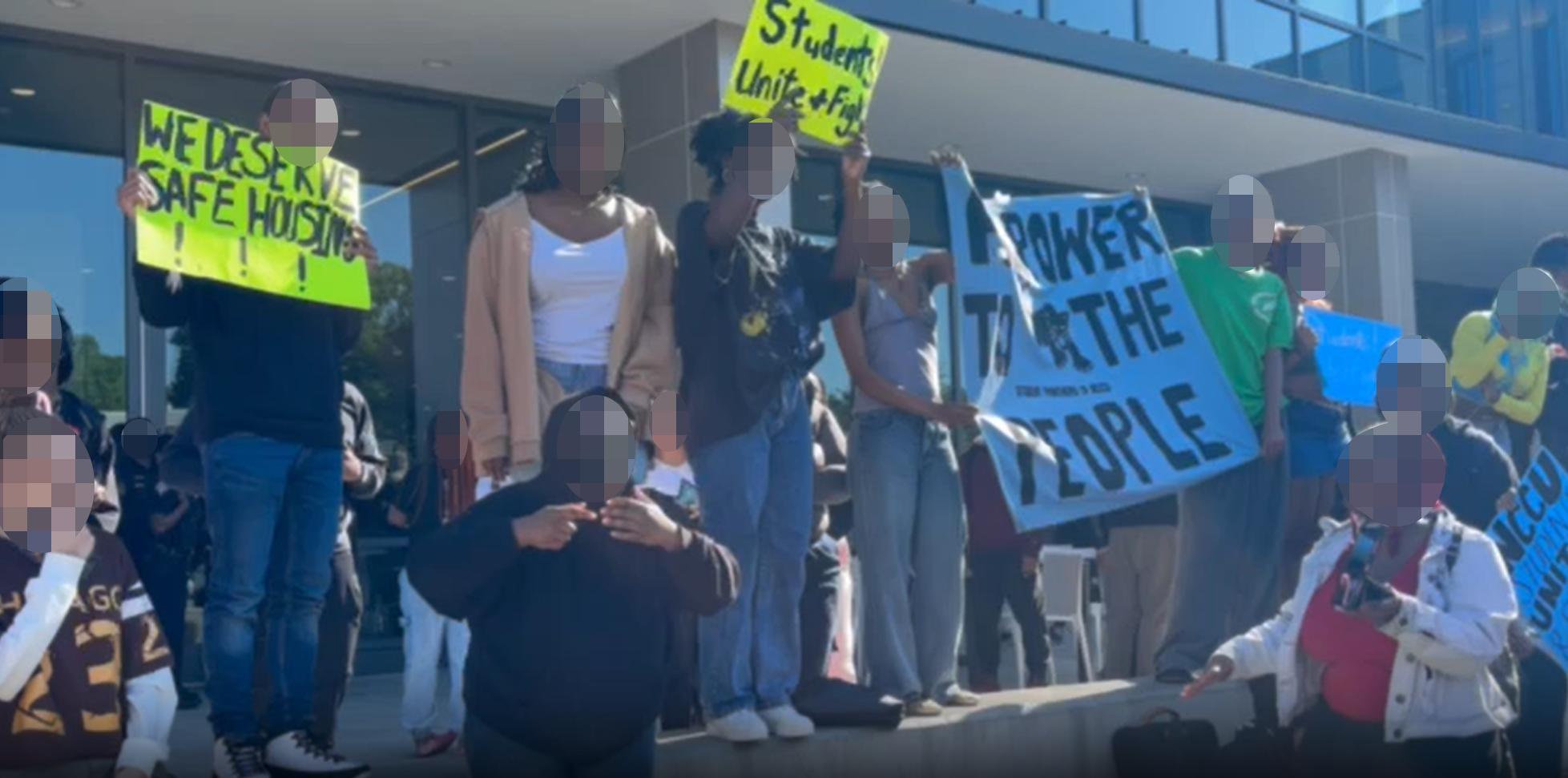
By: Anya Chen and Daniel Kanmuang
[Editor’s Note: The Partisan is excited to present interviews it held with two student leaders with the North Carolina Central University Student Panthers, who are a local chapter of the Revolutionary Student Union. In the interview the comrades talk about their local work, the repression they are facing as a result of their recent campaign and protest against poor housing conditions, and the ways comrades nationally can help support their struggle.]
Tell us a little bit about Student Panthers. What is it, how did it get started, and what sort of work does it do?
Eli: Student Panthers is a chapter of RSU at North Carolina Central University (NCCU) in Durham, NC. We’re the only all-Black chapter, and the only chapter at an HBCU. We have special interest in the daily demands of the Black nation, specifically Black students. A big part of our work early on was trying to do SICA [Social Investigation and Class Analysis –Ed.] around the daily demands of the students, and we landed on housing. Student Panthers started in 2022 originally. We oriented towards actually getting shit done and having a set of principles we abide by. Primarily our goal is to organize the people into a mass movement at Central.
With Student Panthers being an all-Black chapter, what we mean is a chapter specifically catering to the Black nation, especially the working class and addressing their issues. Our organization has always tried to cater specifically to working-class Black students, students who come from poor neighborhoods, who are in school on a scholarship. Many of the problems these students face are like those that other working class students face, like financial aid or lack of funds or having to live in poorer housing conditions. On top of that there’s harassment from the police, the administration, or professors. There’s policing of ways of speaking, dressing, or carrying oneself. There are many challenges the students face on top of just being a Black student. In this way, the national struggle and the class struggle are closely tied together, and form a part of class struggle.
In the broader movement we have the special role of not only being local leaders in organizing, and showing the correctness of organizing around the daily demands of the students, but also nationally we took a leading role in pushing that line forward to organize around daily demands and really being organizations that can be seen as leaders among our class and our sector.
What are the conditions like for an organization at an HBCU? What does the student population look like class-wide?
Eli: HBCUs have a dual character where because the Black nation is an oppressed nation most of the students will be working-class or Black, but because the school itself is also a training ground for a national bourgeoisie, it tries to promote a culture of “Black excellence,” something we would describe as a bourgeois ideology trying to create more Black capitalists, the idea itself having roots all the way back to Booker T. Washington and the idea of the Talented Tenth.
We do work to combat that trend by trying to cultivate working-class culture and by taking part in and leading the class struggle of the working class students. By fighting against things like poor housing conditions, for example, we are making clear that the working class students and the capitalist administration, even if they are Black, like Chancellor Karrie G. Dixon, share nothing in common.
Why did you call the rally on April 16th? What was the work and campaign that lead up to it?
Fanon: The major and obvious reason is that the conditions students were living in are not fit for human beings. The problem has multiple prongs: the housing that’s available is inadequate, and there’s not enough housing available for students. So students are left in the wind on whether or not they’d be able to attend the university next semester. There’s thousands of kids right now who are unsure about their future in higher education because of the very real pressure of not knowing where you’re going to be living at. There are multiple students who have to transfer because housing is just no longer offered to them. Our decision to run this campaign was informed directly by our social investigation on this campus. As students we knew some major problems that most students had, so we had housing on our mind, but after going out and talking to students it really helped us decide that this is what we wanted to mobilize around: to advocate for better living conditions, better housing, and especially important for us as Black people, getting Black people re-engaged in revolutionary politics.
What needed to be done was investigation and agitation. After investigating and deciding what we want to base our next campaign on, we put all our efforts into agitating. The student body already feels some type of way—we’re very vocal—us as Black people are very vocal and very open for advocating for ourselves, and really agitating and presenting this collective issue for everyone to mobilize and organize around really helped the protest blow up. As soon as we started collecting photos and videos of people’s conditions, and compiling testimonies and agitating around that, then the student body wanted to protest. As soon as we dropped that joint, shit went out.
Tell us about the rally: how did it proceed and what went down?
Fanon: We had a couple reports that there was a lot of police there, and when we showed up it was blocked off on both sides by hella police. The main entrance was blocked off by cars, and had police officers on both sides and the middle, and then on the other side the same thing. And you could just tell they were there to intimidate and dissuade people from congregating in this area. So a lot of people were anxious about police presence. You know how police get to posturing, they holding onto their vests and just trying to intimidate motherfuckers. It already started tense, and they were already agitating the student body off the rip just by being so aggressive. At the start of the protest there were students spread around all in little groups with their friends but obviously here for the protest. I decided to introduce myself to see if people could get more comfortable and see if we could start moving in together.
The crowd was growing and becoming extremely agitated with how they’re being treated. After the first round of repression, the NCCU police start harassing students and trying to divide the crowd and confuse people with calls to leave campus, even though we were all students. While NCCU police is doing that, Durham police are hanging back just observing. The tension starts to slowly come down a little bit, only after the police start to step away. That’s about the halfway point before we started marching through the school.
A comrade stood on a table and invited people to give their testimony, to tell their personal stories about how they felt about housing. At the same time, the administration was doing a counterinsurgency tactic on us, holding another event on the other side of campus, offering free chicken to the first 100 students to pull up. When the testimony started to die down we got up and pushed to move to the admin building.
Once we pulled up to the admin building, that’s when the conflict with the police escalated again. Obviously we know what police are for, but they really proved what they was for. They rushed to the building, because they were just interested in protecting the building. They were so scared that we were going to go into our student center and mess up our student center and they start brutalizing us. We continued to rally with more testimony and more chanting.
Do you feel like NCCU’s response was targeted or discriminatory?
Eli: Hell yeah.
Fanon: I 100% agree. There’s only one reason why you call for police officers. The escalation was before the protest even began. Obviously they had some type of agenda or orders, otherwise they wouldn’t be so aggressive towards students. They created this false narrative that Student Panthers was this outside organization and all these students were outside agitators. In reality Student Panthers is 100% student led, oriented, and organized, by and for students. They used that talking point to legitimize the violence they were inflicting on students, because the reality of the situation is they didn’t really care about students not having housing, they cared about the bad press. Even before the protest, the content we were dropping was blowing up and giving them a bad image. That’s the only reason why you’d drop 30 police officers in the area an hour before a student protest. They were trying to intimidate us, and when intimidation didn’t work, they escalated further and further, and as we called their bluff they backed off.
Eli: On top of that, the campaign of harassment was all to de-legitimize our organization. With these false charges, it’s all part of how universities work—public or private, HBCU or PWI—they exist for the bottom line, and to help train a new generation of the ruling class.
Fanon: Ultimately, to protect private property. Their biggest concern was to make sure we weren’t breaking shit, not to make sure anybody was safe. They were the ones causing the violence, not us. I talk about this a lot: there’s no such thing as a “peaceful protest.” The only way you could ever say a protest is “peaceful” is if you see the violence that the state does as legitimate and morally correct, you don’t view that violence as real violence, you view it as justified, if you ignore the brutalization of protesters.
Eli: On top of that, Mao and the Black Panthers always said: it’s right to rebel. If you don’t fight back for what is right, what’s going to change? You’re just going to get stomped over. We didn’t become free just by asking slave masters nicely, we beat them over the head with a rock. We fought back. Over 400 years of struggle, that’s what people leave out with the 400 years of slavery and subjugation.
How can comrades best support Student Panthers and the Durham 5?
Eli: The best way to support the Durham 5 is to donate to the support fund. We’re working to get all the charges dropped, and especially one who has a trumped-up charge of attacking a police officer, which is obviously untrue if you look at any video of the arrests. No hitting of police officers occurred, unless they were hitting themselves.
Fanon: Sharing as much as you can and combating the misinformation. They keep trying to run with the idea that Student Panthers is this non-Student organization. Sharing and combating that, calling these folks asking why they’re trying to fire a professor for standing with students advocating for housing, things like that.
Eli: One of the best ways to support the type of work our organization does is to do similar types of work at college campuses you live at, neighborhoods you work at, workplaces, wherever, cause revolution can’t happen at one university, it can’t happen in just Durham, it’s gotta happen all over the country and all over the world.
For those currently outside the movement, would you recommend they get organized?
Eli: Get organized, get organized around housing, get organized around the people’s defense campaign around immigrant rights in the US. Speaking out against injustice is not a crime and neither is being born outside of the United States.
Join mass organizations like the People’s Defense Committee, Revolutionary Student Union, join the New Labor Organizing Committee, they’re all doing really great work and are big inspirations to all of us. Student Panthers wouldn’t be in its current orientation if it weren’t for organizations like that.
A big campaign we have as RSU is the People’s Defense Campaign, mainly centering around defending the rights of immigrants and immigrant students, who are having visas taken away for having certain political positions such as support for Palestine, or even now rumblings of Chinese students having their visas taken away wholesale like the South Sudanese students have.
A lot of the methods the current capitalist class is using against a lot of migrants and other activists for Palestine are nothing new to the Black community. They’ve done this to the Black student movement in the 60s and 70s, with summary expulsions of folks also at North Carolina Central, in the Student Organization for Black Unity, or the repression of the SNCC [Student Nonviolent Coordinating Committee – Ed.] in Mississippi, and continuing forward to the murder of founders of Black Lives Matter in Ferguson. This sort of repression links our struggle to others— as we face the same capitalist and imperialist system — as the capitalist system is in a crisis and economic recession, they need to make shit shake. It’s really when we get together to fight back in mass organizations, knowing who our enemies are, that we can show our collective strength against this system.