[Editorial Note: The Partisan is excited to publish two articles shared with us by the new revolutionary artist publication Toreador. This article, written by the Toreador Editorial Board, explores the history of the original 1886 May Day events in Chicago, and outlines their support for the class-conscious union movement. Toreador has informed us they plan on launching a website as well as print copies of their first edition in the coming weeks and months. We thank the comrades for choosing our publication to share their launch announcement and encourage all our readers to reach out to Toreador.Editorial@proton.me to find out how to get involved as well as with any feedback or questions.]
By The Editorial Board of Toreador
May 2025
Chicago, IL
Every year, on the First of May, workers around the world converge into red waves which surge throughout city streets in commemoration of International Workers Day and the Haymarket martyrs who gave their lives for the eight hour day. Each year, the wave’s crest grows higher, as more and more toiling masses are woken up to the realities of exploitation and subjugation under imperialist domination. This year was no different. Despite the renewed counter-offensive of the imperialists and their running dogs against people’s struggles everywhere, millions marched in demonstrations which celebrated the movement of our predecessors and put forward new demands of their own.
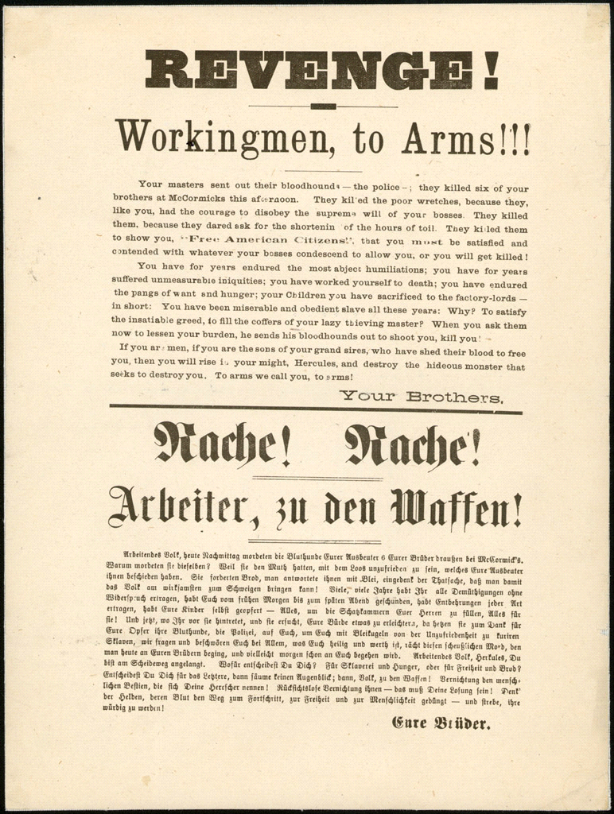
Although this celebration is held on the first, the catalyst for International Workers’ Day occurred on this day, May Fourth, in 1886. After two years of planning and preparation, the Federation of Organized Trades and Labor Unions initiated a general strike on May First which saw upwards of 340,000 unionists withhold their labor in demand of an eight-hour day. Chicago was the epicenter of the mobilization, where 80,000 workers hit the streets on day one of the nationwide strike. The first two days of the action went off peacefully; workers gathered, sang songs of the labor movement, and voiced their demands without incident. However, on May Third, strikers at McCormick Harvesting Machine Company confronted scabs at the sound of the end-of-day bell. The Chicago Police Department, skilled as ever in conflict resolution, responded in typical fashion. On that Monday evening, the proletariat gained six martyrs at the hands of capitalist state.

The workers would not take such an attack lying down. The following night, thousands gathered under a black cloud in Haymarket Square to protest against the hideous monster which sought to destroy them. Union organizers, Socialists, and Anarchists addressed the crowd over the course of many hours, as drizzle turned to downpour, before an army of pigs arrived around 10:30pm. The exact sequence of events which follows, their exact order, and who is responsible for what, remains a matter of uncertainty and debate to this day. What is known is that, in some order or another and in rapid succession, a dispersal order was given, a homemade bomb was detonated, and frantic bulls entered a frenzy of erratic gunfire. After the dust had settled, the Chicago Police Department had seven good cops, and the proletariat at least four more martyrs.
Repression came down hard and fast. Like a ghastly foreshadowing to the treatment of contemporary anti-Zionist activists, police targeted suspected (!) anarchists and workers of German and Bohemian descent1 without regard for legal processes or democratic rights. The headquarters of Arbeiter-Zeitung was raided on the morning of May Fifth, where pigs captured August Spies, Michael Schwab, and Adolph Fischer. Over the following weeks, police had also arrested George Engel, Louis Lingg, Oscar Neebe, Albert Parsons, and Samuel Fielden. Dozens of other arrests were made in this period, although none of them were charged, along with the eight aforementioned figures.

The proceeding trial was anything but legitimate. The defendants were tried on charges of conspiracy. No bomber was ever identified. The city of Chicago, their armed enforcers in the police, the courts, the ruling class at large—they did not care who did the bombing or if any of the men they sought to hang were directly involved in any fashion. The masses had rebelled. They had cast off the illusion—an illusion which still sticks in the minds of workers too often today—that the capitalist state and their hounds were untouchable. A spectacle had to be made. Someone—many, in fact—needed to die. Ultimately, Neebe received 15 years in prison. The other seven were found guilty and sentenced to the gallows. The cowardly (i.e. Centrist) then-Governor of Illinois, Richard James Ogelsby, offered to pardon any who asked for clemency; a deal which only two men—Fielden and Schwabb—would take, as the other six insisted they were guilty of no crime to begin with. Lingg died by suicide on the eve of his scheduled execution. Spies, Fischer, Engel, and Parsons were hanged on November 11, 1886. In 1889, the American Federation of Labor geared up for yet another general strike in demand of the eight hour day with May First as its initiation; this action was supported by the Second International2 in an international demonstration with the dual purpose of honoring the workers and unionists who gave their lives in 1886 in what is known as the first International Workers’ Day.
The battle of the working class against our capitalist overseers continues to this day. At the time this article is released, we are on the precipice of a crisis of overproduction, as the price of commodities produced by our own labor will have far exceeded what we can afford with our measly wages. The result will be mass layoffs (more, that is, than we have already seen in the first half of this year), a depression in the value of our labor-power, further erosion of the so-called “middle class” (i.e. petit-bourgeoisie), and greater concentration of wealth in the hands of an ever-shrinking number of hands. A new generation’s ’08 is what awaits; likely worse. Today’s union leadership, a far-cry away from those militant unionists of the 19th Century, are incapable of leading us to better conditions. The established state unions3, rather leading us in militant strikes against our exploiters and their dictatorial state, will only continue to pursue farcical electoral and collaborationist policies. As the Democratic political machine actively works against striking rail road workers, SEIU will dump millions of dollars into Democratic Party political campaigns and $0 into strike funds. As workers plan their own independent, militant actions, SBWU will alert the pigs of planned strike actions. As immigrant workers are hauled off to death camps by the modern-day Gestapo, AFGE will organize ICE!
Just as we need to build a revolutionary working class culture—our mission here at Toreador—we must re-build a truly working class labor movement. Today, this work for an independent labor movement, by and for the working class, which rejects the collusion of the state unions and the exploitation of our class, is carried out primarily by the New Labor Organizing Committee. We are compelled to encourage all artists and workers to support these comrades wherever they can in our united struggle.
Long Live the Haymarket Martyrs!
Long Live International Workers’ Day!
- Workers from Germany and the Bohemian region of Europe, having emigrated from countries with particularly strong labor movements, were among the most prominent and militant leaders in the early American labor movement. Arbeiter-Zeitung (tr. Workers’ Newspaper) was a popular German-language anarchist newspaper in Chicago at the time of the 1886 General Strike and the Haymarket Affair. ↩︎
- The Socialist International. An international association of Socialist and Labor parties, and labor unions which included figures such as Friedrich Engels, Vladimir Lenin, and Rosa Luxemburg. ↩︎
- See “State Unionism in the United States” by New Labor Press. ↩︎