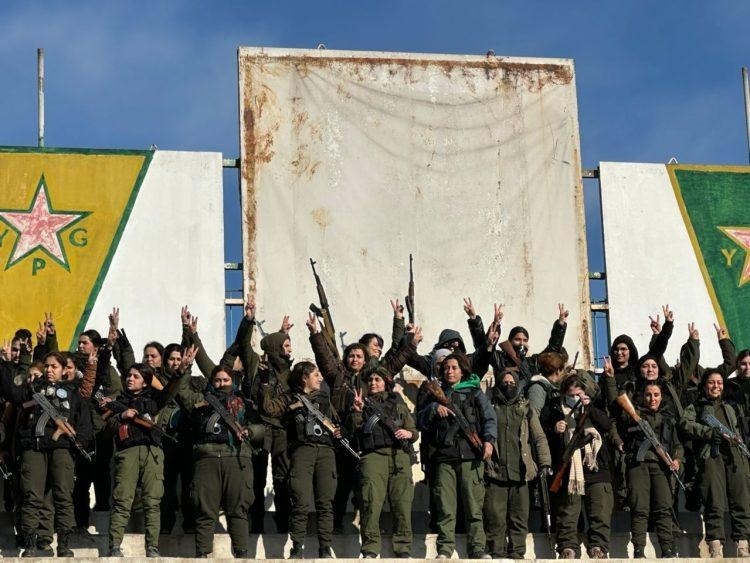
Since January 13, the reactionary Syrian State has carried out a military offensive against the Kurdish-lead Democratic Autonomous Administration of North and East Syria (popularly known as Rojava), backed by Turkish expansionism.
The offensive came after the Syrian State succeeded in conquering the isolated Kurdish-majority Sheikh Maqsood pocket of Aleppo City on January 10; the Rojava leadership had previously surrendered the enclave after only a few days of fighting in vain hopes of winning favors from the Syrian State and US imperialism. Instead, the Syrian Army has continued their offensive, advanced rapidly and met barely any resistance from the Rojava side. Entire Arab-majority divisions of the Syrian Democratic Forces (SDF, armed forces of Rojava) have defected or deserted as Kurdish-majority divisions hastily retreat.
These events heavily mirrored the fall of the Assad regime, which collapsed in just a week, almost a year ago. Despite some weak warnings, US imperialism has remained publicly indifferent on the collapse of its long-time ally and quietly pulled out troops stationed in Rojava territories.
As of January 18, the Syrian Army had taken most parts of the Arab-majority governorates of Deir ez-Zor and Raqqa. Numerous ISIS prisoners in Rojava prisons were freed by the advancing Syrian Army. The Syrian Army has also carried out extrajudicial executions and sexual violence against Kurdish SDF fighters and civilians. Facing the insurmountable pressure, top SDF leader, Mazloum Abdi, signed a ceasefire agreement on the same day.
The agreement stipulated the complete surrendering of the Deir ez-Zor and Raqqa governorates, once conquered with blood of the people at the hands of ISIS, surrendering of international border crossings, oil and gas fields, and removal of Turkey-based Kurdistan Workers Party and other international leftist elements from Rojava.
Despite this second capitulation, the Syrian Army has not stopped its offensive against Rojava. After a failed negotiation attempt in Damascus on January 19, the leaders of Rojava and SDF have begun to call for a last stand and general mobilization. If the situation continues to deteriorate, it is certain that the Kurdish nation in Syria will again fall under heavy national oppression.
Background to the Current Conflict
Political Power in Rojava is controlled by the Syrian extension of the Kurdish Workers Party, the Democratic Union Party (PYD), a Kurdish revisionist organization. Since the 1990s, it has abandoned verbal adherence to Marxism-Leninism and national self-determination but instead opted to use armed struggle to “democratize” the existing State structures without overthrowing them.
Kurdish Rojava forces rose to fame during the Syrian Civil War through struggling against ISIS and defending the interests of minorities and women. It was in this period that most leftist organizations across Turkey mobilized to join the armed struggle of Rojava.
As a major anti-Assad and anti-ISIS force, the rise of Rojava coincided with the interest of US imperialism for its “global war on terror”. As a result, US imperialism provided material and military support to Rojava, using airstrikes to aid ground offensives against ISIS. In exchange, the Rojava leadership dropped its anti-imperialist rhetoric and offered US imperialism the region’s massive oil wealth. While the oil production has not seen meaningful US development, US troops remained deployed to defend these resources for future use and to maintain direct control in Syria and MENA.
The situation changed when the jihadist Ahmed Al-Sharaa seized State Power in early 2025. This leader of the backwards semi-feudal landlord class rapidly integrated himself with the comprador faction of the big capitalist class and opened the country completely to US imperialism while maintaining ties with Russian imperialism.
Major US sanctions against Syria have been revoked. On November 10, 2025, Al-Sharaa personally met with Donald Trump and discussed US economic, political and military interest in the region. The jihadist faction led by Al-Sharaa has a long history of collaboration with the US even before seizing Power, and has received direct training from the CIA.
With Al-Sharaa seizing State Power in the entire country the Kurdish faction’s usefulness to the US has greatly diminished. On November 19, Trump confirmed that he is committed to “preserving the unity and independence of Syrian territory” and combating “extremism” on a phone call with Al-Sharaa. The irony is apparent: only a few months ago, Al-Sharaa had unleashed a wave of genocidal attacks against the Alawite people, another minority group in Syria.
Rojava “Revolution” and the Bankruptcy of Revisionism
The reason for Rojava’s rapid military collapse is simple. The SDF relied on external support from US imperialism, and once that favor was passed from one puppet to another, the Rojava leadership quickly found itself isolated. Similarly heavily on ethnically Arab tribal militias who had sided with them opportunistically against ISIS. Old feudal tribal structures of personal subjugation were never dissolved but incorporated wholesale into the State. Facing the advancing Syrian Army, the Arab semi-feudal landlord class immediately changed sides to the winning one.
More than ten years of the Rojava “revolution” did not overthrow imperialism, semi-feudalism, and bureaucrat capitalism. The leaders of Rojava have served US imperialism’s plan to maintain its hold on the region and simultaneously opened up its market to both US and Russian capital, citing realpolitik.
Land reforms were not carried out thoroughly; the State has distributed some land to peasants without touching the interests of big and medium landowners. Meanwhile, in both the countryside and the cities, the State tried to set up profit-oriented “cooperatives” based on competition. With a formal democratic ruse – now taken to mean bourgeois and not people’s democracy – the Kurdish national (middle) capitalists in Power are trying to create a big capitalist class and reintegrate into the global imperialist system.
In Rojava, national contradictions have continued to sharpen between the Arabs – the majority of the Syrian population – and the Kurds that by and large control the State machinery, as well as other minorities such as Assyrians and Yazidis.
Only few months ago, the Kurdish Workers Party itself, which operated in Turkey, officially liquidated the armed struggle and surrendered to the State. This proved a major milestone in the degeneration of the Kurdish national movement.
The dominant political leadership of the Kurdish national movement has formally rejected Marxism since 1990s, the leading role of the working class, and the need for new democratic revolution. It is a movement of the Kurdish national capitalists. Despite this, numerous revisionist groups in the region have heralded it as an example of revolutionary transformation for opportunistic reasons. One such example are the right liquidationists in Turkey, who have attempted to destroy the new democratic revolution in Turkey led by the Communist Party of Turkey/Marxist-Leninist and tail behind the revisionist leadership in command of the Kurdish national movement.