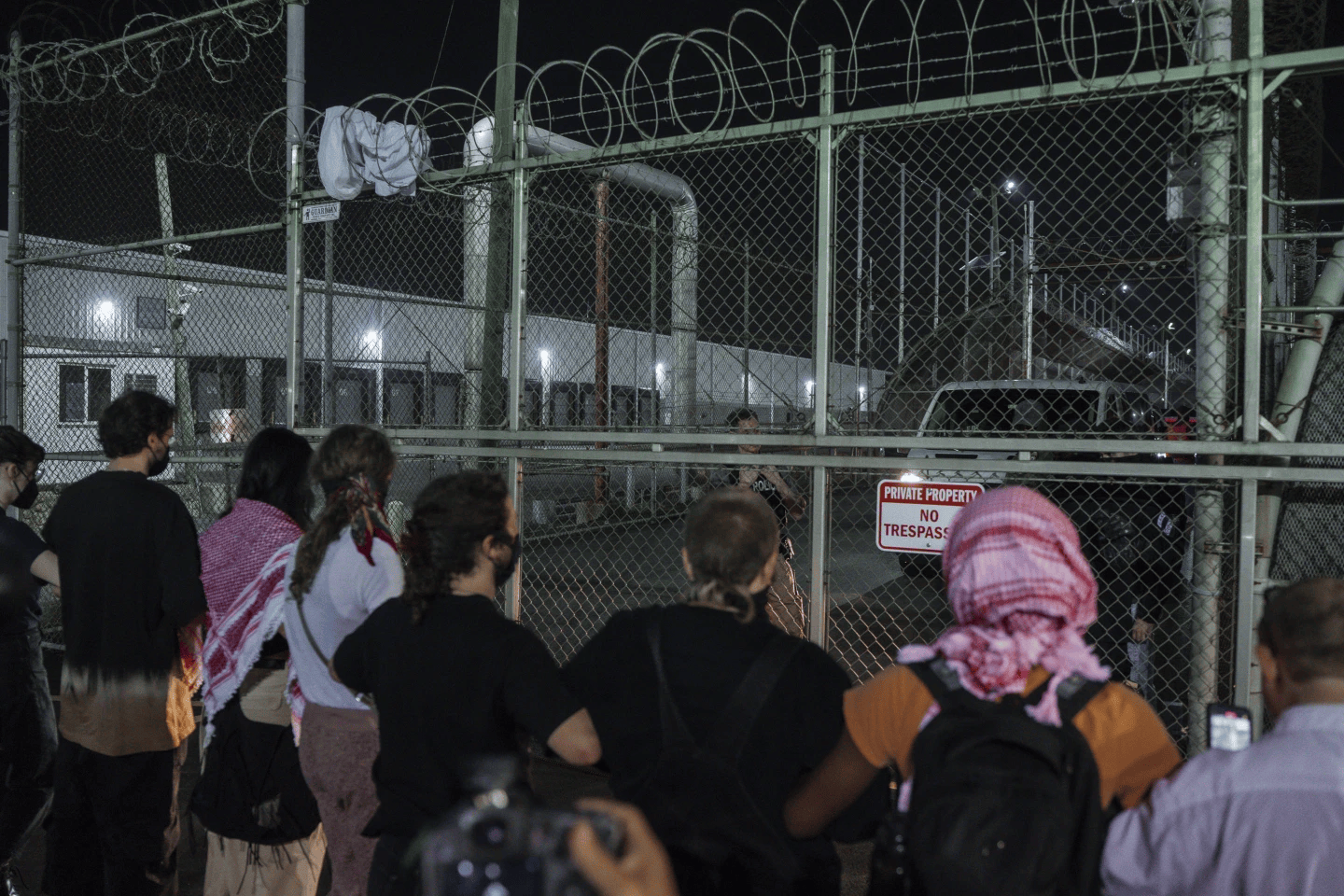
On June 12, immigrants detained by ICE at Delaney Hall detention center in Newark, NJ started a spontaneous uprising against their inhumane treatment. Within the hour, dozens of local workers, students, and other community members rallied in militant action to defend the detainees, blocking ICE and police reinforcement. Four detained immigrants were able to escape from custody. The Partisan has interviewed Lisa, a comrade from NJ Build Up Resistance Now (BURN), a local revolutionary mass organization that took a leading role in the action.
Can you tell us a little about the protest? How did it start and how did it go down?
First and foremost, I want to talk about Delaney Hall and what’s happening on the inside, because that’s the whole reason why we were out there. Delaney Hall, located in Newark, New Jersey, is the largest migrant detention center on the East Coast. It is run by the private prison corporation, GEO Group. Inmates are constantly abused by prison staff. The building is physically unsafe, with boiling water pipes bursting and flooding the facility. Visitors and immigration lawyers have been denied entry for weeks. Meals are served frozen, and sometimes not at all.
This past week, after going over 20 hours without food, about 50 people banded together to smash through one of the prison walls. The guards fled, and soon, word got out that there was a riot happening inside. We heard that someone was setting fires in the building, and that a handful of detainees were able to escape.
While this was all going down, protesters began to arrive on the scene, using their bodies to prevent ICE from entering and exiting the facility during this moment of rebellion. Throughout the evening until about 11:00 PM, ICE vehicles were brought to a complete standstill, vans were forced to retreat back through the gates, and the driveway remained barricaded with roadway dividers and wooden planks. The protest diverted ICE personnel and disrupted the ongoing manhunt for the escaped detainees. This is the reason why we mobilized to Delaney Hall on the evening of Thursday, June 12th. It wasn’t some random action or symbolic demonstration — it was a move taken in real, tangible solidarity with the uprising and the escapees.
What was law enforcement’s response like?
After hours of holding them back, ICE called for reinforcements, and even requested that Newark Police help clear us from the scene. Fifty or so militarized federal agents came to fight us, and at a one-to-one ratio of pig-to-protestor, our defense was broken. They deployed pepper spray against those on the frontlines, while using their batons to push and shove anyone else in the vicinity trying to help. Their vehicles swerved recklessly through the crowd, driving over sidewalks and crashing through the makeshift barricades. At one point, they even crashed into the gates of Delaney Hall.
The next day, on Friday, June 13th, it was announced that ICE would be transferring detainees out of the state in response to the uprising, and people mobilized once again to try and block the vans. With the ICE reinforcements still present, our defense was not successful. People were beaten back even more violently than Day 1. One person was tazed; another was grabbed off the sidewalk and dragged into Delaney Hall. People sustained concussions and were left bleeding on the ground with huge gashes. Once again, ICE crashed their own vehicle while trying to make their way through the crowd, this time ramming into a passing truck.
Unlike the neighboring NYPD, who have massive numbers and specialized protest training, Jersey cops tend to be more disorganized, undisciplined, and uncontrolled. The same can be said about these federal ICE agents. While the NYPD takes an extremely systematic and professionalized approach to repressing mass protests, almost like a small army, the ICE agents at Delaney were reliant on brute force. They have no sophisticated anti-protest protocol. Like I mentioned, they crashed their own cars twice, something which also happened with the New Brunswick Police when we held a small demonstration against the Tel Aviv University satellite campus being constructed there. When they deployed pepper spray against us, it got in their own faces. They were easily triggered and extremely reactive, breaking composure to call us f*ggots and tell us “you’re next.” While we were verbally berating them about the families they ripped apart and the lives they destroyed, one agent started visibly crying. What this means is that — while law enforcement outside the major cities can sometimes be more violent and unpredictable, they are also more vulnerable. They are untrained, under-resourced, and underprepared. They are thugs, not soldiers. And seeing the situation for what it was, the people of New Jersey fought back.
Can you tell us about the facility’s history, ICE’s campaign in Newark, and the community there?
Delaney Hall originally opened in 2000. It closed in 2017 and was transformed into a halfway house. Their contract with ICE was renewed in the Spring of 2025, and Delaney Hall reopened as a migrant detention center. It is located on the outskirts of Newark, sharing a street with the Essex County prison, multiple warehouses, corporate facilities, the Interstate Waste Services, and an animal waste treatment center.
Newark is a majority Black city, with a 10% unemployment rate and 25% of the population living under the poverty line. In 1967, it was the seat of the Black-led Jersey rebellions. The legacy of the 1967 uprising lives on in the collective memory of Newark, with a mix of pride and caution. Today, Newark is the most populous city in New Jersey.
Although Delaney Hall is located in Newark, ICE’s street operations are in no way limited to or concentrated there. If anything, most of the reports about ICE have been concentrated in the smaller industrial cities and working-class towns of New Jersey. There have been numerous reports of ICE invading warehouses and conducting illegal stops in immigrant neighborhoods, like Jersey City, New Brunswick, and the proletarian sections of shore towns like Neptune, Asbury Park, and Long Branch.
Since 2014, Newark has been under the political control of progressive Democrat mayor, Ras Baraka. He is the son of a Black liberation activist and poet, Amiri Baraka. Today, the city of Newark (and Essex County more generally) is a Democratic Party stronghold. Especially since 2020, we’ve seen the explosion of state-aligned nonprofits, police reform programs, and progressive rhetoric out of Newark, all while homelessness, poverty, and police brutality continue. A mini-Cop City was opened last year in the South Ward, where police from all over the state convene to conduct training scenarios on mock vehicles, a mock bodega, and a mock 2-bedroom apartment. The training center is named after the first Black social worker and is advertised as a “community care center,” complete with recreational rooms, classrooms, and gender-neutral bathrooms. Newark politicians have stated that it is “revolutionary” to have “social workers, outreach workers and community activists sharing space with local police.” For us activists at NJ B.U.R.N, we’ve identified the Democratic Party state machine as a primary challenge in our particular region, a topic that we’ve touched upon in our analysis regarding the 2024 presidential election.
What are the newest updates on the detained migrants?
No one knows for sure what’s going to happen, in large part due to the incompetence of GEO Group. After the uprising, authorities stated that they would be transferring everyone out-of-state while they conduct a security review — but there has been a lot of back-and-forth. At the protest, we met a woman (an American-born citizen) whose husband had been kidnapped by ICE and locked inside Delaney; she was told that he was being transferred to Texas, but it turns out that they’re keeping him locked up in Newark. He was able to call for a few minutes, and he said he was being denied water as punishment and couldn’t think clearly. People are still being denied visitation, from both family and immigration lawyers.
Regarding the escapees, two of them have been located by police. One of the escapees has come forward with a statement remarking on the constant “hunger, maltreatment, and threats inside the detention center” which pushed him to escape. Two escapees are still on the run. [Note – Since the interview was conducted one more escaped detainee has been caught, leaving one still on the run.]
What do you think will happen next?
We live in New Jersey, a deep blue state. There is going to be an effort to redirect and consolidate anti-ICE energy behind the Democratic Party, especially its progressive wing, which includes politicians like Newark Mayor Ras Baraka. Earlier in the year, Baraka got arrested at a Delaney Hall demonstration. He champions Newark as a “sanctuary city,” and has filed a lawsuit against GEO Group. He constantly boasts about how Newark Police will not cooperate with ICE. He is currently running for governor of New Jersey, and after his arrest, his campaign team immediately asked for donations, while instructing protestors to cease any chants about Palestine. He is extremely popular amongst affluent suburban liberals, many of whom border Newark while endorsing anti-Black redlining policies.
After the 1967 rebellions (in which Newark played a leading role), Democratic president Lyndon B. Johnson commissioned a report on the riots, studying the causes of uprisings and how to prevent them. Liberalism today is largely the same. In the days after the Delaney Hall uprising, New Jersey Democratic senators Bob Menendez and Andy Kim visited the facility and held a press conference, condemning the inhumane conditions and lack of proper security. It is clear to us that when the Democrats say they want a “more secure facility,” they are pretending to be a progressive force, when in reality, they just don’t want another uprising. They don’t want to stop the concentration camps — they just want the concentration camps to be more palatable. They want sophistication for the deportation machine. They want professionalism and stability in the system of U.S. imperialism. They want the prison walls to be made out of reliable concrete, instead of drywall and mesh.
And finally, is there anything you want to tell the readers of The Partisan?
If you consider yourself to be a political organizer, you need to set your mind towards political strategy. I think one mistake of the Delaney Hall protests was an overemphasis on tactics above strategic thinking. As soon as it became clear that we would no longer be able to overpower the Feds, as soon as they called for reinforcements and our defenses were broken, people should have started to re-assess the overall strategy behind the action.
I’d like to take the time to explain this point. In my view, it’s often helpful to view political activity in three domains — politics, strategy, and tactics. Each domain has its own importance, and each must be triaged, prioritized, or deprioritized depending on the concrete situation in a specific moment. Politics has to do with things like: Do we support the progressive Democrats or not? Is Mayor Ras Baraka an enemy or an ally? Do we want to abolish ICE, or reform ICE? These are all questions which define one’s overall political line.
Strategy has to do with the blueprint and the methodologies we adopt to accomplish our political objectives. Are we aiming to genuinely disrupt their operations? Are we trying to expose an injustice to the media and broader society? Do we try to gain mass support for our cause? Should we get beat up and imprisoned in hopes of sparking mass outrage?
And tactics are the nitty-gritty details of how we accomplish our overall strategy from an operational standpoint. How do we most effectively lock arms? Who is keeping an eye on the police vehicles, and how do we communicate their activity? Is there any way to strengthen our physical defenses? Who has media contacts? There is a lot of creative thinking that can take place in the realm of tactics — there was discussion about using bike locks on the gates, tracking ICE vehicles with AirTags, and more.
It seems like in the absence of strategy, people get hung up on tactics as a means of activism, or as a means of proving their radicalism, dedication, and militancy. Unfortunately, no amount of bike locks or arm-locking can stop the pigs when they already have you outnumbered and overpowered. In the evening hours of Day 1, when the protesters still outnumbered the pigs, I agree that tactics were of primary importance. The most pressing thing in that moment was the barricades, the physical blockades, and how we could concretely disrupt their operations — all tactical considerations. But as soon as ICE deployed less-than-lethals and broke our formation, as soon as we provoked a violent response, as soon as we were definitively outnumbered and overpowered, we should have ascended beyond mere tactical discussion and re-assessed our strategic purpose. On Day 2, people were stuck on trying to recreate the successes of Day 1, when the better move would have been to re-adjust our strategy to one that exposed the brutality and repression being inflicted upon us. And if this were the protest where Mayor Ras Baraka got arrested, where half the crowd was actively being coerced back into the ranks of the Democratic Party, maybe the importance of politics should have been elevated above strategy and tactics. To be able to triage all of these considerations — that is the meaning of leadership, and it is the duty of revolutionary organizations to step up to this task and this way of thinking.
[Image Credit – AP Photo/Olga Federova]