“If there is to be revolution, there must be a revolutionary party. Without a revolutionary party, without a party built on the Marxist-Leninist revolutionary theory and in the Marxist-Leninist revolutionary style, it is impossible to lead the working class and the broad masses of the people in defeating imperialism and its running dogs.” – Chairman Mao, Revolutionary Forces of the World Unite, Fight Against Imperialist Aggression!
The goal of re-establishing a vanguard party of the workers, a new Communist Party in the United States, is a goal which is shared by many different groups, trends and comrades in our country. It’s easy to understand why: since the Communist Party (USA) was dissolved by its own Central Committee and Secretary in 1944, the infamous revisionist Earl Browder, the revolutionary movement in the United States has remained split and divided. Even the newest activist realizes almost immediately how this fragmentation weakens our revolution, and works to the detriment of the workers and oppressed nations within the territory of the United States. In this way, because this problem that plagues our class is obvious (the lack of a single vanguard political party), there are ironically a million different competing solutions and formulas that try and resolve the issue.
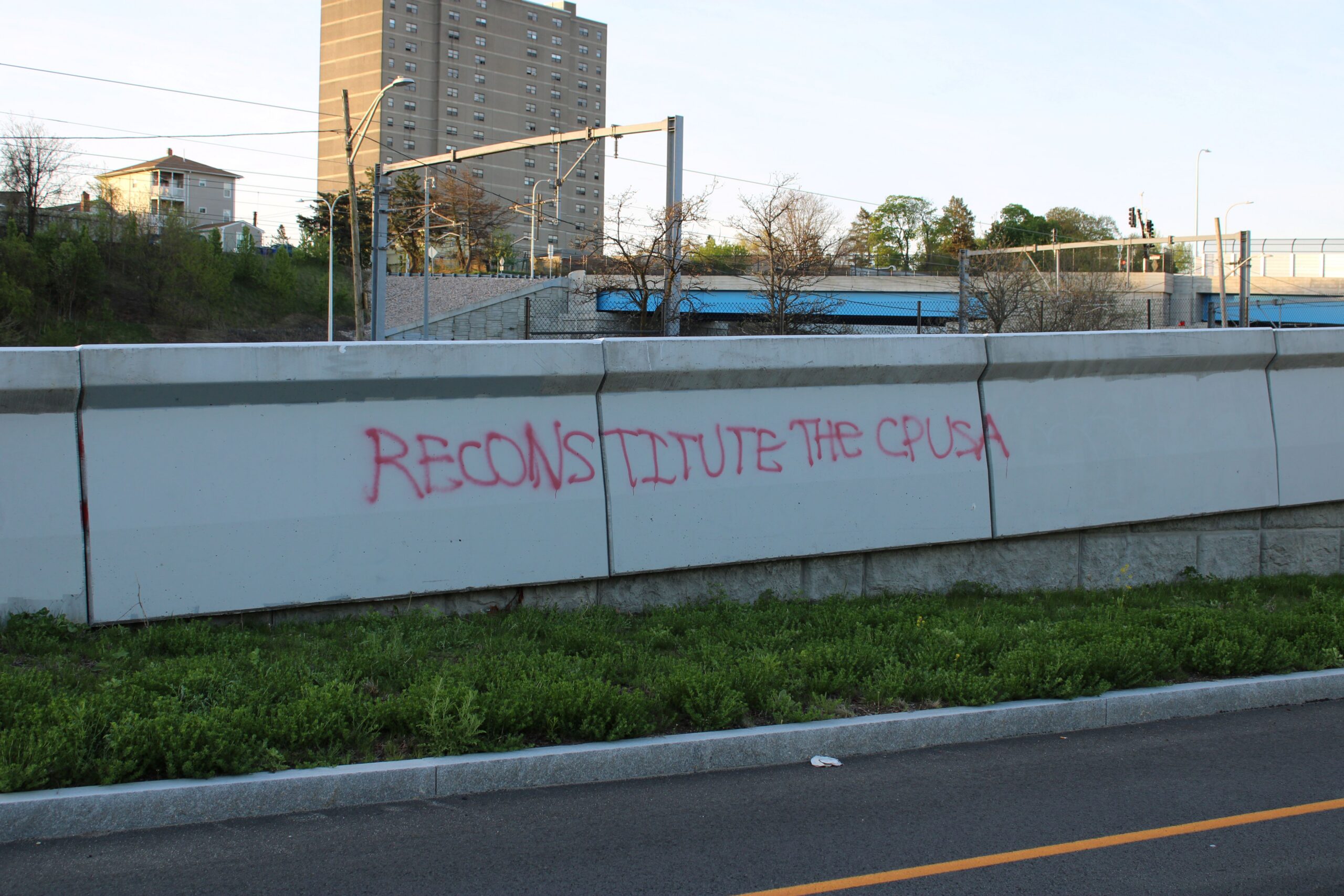
If we look to the history and ideology of the International Communist Movement as a guide, what we find is that this problem is actually very common and has a term associated with it: “reconstitution.” The basic concept is that in countries where there was originally a Communist Party which had formed and then degenerated because of the combined blows of revisionism and reaction, there is a need to reconstitute those Communist parties which had already once been constituted, but have now fallen apart. This thesis was famously and correctly described by Chairman Gonzalo and the Communist Party of Peru, who first raised the slogan “Let us Retake Mariategui and Reconstitute his Party” in order to lead their own reconstitution process after the original Partido Comunista Peruano had degenerated by the 1960s. Chairman Gonzalo then raised the thesis that the task of “constituting or reconstituting” Communist Parties around the world was universal, and the main task for revolutionaries in the current period.
While Chairman Gonzalo and the Communist Party of Peru defined the process of reconstitution theoretically, practically it is a process which has played out time and time again throughout the history of the International Communist Movement. All of the most well-known and active Communist Parties worldwide that are actually waging revolution are, in fact, reconstituted Parties. For example, the original Communist Party of India had degenerated by the 1950s, was briefly refounded under the leadership of Charu Majumdar as the Communist Party of India (Marxist-Leninist) in 1969, felt apart again after his death in 1972 following internal factionalism and fierce State repression, and was once again re-established as the Communist Party of India (Maoist) in 2004. This process of constitution, degeneration, and reconstitution has played out elsewhere in countries such as Turkey, Nepal, and the Philippines, and is playing out now around the world. Each time there is an intense process of two-line struggle and class struggle, which serves as the preparatory work leading up to the reconstitution of a Communist Party, thus giving that term real concrete meaning and not letting it become some empty declaration or proclamation.
Although reconstitution may seem very straightforward, obviously there are a lot of potential errors and challenges associated with carrying out this process, as otherwise it would have been accomplished already. For the purpose of this Basics article, we are going to cover three very common errors that comrades almost certainly will encounter in their daily work within the US revolutionary movement: the so-called base-building trend, the study-is-primary trend, and the trend we will refer to as the “conventionist” trend. Like with many errors of our movement, these three incorrect trends all ultimately originate from the world outlooks, methods, and class stands of the many non-proletarian activists, intellectuals and students who populate our organizations and leadership bodies. Furthermore, the error of each of the three trends comes from taking one aspect or contradiction present in the reconstitution process, and making a fetish of it; one-sidedly focusing all efforts on it to the neglect of other necessary, reciprocal, and simultaneous tasks. In this sense, all of these trends are incorrect answers to that most famous of questions: what is to be done? In analyzing these trends, we will also explore how reconstitution contrasts with them, and what it proposes to be done in their place.
The conventionist trend is one of the most common shortcuts to party reconstitution presented by different groups in the revolutionary movement. The basic idea is simple: to reconstitute some kind of center in the United States, why don’t as many revolutionary activists as possible just get in the same room and hammer things out?
The immediate problem with this approach is that it is based on an unacceptable hypothesis. Specifically, that the State’s security forces and repressive apparatus are simply not paying attention to the revolutionary movement, and are either not capable of or are not willing to actively infiltrate, suppress, compromise or surveil US revolutionaries-in-formation. In contrast to this hypothesis, the verdict is clear: a Party Organization is either clandestine or it is not a true Party Organization. Closed bodies can never be formed correctly out of open bodies. The conventionist trend takes reconstitution, which must be a closed process, and makes it a functionally open process.
One cannot take all the random spontaneous sects, groupings, and organizations nationally who self-identify as “revolutionary,” “communist,” or “Maoist,” invite them to some conference space, and have themselves a principled or “closed” process at the end of the day. The State couldn’t hope for a better honey pot in their wildest dreams! We don’t even need to imagine what the fruits of such a reconstitution method would be, as this was tried before in our own country in the 1960s and 1970s, and resulted in many of the major “parties” of that time having police infiltrators, literal spies, and turncoats in their central committees, their political bureaus, and their internal communication channels. Notoriously, the Revolutionary Union (RU), the predecessor of the Revolutionary Communist Party (USA) already had two informants sending reports directly to FBI chief J. Edgar Hoover on the positions, membership and proceedings of the RU’s Executive Committee in 1968, the same year the organization was founded via meetings between different Mao Zedong Thought inspired collectives in California.
The conventionists tend not to understand the real meaning of clandestinity, which is an essential principle of Party construction. If you are identifying as a member of a “Communist” organization in calls, emails or direct messages, if you are laying out your lines and proposals on Party formation on a blog or in a room full of unvetted strangers, if you say your organization is “closed” or made of “cadre” but its leadership, membership, and structures are known by non-members, you are not calling for or participating in a Party reconstitution process. You are calling for the revolutionary version of a pyramid scheme, a house of cards that will blow over when confronted with the inevitable winds of reaction and revisionism.
The conventionist trend is very US-appropriate insofar as it desires a short-term easy solution to what is a long-term difficult problem. Our capitalist system teaches us to desire shortcuts and fast results over strategic patience and quality construction methods. Such mentalities and attitudes must be combated by emphasizing the need for work based on common principles, tried and true secure methods, in addition to a long-term and far-sighted strategic approach that avoid hastiness and shortcuts when it comes to the most important task before our movement.
The base-building trend is a political expression of the narrow-minded pragmatic and localist attitudes present among many middle-class “revolutionaries” and activists. The base-builders look at the questions posed by a lack of an organized proletarian vanguard, and answer that to reconstitute the Communist Party, we must first organize the class around its local and sectoral demands, typically by engaging in local tenant and labor work. They take this approach because in their view, there is not yet the class material for a new vanguard organization because the masses in the United States are relatively de-mobilized, de-politicized, and de-organized.
The idea is that this localized mass work will “build” a revolutionary “base” among the working class and poor in different cities, towns, or rural areas, and that these bases will then serve as the raw material for a future revolutionary process or organization. In the words of the base-building manifesto From Tide to Wave: “Our base building work should be seen as means by which we can engage in mass action and make militant action possible. Our base building efforts if successful should be able to open up new avenues and possibilities in social struggle and allow us to meaningfully engage social movements.” Positions like these demonstrate how base-building practices avoid and postpone uniting and leading the class-conscious movement of the masses into some far-off future point in time, and view processes such as party reconstitution similarly premature, all pending the development of their “bases” and localized mass organizations.
The base-building trend thus over-emphasizes certain political-organizational problems facing our movement, while downplaying the problems posed by the lack of a center, and the lack of an application of revolutionary ideology to our national conditions. This trend has a linear, mechanical mentality when it comes to reconstitution that avoids the type of dialectical all-sided thinking that sees the interconnectedness of our different tasks and our problems. Base-builders also avoid ideological questions, and in fact tend to view most political ideologies as obsolete. Instead they like to mix and match contradictory ideologies and their own scattered ideas into the theoretical equivalents of Frankenstein’s monster.
The revolutionary movement and the class-conscious movement of the masses must be constructed from the center outwards. This does not ignore the problem of building up local work or the isolation of revolutionary leadership from many concrete class struggles nationally, but rather holds that the development of such work should fall under the authority of one center rather than dozens of small fragmented circles. The problem is straightforward: many different local groups have begun to build their “base” or to take leadership in a struggle only to then fall apart, taking their mass work and “base” with them, because of this or that internal issue.
The base does not build the center, but rather the center builds the base. Collapse can also happen to aspiring centers, but relying on little local groups to develop and slowly evolve themselves into a center is fundamentally a losing strategy. It relies on a kind of narrow “practice-only” approach that ignores the defining role a revolutionary center’s political line and positions can play in ideologically and politically consolidating and uniting movements and struggles. It also flips the local-national contradiction on its head, and tries to make the fragmented local circles the axis on which on our movement is built. Like all of the three erroneous trends we are covering in this article, in the final instance base-building is a reflection of the class instincts of non-workers, who desire their own little local kingdoms and fiefdoms where they get to play as if they were Lenin, rather than submit themselves to a national movement which would force them to become disciplined and prove their revolutionary character in practice.
If the base-builders commit the error of a “practice-only” approach devoid of common theory or politics, the study-is-primary trend is their opposite. The study-is-primary trend thinks that when approaching the question of reconstituting a new Communist Party in the current period, reading the works of historic Communist leaders is more important than leading and organizing the struggles of our class. They hold that studying and spreading Marxist texts is primary over revolutionary practice in carrying out the tasks of our modern US movement. The problems with this approach are again very obvious, which is why this trend reflects the dogmatic book-worshipping and idealist tendencies of many non-proletarian activists, in particular those who are professionals, graduate students, professors, etc., or those who come from that class background. While there are many justifications given for turning Party reconstitution into a process lead by book clubs, they all fall flat under basic scrutiny.
The first justification is the “substitution” argument. It takes the truth that in Marxism knowledge and theory come from collective social practice, specifically in class struggle, production, or scientific experimentation, and turns that truth on its head. Those who use this justification proclaim that “if theory comes from practice, that means our theory already comes from historical and international practice and we don’t need to focus on practice of our own!” This is yet another shortcut given by brilliant middle-class “revolutionaries”; why do the hard work of leading class struggles when Mao and Lenin already did it for you?
The ideology of the proletariat, Marxism-Leninism-Maoism, does indeed come from a great chain of historical social practice. None of that truth negates our own need to learn that ideology mainly through practice, and to verify whether or not our application of our ideology to our modern national conditions is true or not, based on the results of our practice. We might take the ideas of Chairman Gonzalo as our guide, but to paraphrase Chairman Mao, you can’t learn the taste of a peach by reading about it, you must eat it. Thus, in order to determine the correctness of a specific application of Marxism-Leninism-Maoism to our conditions, we must practice and apply it.
The second justification provided for the study-is-primary trend is usually some bad interpretation of Lenin’s quote “without revolutionary theory, there is no revolutionary movement.” This justification then begs the question: how is it determined which group in a country has the most revolutionary theory? Is it based on verbal or written “adherence,” the Marxist version of “I say so, and thus it is”? In contrast to this, whether or not someone upholds or truly grasps revolutionary theory is determined by things like their success in practice, and by their world outlook, their class stand, and their methods of work. One class-conscious worker is worth one hundred “Marxist” graduate students, who view themselves as the arbiters of the most pure and sacred “revolutionary ideas.” According to those who use this type of justification, whether or not one has read all of What Is To Be Done? or the General Political Line of the Communist Party of Peru is more important than if someone has a proletarian world view and has correctly lead fellow members of their class in struggle. Whatever quotes these people mine from something they found online, serious revolutionaries-in-formation know this trend they goes against the most basic truths our movement and (ironically!) its theory are founded on.
Finally, the most erroneous justification of the study-is-primary trend is a variety of eclectic or contradictory justifications. This is especially a problem considering that the study-is-primary trend is mostly prominent among those who have failed in their own practice in the class struggle. The idea that reading and sharing Marxist works is “principal” in determining who is and is not a leader is for many just a convenient way to cover up past failures of organization and practice. Their own repeated and constant failures in actually leading revolutionary practice doesn’t matter so much to them if practice in the class struggle is itself reduced in importance. They will endlessly go to extreme lengths of inconsistent rhetoric to justify holding theory as primary over practice. Whether or not the cover is correct is less important than the establishment of the cover itself. This can be seen in our own country in the notable history of groups such as the Revolutionary Communist Party or the Committee to Reconstitute the Communist Party (USA). Groups like these begin with attempts to practically organize the masses and elaborate class lines for their work, but quickly their own failure to lead the masses and establish stable revolutionary bodies inevitably meant that they began to close themselves off practically, and retreat to the comfortable role of book and newspaper purveyors. Thus, in an ultimate sense this trend represents where Party reconstitution efforts go to die once they exhaust any revolutionary potential they once had.
While these are some of the main incorrect trends present among those who desire Party reconstitution, they are by no means the only trends. Similarly, while they all present in different forms, in essence all of these trends represent ideas of the old decrepit ruling class that filter into our movement from both newer local amateurish activist circles, as well as different revisionist sects that stick around year after year. In contrasts to the erroneous trends enumerated in the article above, revolutionaries-in-formation must raise the following set of correct and essential principles regarding the reconstitution of a Communist Party in the United States:
- In contrast to the conventionist trend, the process to reconstitute the Communist Party must either be closed, or it is not a true reconstitution process.
- In contrast to the base-building trend, the process to reconstitute the Communist Party must be lead from a national center outward, not from the local circles or mass organizations inwards.
- In contrast to the study-is-primary trend, the process to reconstitute the Communist Party must take revolutionary practice among the US multinational proletariat and its allies as its primary criteria for truth and verification, and not the study of Marxist classics, which is an important but secondary criteria.
For further reading, The Partisan recommends:
- Let Us Retake Mariátegui and Reconstitute His Party, Communist Party of Peru
- Rectify Errors, Rebuild the Party!, Communist Party of the Philippines
- On Practice, Chairman Mao