[Editorial Note: As part of our role in centralizing reports, summations and line struggles among revolutionary and class-conscious forces in the United States, The Partisan will be publishing a series of interviews with activists and organizers in key sectors of struggle for the purpose of sharing lessons and information from across the revolutionary movement in the United States for our audience. We are happy to publish this first interview with a comrade from the Filipino National Democratic movement here in the United States, who shares their perspective on the modern ND movement’s origins, approach, activity, strengths, weaknesses, as well as how US revolutionaries can best support the National Democratic movement.]
1) What is the National Democratic movement and what are its origins?
Carlo – The National Democratic movement (ND movement) is a collective term used to refer to hundreds of organizations both in the Philippines and all over the world who fight for National Democracy. “National Democracy” is a response to the reality of the Philippines, which we characterize as “semi-feudal, semi-colonial”: “national” means national liberation from US imperialism and all other imperialist powers, which responds to the status of the Philippines as a semi-colony; and “democracy” means genuine democracy, which means land to the tiller, who make up the majority of the country, resolving semi-feudalism. The term “National Democracy” is not unique to the Philippines; it is the application of the proletarian ideology of Marxism-Leninism-Maoism in the concrete reality of an oppressed country.
Many organizations adhere to the line of National Democracy, such as the Communist Party of the Philippines and the National Democratic Front who took up arms. But in the legal sphere, the ND movement is made up of sectoral mass organizations, independent red labor unions (genuine unions), and partylists representing different sectors. The ND movement has its origin in the long tradition of resistance of the Filipino people against imperialism, feudalism, and bureaucrat capitalism. The first working class organization, the Unión Obrera Democratica, was established in 1902. In 1964, Jose Maria Sison founded Kabataang Makabayan, a youth sectoral mass organization that fought for National Democracy and would go on to lead the mass student movement of the 1960s. In 1970, he published Philippine Society and Revolution (PSR), which along his previous works comprehensively analyzed the Philippine society and its contradictions, reemphasizing the road to revolution. Since the early 1960s until this day, the ND movement has continued to grow and expand in the fire of class struggle. Some important ND organizations include BAYAN, a multisectoral alliance of National Democratic Mass Organizations, Kilusang Mayo Uno, the biggest militant labor union, and Makabayan Partylist, a coalition of sectoral party-lists.
2) How did you get involved in the National Democratic movement?
Carlo – I joined the ND movement after taking part in a People’s State of the Nation Address rally with many fellow young Filipinos. It was a sight to behold, seeing so many people mobilized for a single cause of genuine freedom and democracy. I was deepened by belief to be an active participant after going through the mass orientation and other educational discussions after they shed light with so much clarity on the three basic problems of the Philippine society (imperialism, feudalism, bureaucrat-capitalism) and the revolutionary alternative to turn the class triangle upside down.
3) What role does the National Democratic movement play in the Filipino revolution?
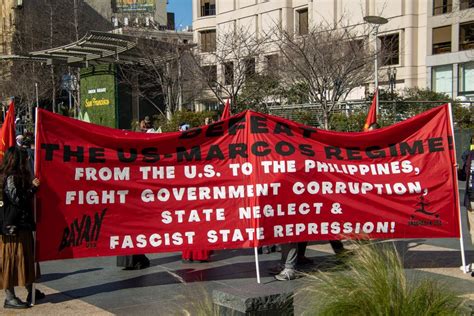
Carlo – Today the ND movement organizes different sectors of the people for their own economic and political demands: for example, KMU organizes workers to fight for higher wages, ANAKBAYAN organizes students to fight for pro-people education, KADAMAY organizes urban poor to fight for (and even occupy) housing, KMP organizes peasants against land-grabbing. All these sectors support each other in their struggle, and all support the basic force of the People’s Democratic Revolution, the workers and the peasants. In every province of the Philippines, whether among the working class, peasantry, students, indigenous people, fisherfolk, or even artists and lawyers, you can find a regional affiliate of an ND organization that fights for the demands of the masses, guided by the line and program of National Democracy. The ND movement also provides for the masses, both after the increasingly common natural disasters and in areas where the US-Marcos regime refuses to provide necessary social service like schools. But it is important to highlight that the movement also rejects reformism, and always emphasizes on the independence of the working class and the oppressed people, distinguishing reformism with the struggle for reforms and putting an emphasis on building revolutionary organizations.
In this sense, the ND movement is the building block of the Philippine revolution that plays an important role in arousing, organizing, and mobilizing the broad masses of people. Its organizations are able to grow to the size of thousands because they actually take part in class struggle against the class enemies, instead of talking about empty theoretical knowledge like many revisionists do, who are limited to the universities. At the same time, they propagate the ND line and program through and alongside these struggles, to the lowest and deepest masses by helping them realize their collective power and the root cause of their misery. In this way, any bread-and-butter issue – whether the lack of income of tricycle drivers or the raising living costs – is linked to the central question of revolution, of political power.
4) What are some differences between the National Democratic movement abroad and the ND movement in the Philippines itself?
Carlo – Like I’ve said before, the ND movement exists both in the Philippines and abroad. However, there are some key differences. While the ND movement is a popular movement that is gradually winning the support of the whole people (proletariat, peasantry, petty-bourgeoisie, national bourgeoisie) in the Philippines, when abroad, it organizes for the revolution back home in the Philippines and not for revolutions in “host countries”. In the United States, for example, it organizes primarily those who are Filipino by blood, and secondarily solidarity allies who support the Philippine revolution, especially those who wish to make this support their primary struggle instead of fighting with the working class of their own country.
5) What are the greatest strengths and weaknesses of the National Democratic movement currently?
Carlo – To keep the scope limited, I will talk a little bit about the strengths and weaknesses of the ND movement in the US.
The ND movement is widely known among activist circles in the US to be a highly principled force: it has always stood on the side of oppressed peoples, whether in Kurdistan, Palestine, or with Black people in the US. The ND movement in the US has existed for decades and it has avoided the common pitfall of organizations here, of endless splits and dissolution, because of the effective organizational line of democratic centralism, as well as a robust culture of education and study around the National Democratic line and program. It also has established solid relationships with both other Filipino-American organizations on common grounds to fight for the benefit of the community, as well as other diaspora and working class organizations, taking part in numerous local and national alliances with progressive and democratic aims. Lastly, the ND movement provides consistent and permanent moral and material support for the working people in the Philippines, always showing up in solidarity actions, pushing the line of the anti-imperialist, anti-feudal struggle both within the diaspora and with the host people, not to mention collecting funds for those displaced by natural disasters like Typhoon Haiyan.
The weaknesses of the ND movement here can be complicated to talk about. The current strategy to organize for the PDR in the Philippines and not for revolution in the host countries has created some difficulties: for example, it is hard to organize Filipino workers solely for their own national interest and especially for a revolution back home, when many of them work in the same workplace with white, Black, and Latino workers, as they share the same struggle and are exploited by the same US bourgeoisie. To organize militant struggles in the US like the ND movement does in the Philippines will require coming to confrontation with the US capitalists as well as the US State. Sometimes the ND movement can only put pressure on the Philippine embassy and ultimately can fall into the trap of alleviating the workers’ conditions through reformist means, like via the NLRB and the legal justice system that don’t challenge the legitimacy of capitalism, nor evoke the same militant nationalist spirit that is expressed back home and contained in the Filipino people’s centuries-long legacy of fighting against oppression. In the meantime, many Filipino workers who have escaped the harsh reality of the Philippines have no desire to return. Because of this, the ND movement in the United States has had trouble building its base among the workers and is mostly comprised of petty-bourgeois students, sometimes second- and third- generations, who are looking to connect with their heritage.
6) How can US revolutionaries best support the Filipino revolution?
Carlo – Joma Sison once said, our best way to support the world revolution is to win the Philippine National Democratic Revolution with a Socialist Perspective. The same is true with the US revolutionaries, although obviously with the difference being the United States is a great imperialist power and the Philippines is a semi-colonial oppressed nation. Despite being the sole hegemonic superpower, the US is also a prison house of nations with a working class being exploited and oppressed. While US revolutionaries can and should provide moral and material support to the people’s movement in the Philippines, they should make as their top priority to develop their own socialist revolution here, by engaging in militant class struggle, organizing the proletariat, the Black, indigenous and other oppressed peoples to fight for their demands, linking and raising these demands for the socialist revolution and struggle for power. As the revolutions in the Third World cut off the tentacles of the imperialist octopus, there is a special place for those in the belly of this beast to weaken it, and eventually, for us to strike the killing blow together.
7) Do you have any other comments or thoughts?
Carlo – I hope revolutionaries in the US can unite on the basis of militant struggle and follow the examples we set in the Philippines! Padayon!