[Editorial Note: As part of our call for reports and summations from the revolutionary mass movement, we are happy to publish this work we have received from the comrades at the Revolutionary Student Union that analyzes the university encampment movement and attempts to chart a path forward given the current wave of repression and defeats.]
On April 17, 2024, students at Columbia University set up tents on the campus’s main lawns, declared the area liberated, and demanded the university divest from Israel or they would not leave. That action lit a spark. Within days, students across the U.S. and the world followed suit, occupying campus spaces, demanding divestment from Israel, and standing in solidarity with the Palestinian people as they face genocide, siege and occupation. What erupted was a just and widespread wave of rebellion.
This moment brought students of all backgrounds into motion, spontaneously unified in a shared rejection of genocide, imperialism, and university complicity. Tens of thousands mobilized, but mobilization alone was not enough. The movement, though brave and inspiring for many, quickly revealed deep cracks, which we must now analyze if we are to go forward with strength.
The encampment movement spurred thousands across the country into action, and had a genuinely impactful role in mobilizing student communities to action. However, a closer look at the encampment movement more broadly revealed that the only thing most encampments had in common were the fact they all had tents (i.e. their form). The encampments had energy but lacked a unified political direction. There was no common strategy, no ideological cohesion, and no plan for how to escalate or sustain the struggle once faced with the predictable wave of repression and co-optation. Instead, contradictory lines flourished: on one side, open reformism and collaboration with administrations and bourgeois politicians; on the other, isolated adventurism and student-centric ultra-leftism. In many cases, we saw self-rationalizing justifications for ending encampments, a return to “regular life” without a plan for sustained activism, organizing, and leadership. Too often did student movements have the illusion that the watered down and empty promises handed down to them by university administrations were genuine and positive. This tells us a couple things.
Firstly, the student movement more broadly lacks political leadership, specifically revolutionary working-class leadership, which if present would have created a unified understanding across encampments that the university administration can never be on our side. Imagine if we were all on the same page about the political natures of our university administrations, on the theory and practice necessary to achieve the transformations and changes we demand; the blow we could have struck would have been much larger. Secondly it tells us that encampments were a tactic, and not a strategy. A long-term strategy and outlook for revolutionary change was unfortunately absent in a majority of these crushing decisions such as agreeing to take down encampments. Tactics must always be guided by strategy, we have to know why we are doing something and what the purpose of what we are doing is, all in relation to our broader goals inside and outside the narrow confines of the campus itself. The fact each encampment was more or less an unanchored ship lacking strategy highlights the spontaneous nature of the movement as a whole.
In opposition to the reformist tendency which had a narrow-minded focus on deals with administrations, there were calls to keep encampments up, and increase direct action against universities. While these calls were correct in identifying the need to keep encampments up, we find they often fell short in situating these calls in correct class politics. For example, mass undertakings such as building occupations were encouraged without proper instruction on how to ensure participation from the masses, connect these escalatory actions to concrete demands the local working-class and/or nationally oppressed community, students, or others held, and place these actions in service of and under the leadership and plan of the broader revolutionary working-class movement.
As repression escalated during the days of the encampments to things like mass arrests, cop riots, suspensions, and expulsions, the student movement showed its inability to respond in a unified and organized fashion because of the lack of overall revolutionary orientation and leadership we identified earlier. Aside from scattered local support, there was no national unified campaign or effort. Even today, we see the cracks from the sharp divides created by lack of leadership in various student movements deepened with the complete abandonment of many who received charges. This highlights the lack of concrete class politics in the student movement and the bankruptcy of a “student vanguard” mentality, ultimately leading to an unfortunate lack of solidarity in many cases. Students alone could not halt the state’s offensive against their just and revolutionary struggle, it is only the workers and their movement which can bring about the ultimate defeat and overthrow of US imperialism which is the ultimate culprit in the ongoing genocide of the Palestinian people.
Demands, where they existed, were often narrow or incoherent. Political demands from nationally oppressed and racially discriminated students, often against university expansion, gentrification, and policing were sidelined. We find the internal counter-offensive against these types of demands to be the most harmful, as they reached the closest to spontaneously tying the encampment movement’s goal of divestment to concrete struggles students from working-class backgrounds faced. The sidelining of these demands also highlighted the inefficacy of tactical and sporadic upsurges when concrete strategy guided by revolutionary working-class leadership is absent. Important topics to this countries revolutionary movement, such as the Labor and National question were forgotten and absent overall. Should unity under such leadership had existed, closer attention could have been paid to what we are demanding and why. Demands intimately tied to the National question in this country, such as anti-gentrification for example, could have been raised. Tens of thousands more who were otherwise untouched by the vague demand of divestment could have been mobilized.
The demand for divestment itself wasn’t concrete enough to result in large sustained mass movements in many campuses, and as a demand had many shortcomings particularly when raised in isolation. The main support and historical axis of the Zionist project is the broader system of world imperialism, which once was centered in the British Empire and now is centered in the United States. Through their interconnection with the US and Israeli defense industries, the universities play their role in the oppression of the Palestinian people, but it is undeniable that even if divestment is achieved the Zionist project will be able to continue on in much the same form as long as its main pillar, US imperialism, remains untouched. In this way socialist revolution in the United States is a non-negotiable for any supporter of the Palestinian cause: without weakening and confronting Israel’s main support and source, US imperialism itself, we will not be able to act in full and complete solidarity with the Palestinian people and all other peoples oppressed by imperialism around the world. The literal means by which U.S imperialism sustains Zionist Colonialism through manufacturing and logistics emphasize even further the importance of the Labor question, a question entirely untouched by the encampment movement.
With no national coordination and no deep political unity, most encampments faded after weeks. The students had taken a first step, but the absence of organization, discipline, programmatic unity, and correct leadership allowed the state to crush us and our momentum.
And today? Many student organizations have splintered or collapsed under the intensified repression and disunity. The Trump administration has begun a campaign of terror and violence, revoking student visas, criminalizing protest, and coordinating with university administrators and fascist Zionist organizations to suspend, expel, and blacklist students. The student movement has been unprepared for and blindsided by the recent attacks from the Trump administration. The deportations we are seeing shouldn’t be happening. We should be organized enough to be able to mobilize at a moments notice to defend immigrant students, in tandem with our other campaigns. We should be organized enough to support the struggles of the non-student immigrant masses already facing deportation terror regularly. We must understand that it is because of the failure of the encampment movement for the aforementioned reasons that this was not possible.
The radical energy that once surged has been reduced by surveillance, arrests, and deportations, and has been mainly weakened by internal contradictions. Where it hasn’t been crushed outright, it has been reabsorbed by liberalism or left to flail, isolated, defensive, and disoriented. But the conditions that produced this wave of struggle have not gone away, they have only sharpened. The question now is not just how we recover, but how we rebuild with greater strength, clarity, and organization. The time to act is now. This country is rapidly trending towards fascism, and the longer we remain complacent, the more unprepared we will be for already-seen intensification of repression.


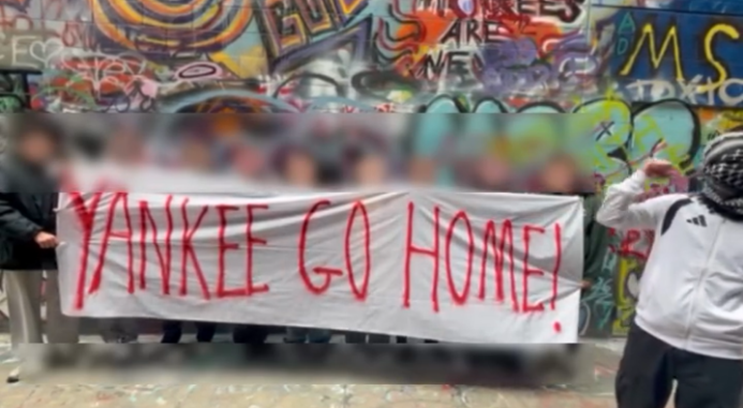
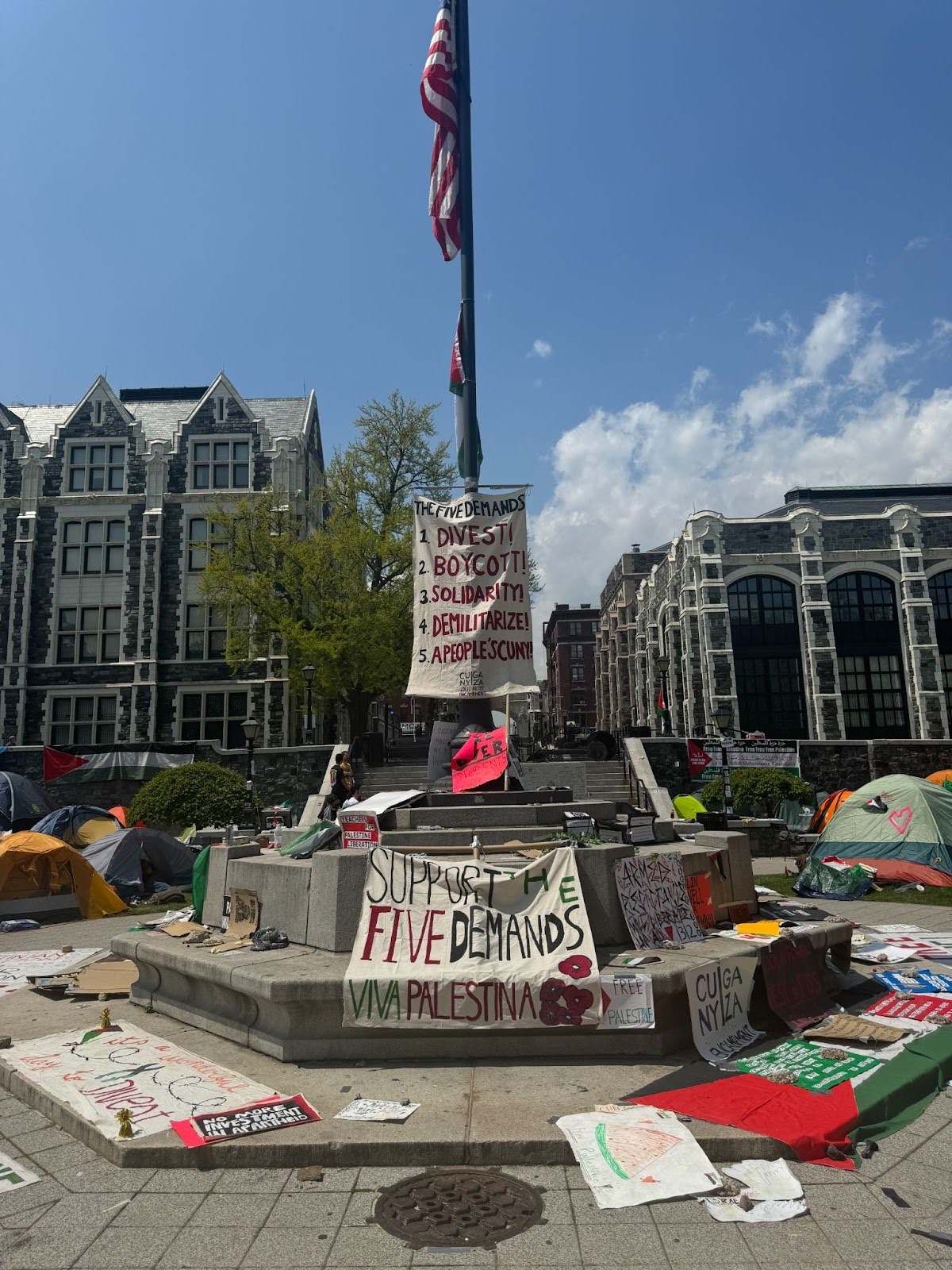
Selected images from the CUNY, RISD, and University of Michigan encampments.
What lessons should we learn? We cannot repeat the same errors. To move forward, we must clarify our political line and reorganize the student movement along the following five foundational principles:
1. Unite the Student Movement and Organize the Student Masses Under a Clear Program and Organization
We must fight for programmatic unity, a shared political basis that clearly defines our enemies, our demands, our strategic goals, and our relationship to other class forces. This means building a national revolutionary student organization that is not only anti-imperialist and anti-capitalist in words, but in structure, strategy, and practice. Right now the movement is scattered. There are a lot of positive forces who are ready to fight, but they are lead by liberal, reformist or opportunist groups/lines, and the Student Intifada showed us that we can’t have any illusions that simply throwing down will get us anywhere unless it’s (nationally) coordinated, guided by program and strategy, and planned.
Our task is not simply to unite the already-radicalized students under a national organization, but to integrate the students into the living struggles of the masses under the class leadership of the proletariat. We should ask ourselves why the encampment movement had some of its most dramatic confrontations at the country’s most elite private institutions, while the community colleges and public colleges with larger more working-class and nationally oppressed populations remained largely on the margins. We need to reckon with the fact that the student movement was unable to reach or meaningfully organize a majority of students who are oppressed in some way and rectifying that is a pending task we need to take on with enthusiasm and tact. Students must be remolded in this process: shedding our individualism, apathy, and petty-bourgeois habits through direct participation in revolutionary politics and practice. The transformation of the student masses into a powerful auxiliary for the working-class cannot happen spontaneously, it must be guided and consolidated through a disciplined national organization, one that arms students with ideology, strategy, and the structure to fight as one with the people in class war. An organization which functions as part of a larger united front with organizations of the workers and oppressed masses, and upholds the guidance of revolutionary working-class leadership.
2. Develop a Strategic Vision Beyond the Campus.
As an extension of this point on the new type of unity and organization we need, our work must not end at the gates of the university, nor should our vision stop at the point of a limited demand like divestment or university policy change. These are moments of struggle, not their end points or even their mid-points. Our long-term goal is revolution within our lifetimes: the overthrow of the capitalist system and the construction of socialism. All our actions, on and off campus, must be steps toward this ultimate and fundamental goal. At the heart of the spontaneous impulse that drove the encampment movement, which was ultimately ignited by the Palestinian people, we raise the task of making the ultimate contribution we can make to the Palestinian masses and the oppressed peoples to the world—the elimination of the US imperialist system.
Students must not see themselves as an isolated moral voice. Instead, we must forge ourselves into fighters under the leadership of the oppressed and exploited in this country and worldwide. The university is not neutral, it is part of the ideological, economic, and political infrastructure of imperialism. Therefore, organizing within it must be organizing along class lines, with a long-term strategic orientation to put up a real fight against this entire system, not simply lobby it for reforms. It may be true that these universities will never serve us until the whole system comes down, but we will certainly take them on until that day comes, developing comrades that will support the leading and main force of our revolution in landing the striking blow in the process.
3. Mobilize, Politicize, Organize
These three terms are not just slogans, they are our strategy for building a revolutionary student movement. Too often, especially today, we see an imbalance or lack of one or more of these three key elements. For example, over relying on the tactic of marches and rallies alone highlights an over-emphasis on mobilization, which gets us nowhere without proper organizing being done to develop and consolidate the people we bring out. The point to politicize shows we need to properly understand our situation in order to move forward with our goals and actions, and educate our comrades in this understanding. No more haphazard demands, but carefully planned out steps that follow a strategy derived from an understanding of our concrete situation, as derived from our program and principles.
• Mobilize: We mobilize the masses around their common demands, collective action and planned confrontations like strikes, occupations, and disruptions. Mobilizations build unity, sharpen militancy, and produce real gains. But they must be organized around real contradictions between the masses and their oppressors, not symbolic gestures.
• Politicize: We raise consciousness through propaganda and education. We expose the system, name the enemy, and put forward a revolutionary alternative. Our education must prepare students to act, not just understand, but struggle.
• Organize: Organization is what turns struggle into lasting strength. It is forged in mass struggle and solidified through consolidation and expansion. We expand by bringing in new people through consistent mass work. Strong organization requires leadership rooted in the masses, sharpened by struggle, and guided by revolutionary politics. We organize not just to resist, but to win, and to fight forward with greater strength.
Through mobilizing, politicizing, and organizing the student masses under the banner of proletarian political leadership, we remake the student movement as a weapon for working-class revolution.
4. Be Tactically Versatile and Learn From Our History
We must not repeat past errors. Tactical rigidity, doing the same thing over and over while expecting different results is a dead end. We must develop our ability to assess the terrain, learn from victories and defeats, and adjust accordingly. This requires political leadership, criticism and self-criticism, and a living connection to the masses.
Instead of relying on fixed templates, we must sharpen our tools: occupation and strikes when the fruit is ripe, agitation, mass work, and education always. We must draw lessons from historical student movements that advanced class struggle, not only abroad, but here in the U.S.
For example, in 1969, Black and Puerto Rican students at City College (CUNY) occupied buildings and demanded open admissions for oppressed-nation students. Their organizing was strategic, rooted in the daily demands of the broader exploited and oppressed masses, and tied to neighborhood and anti-imperialist struggles. Their gains were real, and their fight remains a lesson for today.
5. Internal Contradictions Feed Off of External Pressures
The Student Intifada, or encampment movement, in many ways demonstrated how capitalist institutions like our universities actively undermine collective actions and subvert the establishment of revolutionary unity among the masses. Serving as contained training grounds for the bourgeois professional class of tomorrow, the university system as it exists today is built against, and not for the working class. From orientation through graduation, everything the University instills in us as students is done with a purpose: to fragment solidarity, to teach obedience to bourgeois class rule, and to discipline us into capitalist life.
In many cases, this has manifested in students—sometimes subconsciously and other times blatantly—valuing themselves over other activists and community members because of their position as students. What we see here is the way in which bourgeois pressures facilitated through the university system manifest in internal politics. Students at some universities played directly into the hands of the backwards and reactionary “outside agitator” narrative being pushed by both the Biden and Trump Administrations and the universities themselves. Students many times were overly hostile to people who came to support who weren’t students, even though in the end many of those facing felony charges for the encampments today were those very same “outside agitators” who were treated with disdain and hostility.
The only way to correct this is to remold through political education, class struggle, and unity under revolutionary leadership. Only by joining ourselves in struggles with our community, with the working class, with the masses, can this attitude be constantly chipped away at.
In conclusion, the Student Intifada showed the potential but also the limitations of today’s student movement. It proved that masses of students can be mobilized for rebellion but also revealed the disorganization, incoherence, and political weakness inherent to purely student-led movements, weaknesses that allow the state to win time and time again against them.
We must learn from our failures during the Student Intifada the seeds of our future victories. The path forward is not more of the same—it is unity, reorganization, and revolutionary leadership.
The storm is not over. Trump’s reorganization of the state as part of the general trend towards fascism, US Imperialist destruction all around the world, and the intensifying crisis of capitalism demand that we act. Let us rise, not as individuals or small groups, but as an organized force that is a part of a greater whole, with discipline, with clarity, and with a correct revolutionary strategy.
FOR A CLASS CONSCIOUS AND MILITANT STUDENT MOVEMENT!