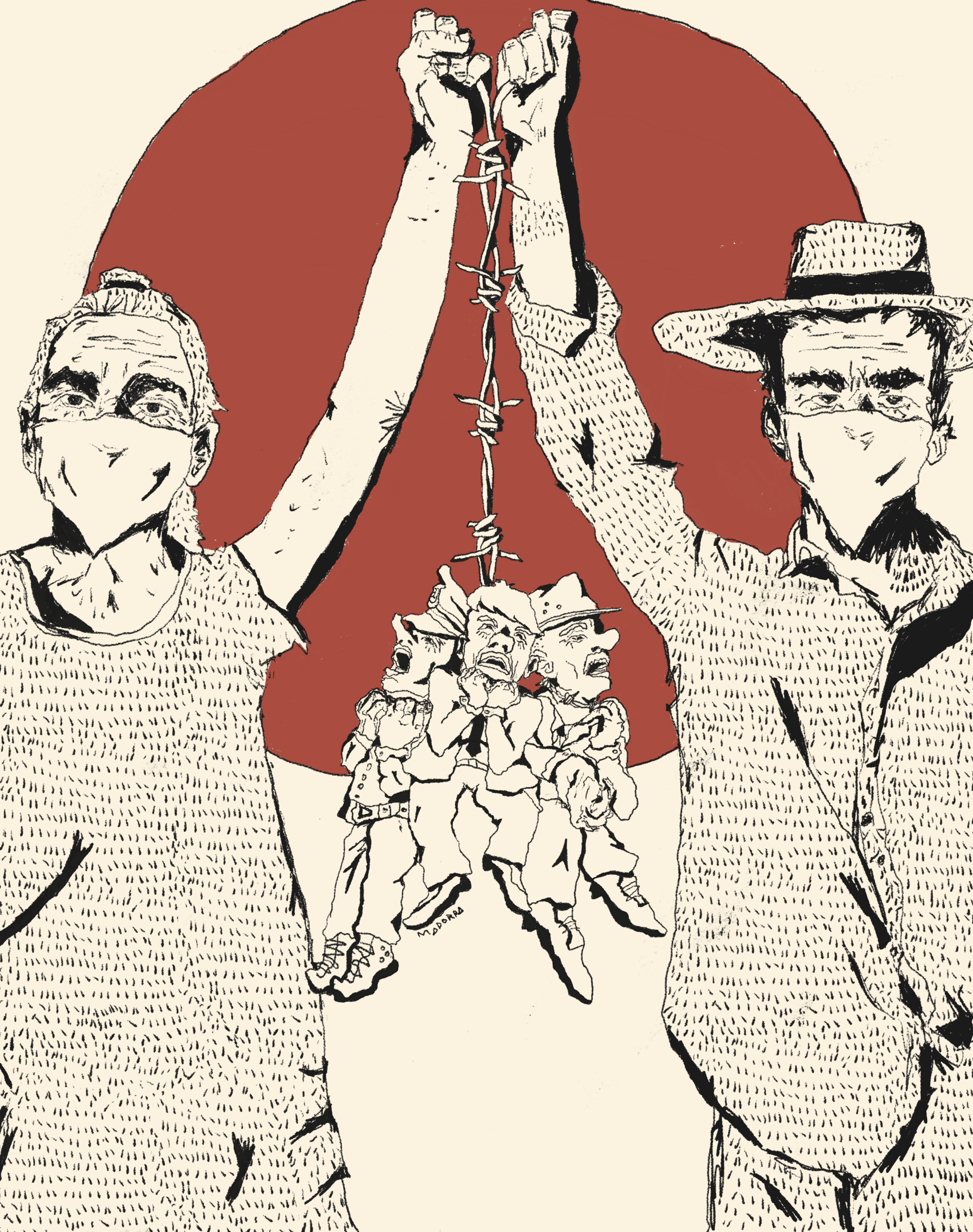
Art credit to @davimadorra on Instagram and A Nova Democracia.
“What we now frequently experience only in the domain of ideology, namely, disputes over theoretical amendments to Marx; what now crops up in practice only over individual side issues of the labour movement, as tactical differences with the revisionists and splits on this basis—is bound to be experienced by the working class on an incomparably larger scale when the proletarian revolution will sharpen all disputed issues, will focus all differences on points which are of the most immediate importance in determining the conduct of the masses, and will make it necessary in the heat of the fight to distinguish enemies from friends, and to cast out bad allies in order to deal decisive blows at the enemy.” Marxism and Revisionism, Lenin.
In our prior entry in this series, we discussed the principle of “Practice Marxism and Not Revisionism” from Chairman Mao’s Three Do’s and Three Don’ts. In this entry we will explain the two principles that follow “Practice Marxism and Not Revisionism.” The second “Do and Don’t” is “Unite and Don’t Split.” At a basic level this means upholding principled unity against sectarianism and factionalism. There are two important types of unity: the internal unity between revolutionaries and the unity of the revolutionaries and the people. Both of these unities in turn have their particularities depending on the context; especially the internal unity between revolutionaries can take different forms depending on the context and period, but we will discuss both unities broadly for our purposes.
Ensuring organizational unity means ensuring the organization is united around revolutionary principles and practice, which are generally dialectically combined into what is called a “program”. Chairman Mao once said: “We hail from all corners of the country and have joined together for a common revolutionary objective.” We wage two–line struggles as we test out our right or wrong ideas in practice. Proletarian revolutionaries are unafraid to be proven wrong, because we follow these principles and serve the interest of the majority of the people. Only this way can the correct political line be synthesized and further developed. In place of principled struggles that strengthen unity, revisionism will inevitably push for a split in organization or to advance the interests of their small group, because revisionists serve only themselves and not the broad masses of the working class. In the reverse error, those who push for an all-inclusive “unity” that masks or covers over real differences in line, program, principles, and practice, also fundamentally push for splits.
The fact that two seemingly opposed errors produce the same problem is dialectics: two–line struggle without a desire for unity will result in splits, and unity without a correctly structured two–line struggle process will also result in splits. Thus struggle and unity exist in a unity of opposites, which is in part why sometimes two-line struggle between groups is often expressed in the formulation “unity-struggle-unity”. In discussing this principle, the Colombian organization Proletarian Power writes in their work “Unity Among Communists: Struggling for the Party and for the Communist International of a New Type”:
“Because they have insisted on setting or imposing “the correct line” as the primary unifying factor of Marxists, they have unleashed the formation of as many revolutionary organisations as there are political lines, or nuances, promoting the metaphysical idea of a monolithic organisation without internal line struggle; However, these organisations which promote unity, not in principle, but in line, in practice cannot abstract from contradiction and, since there is no real line struggle, this struggle is inevitably replaced by small differences of appreciation of reality, disagreements in work plans, by ideological deficiencies of comrades, by personal quarrels, by all the problems generated by the inevitably artisanal methods of revolutionary work in small circles, in short, by contradictions inherent in coexistence. On the other hand, these contradictions, which to a large extent are petty differences, are magnified by grandiloquent language, full of quotations from the masters of the proletariat, which give the impression of the greatest theoretical seriousness, but lack, fundamentally, a real application of Marxism to our reality. [emphasis ours]”
This revisionist method of creating endless splits over any difference in political line is not new, it has a long history in the international working class movement. Trotskyite organizations, for example, are known for being mini-sects who suffer from splits after splits. This is because they insist on a dogmatic unity based on abstract ideas and rigid doctrine, and not a living, breathing unity based on concrete struggles and interests of the working class and the oppressed peoples. A political line can only come as the product of unity, through taking part in class struggle together and deepening our understanding of Marxism in our own national and local contexts. Revolutionaries-in-formation should not fear splits, because although they present a danger, resolutely practicing Marxism in the face of a split will ensure success. Before any personal differences that we may have, we revolutionaries are united in the struggle for socialism and for the liberation of all the oppressed peoples of the world.
At the same time, we need to ensure unity between revolutionaries and the people. Without the unity of the broadest possible masses of toiling and oppressed people, and in particular unity with their most deep and profound sections, we cannot make revolution. The masses are the motive force in the making of history, not a handful of revolutionaries. We fight for the interest of the people and it is only natural for us to align ourselves with them. Revolutionaries-in-formation must forge the closest links with the masses, practicing the “three withs”: live with, work with, and struggle with the masses, a principle which we will cover later in this series.
We cannot close our doors to the masses because they aren’t as advanced as us. This is a condescending approach that originates in the worldview of the petty-bourgeoisie, those who are interested in a battle of abstract ideas divorced from the harsh material realities of the class. Chairman Mao once said: “The masses are the real heroes, while we ourselves are often childish and ignorant, and without this understanding, it is impossible to acquire even the most rudimentary knowledge.” If we don’t do the patient mass work based around struggling for the masses’ daily demands, and instead split from the masses, we will only suffer retreats and defeats.
The third “Do and Don’t” is that of “Be Open and Aboveboard, Don’t Intrigue and Conspire.” Yet again, the distinction here is one between Marxism and Revisionism, or between the proletariat and the bourgeoisie. In the US, one often encounters those who treat political activism as simply a career, those who want to climb the ladder for control and prestige and approach it as if it were yet another petty-bourgeois corporate job. Chairman Mao said that to distinguish between true proletarian revolutionaries and bourgeois careerists, one must look at whether a person is open and aboveboard or works through intrigue and conspiracy.
Revisionism, being fundamentally false, cannot stand in the face of objective reality. Thus, revisionists must use conspiracy and schemes to push for the implementation of their revisionist lines. They are afraid that if their revisionism was out in the view of the proletariat that they would be quickly rejected, so they must use lies and deception. True revolutionaries must be open about their lines and actions. Working in an aboveboard manner is what facilitates criticism, and forms the backbone of an organization’s rectification away from revisionism and towards Marxism. When proletarian revolutionaries have differences, they must put these differences on the table, so they can be thoroughly and completely struggled over, based on the concrete practice in class struggle.
As Chairman Mao said, paraphrasing the Communist Manifesto: “We Communists do not conceal our political views. Definitely and beyond all doubt, our future or maximum programme is to carry China forward to socialism and communism. Both the name of our Party and our Marxist world outlook unequivocally point to this supreme ideal of the future, a future of incomparable brightness and splendour.” While this idea should be applied taking into consideration the level or context at which the discussion is occurring (the question of clandestinity), the principle is clear. We should not conceal our political views about this or that issue or point whenever possible. We should not hide or make secret lines or positions concerning topics which are clearly open and principled to discuss: to do so would be to use the method of the class enemy and revisionism.
We must remember that we are in the ranks of revolution for the interest of the working class and oppressed peoples and nations of the world. We are not fighting for personal fame or gains, and we should constantly and wholeheartedly remold our petty-bourgeois and bourgeois habits, serving to advance the class struggle and the revolutionary movement by being aboveboard and honest, and by working together under principled unity as revolutionaries and with the masses.
For further reading on this topic, we suggest:
- A Basic Understanding of the Communist Party of China – Chapter 5
- Marxism and Revisionism, Lenin
- Marxism and Reformism, Lenin
- On the Correct Handling of Contradictions among the People – Section VIII, Mao