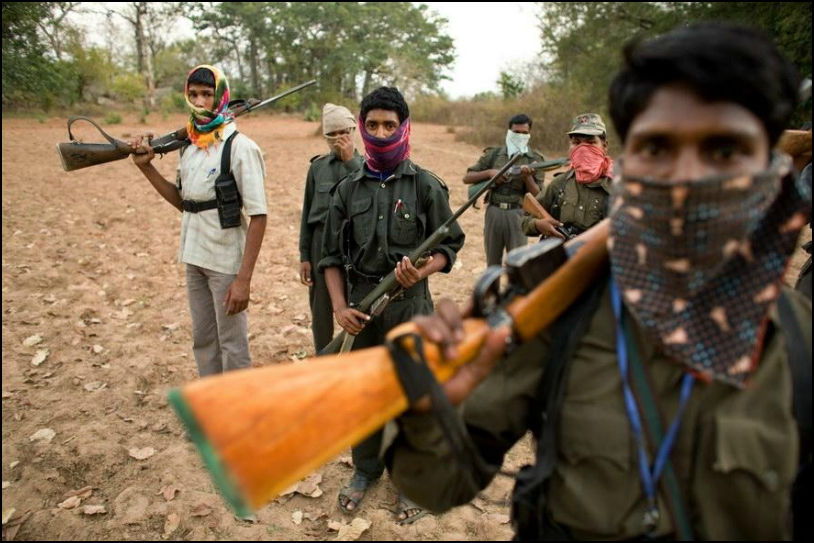
The principle of revolutionary violence, that a socialist revolution will only occur through violent rebellion in which the working class overthrows the capitalist class, is one of the most important principles a revolutionary-in-formation can understand and grasp. In one of his most famous and widely cited quotes, Chairman Mao wrote: “A revolution is not a dinner party, or writing an essay, or painting a picture, or doing embroidery; it cannot be so refined, so leisurely and gentle, so temperate, kind, courteous, restrained and magnanimous. A revolution is an insurrection, an act of violence by which one class overthrows another.” This quote is an illustration of a basic principle of our class that has been expressed by our international movement since its very beginning.
For example, in the Communist Manifesto Marx and Engels write that:
“In depicting the most general phases of the development of the proletariat, we traced the more or less veiled civil war, raging within existing society, up to the point where that war breaks out into open revolution, and where the violent overthrow of the bourgeoisie lays the foundation for the sway of the proletariat.”
This is the first key aspect to grasp when trying to understand the principle of revolutionary violence. Class violence is something that is always occurring and which is already upon us. According to Marxism, all of human history following the development of private property is the history of class struggle. These struggles should be understood as undeclared civil wars “raging within existing society” that at certain moments break out into revolt and “open revolution.”
Generally the old exploiting classes, who become obsolete and cling to their rule with violence, are always eventually replaced by new classes that represent new productive forces. That is, while in the overthrow of one class by another new science and technology are developed and progress is made, the exploiting class always overstays their relevance in the pursuit of further plunder and wealth. However, this transition always happens through revolutionary violence as the highest form of class struggle, by those belonging to the new exploited and oppressed classes as they consciously accelerate the progress of history. Referring to this law, Marx famously said: “force is the midwife of of every old society pregnant with a new one.” In the modern era, Maoism teaches us that the revolutionary violence of the proletariat reaches its most powerful and developed form through the process of people’s war, examples of which can currently be seen in Peru, India, Turkey and the Philippines.
Prior to the current period marked by the struggle between the proletariat and bourgeoisie, this class struggle was waged between the feudal lords and the bourgeoisie. This latter class, which went on to become the modern capitalist class, overthrew the feudal lords through revolutionary violence of their own, thus ending feudalism and establishing capitalism. In turn, the modern working class will eventually overthrow the capitalist class, and thus end capitalism and establish communism, with socialism as the transitional period between the two. In every historical change, there is always the use of force, because the oppressors have never voluntarily given up their own power.
To grasp the principle of revolutionary violence means to put into perspective the overwhelming amount of violence inflicted upon our class and the oppressed peoples of the world on daily basis. From the genocide in Palestine to the mass exploitation and poverty inflicted upon billions of workers worldwide, the capitalists and their imperialist system wage war upon the workers and oppressed nations through a vast military and police apparatus. Our historic task is to defeat this apparatus, which obviously cannot be done peacefully (i.e., pacifism), nor with the capitalists’ permission (i.e., the electoral road), thus logically leading us back to the principle of revolutionary violence.
The second key aspect to grasp is the military thinking this material reality imposes upon workers and the revolutionary movement. Lenin said a Communist Party must have “military discipline.” Each struggle between the workers and the capitalists must be thought of within the broader framework of the class warfare raging within our society, even if such struggles are unarmed. In this way each struggle is a skirmish, each strike or militant street protest a battle, and the ranks of revolutionaries can only grow by combating and resisting the class enemy at every turning point, with the appropriate form of organization to match.
Once we open our eyes to the class warfare raging all around us, and the historic need for revolutionary violence to establish a workers’ state, we begin to realize what must be done even in the realm of the united front and the primarily open fields of work.
We begin to see how there must be discipline, how there must be a patient and careful strategic, operational, and tactical approach to each struggle and campaign. How both our forces and the forces of the enemy must be weighed and assessed, as well as the conditions and features of our given trench and battlefield. For example, in planning a strike we must consider what forces we have at our availability, what their readiness and strength are, what tools and countermeasure the class enemy has to bring to bear, what the industrial layout of the literal buildings and supply chains of the company is, whether we have the element of surprise, etc. Most importantly, we must understand that it is only through carefully carried-out actions and the result that they produced that the broad majority of masses will be won over to the side of the revolutionaries, and it is only through the lower forms of class struggle that it can eventually rise up to its highest form, in order to transform the society as a whole.
Marxism-Leninism-Maoism teaches us that ultimately it is the Party which wields revolutionary violence, through its Army and armed masses, to achieve our revolutionary aims. In this way understanding the principle of revolutionary violence is also not a call for anarchistic violence and adventurism, nor is it a call for amateur revolutionary circles to hurriedly turn their mass organizations into pseudo-military formations. Such poor applications of the Military Question ultimately hurt us more than they help us. Universal to all levels of our work however, grasping the principles of revolutionary violence means understanding the laws of history, and the correct course to master them. Only in this way can the age-old anger of the masses be correctly channeled and turned into a mighty force able to shake off their shackles.
Suggested Readings:
- Report on an Investigation of the Peasant Movement in Hunan, Mao Zedong.
- Lenin & the Militarized Communist Party, Communist Party of Brazil (Red Faction), from El Maoísta 2.
- “Hate, Stamp, and Crush Centrism,” Charu Majumdar’s speech at 1970 CPI(ML) Party Congress.