On March 28, the government of the Ansarallah movement in Yemen announced that their armed forces had begun “immediate intervention in support of the Islamic Republic of Iran” by striking targets in Israel. Earlier that week in Bahrain, the recent murder of Shiite activist Mohamed al-Mosawi, who had tortured to death after being detained on charges of spying for the Iranian government, sparked widespread street protests. Elsewhere, the strait of Hormuz remained closed to most oil tanker traffic for the fifth week, and in Lebanon, the Zionist settler government announced on March 31 it planned to occupy all Lebanese territory below the Litani river indefinitely. From these and many other events of the last few weeks, since the United States attacked Iran unilaterally on February 28, it is clear that US imperialism has found itself caught in another strategic military quagmire overseas, with the main beneficiaries being Russian imperialism and Chinese social-imperialism.
Despite US president Donald Trump’s statements, which have begun to contradict each other even more frequently and fragrantly since the war’s start, there is no simple way out of America’s latest imperialist expedition in the Middle East. The Iranian State is determined to inflict as damaging and powerful a blow as possible on the United States in order to seriously deter against any future attacks. Israeli expansionism, on the other hand, wants to continue any war of plunder, bloodshed and conquest it feels it can benefit from as long as possible with the final aim of neutralizing the Iranian Islamic Republic, its top rival in the region. The war has also proliferated regionally in ways the United States, paper tiger that it is, has been caught seemingly off guard by. Iran and supportive paramilitary groups, like the Iraqi Popular Mobilization forces, continue to successfully strike US bases and embassies with impunity, as well as the bases and key infrastructure installations of American-aligned governments in the region. Rather than defeat these attacks, the United States has opted to partially or fully evacuate most of their installations in Iraq and the Gulf, leaves the local puppet regimes to fend for themselves.
In his most recent speech on the night of April 1, Trump changed his rhetoric and unilaterally declared “we’re getting very close” to defeating Iran, preparing the ground for an exit to the war. In this sense, the US imperialists have quietly admitted their defeat in the goal of regime change, while military aggression will continue to force a more favorable deal on the negotiation table and to exhaust the Iranian State to dropping its “intransigent” demands – for example, Trump’s resignation and the evacuation of US military presence in the Middle East.
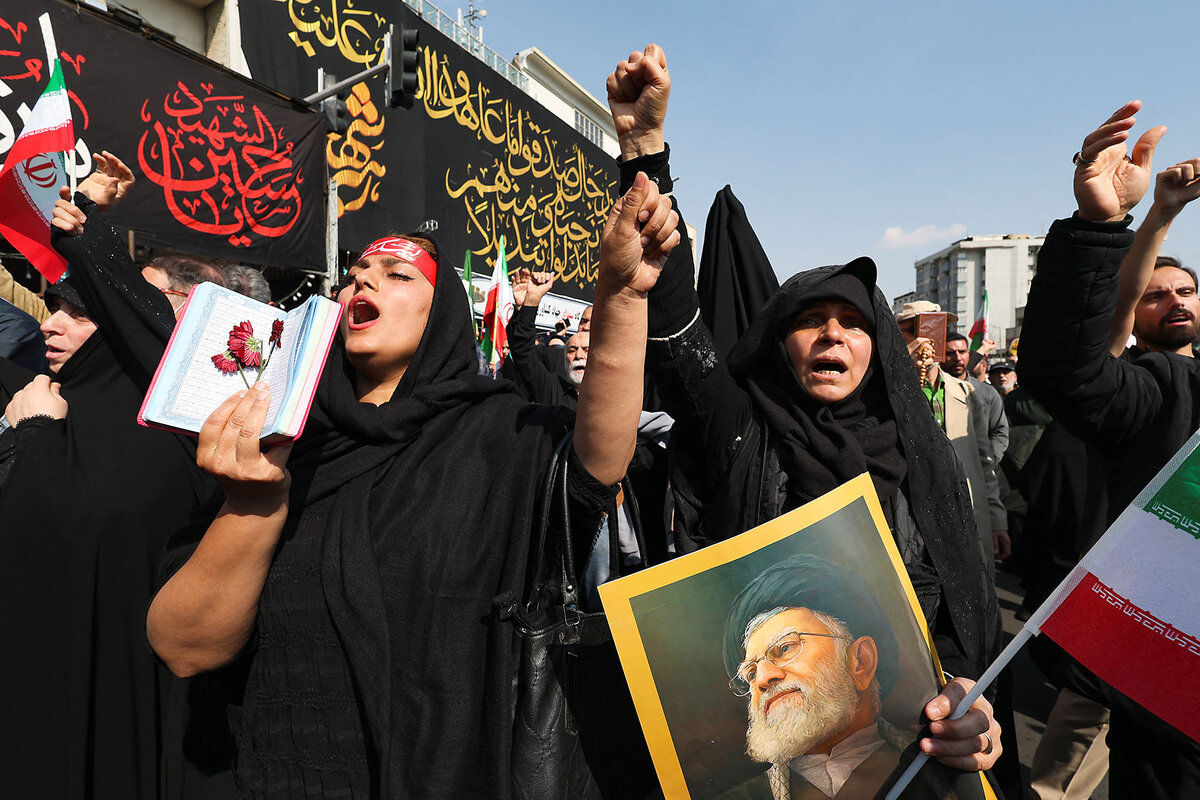
Contrary to Trump’s claims, the Iranian big capitalist-landlord class itself has so far weathered various US-Israeli blows, re-consolidated around Ayatollah Ali Khamenei’s son, the new Ayatollah Mojtaba Khamenei, and launched tit-for-tat daily retaliations for US-Israeli bombings. Materially the US war, as all imperialist wars are, has been brutal and barbaric. The US has bombed schools and universities, hospitals, world-renowned historical and cultural sites, and other civilian infrastructures. The bombing campaign has killed thousands, according to the Iranian Ministry of Health. Meanwhile, pro-government rallies continue to draw tens of thousands throughout the country, demonstrating how the American war actually has rallied segments of the masses around the current theocratic Iranian government during its war of resistance, not further alienated them in order to pave the way for some kind of pro-US/Israeli puppet. Like Chairman Mao said, “When imperialism launches a war of aggression against such a country, all its various classes, except for some traitors, can temporarily unite in a national war against imperialism. At such a time, the contradiction between imperialism and the country concerned becomes the principal contradiction, while all the contradictions among the various classes within the country (including what was the principal contradiction, between the feudal system and the great masses of the people) are temporarily relegated to a secondary and subordinate position.” Objectively, Iran continues to wage a national war of resistance and creates troubles for the US imperialists.
Economically, the average price of a gallon of gas in the United States reached $4.00 on March 31, a level it has not reached since the Russian invasion of Ukraine in 2022. In India, Europe and elsewhere, the war has sparked an oil and natural gas crises. Many corporate firms and forecasters are cutting their their US and global GPD growth predictions for 2026 as negative data flows in, and recession concerns are once again on the imminent horizon. The immediate economic question on many workers’ mind is whether or not the war will cause a new wave of broad-based price inflation. The war has also caused a renewed push toward “de-dollarization” globally, with Iran demanding toll payments from certain countries’ oil tankers, so that they can pass through the strait of Hormuz, in Chinese Yuan. For example, according to the Atlantic Council: “monthly averages for daily transaction volume remained within a $85–105 billion (600–750 billion yuan) range over the past year”, however in March, “daily observations rose to over $130 billion.” All of this occurs amidst the already existing international crisis of overproduction which worsens each year alongside the decay and stagnation of the imperialist system at large.
Politically, the war has also been an unmitigated disaster for US imperialism. Internationally, the US War on Iran has caused major fractures and confusion among its allies. The European imperialists were not involved in the planning of the war, but are expected provide support or accept potential delays in promised arms sales, leading imperialist Powers such as Spain publicly refusing the US military from using its bases for the Iran war. The Gulf States, who are receiving a significant part of the retaliatory blows from the Iranian armed forces, are reported to be significantly frustrated by the Americans’ inability to meaningfully protect them and their apparent lack of an exit strategy from the war. It has been reported that the Gulf States, US vassal States and regional expansionists at the same time, have been some of the strongest proponents for a US-led ground invasion to ensure the opening of the Straight of Hormuz. Other US allies like fascist India have been left to deal with their own natural gas crisis due to the closing of the strait of Hormuz, forcing the United States to lift certain sanctions on Russian oil and gas to assuage countries like India.
Within the United States itself the war has remarkable unpopularity, with only around 28-29% of respondents being in support of the war according to both recent YouGov and University of Massachusetts (Amherst) polls. Just as it has provoked fractures among US imperialism’s international allies, the war has also caused severe discord within Trump’s political coalition, with the most public split occurring with influential reactionary media figure Tucker Carlson. Imperialist misadventures like this war will drive the masses towards rebellion, particularly a war such as this one where there has been no such “rally-around-the-flag” effect as happened during Iraq and Afghanistan. As the quagmire continues, the economy worsens, Israel escalates, and Trump commits more and more resources, the masses in the US will combine their anti-war sentiment with their already spontaneous anger towards ICE, poverty, repression, and the other daily injustices of working-class life under imperialism, into a likely new wave of mass rebellions this Spring and Summer.
Although there is yet to be a final settlement to this war, and much awaits to be seen in terms of how would the war be concluded, it is clear enough that, among the imperialist powers, China and Russia have gained the most so far. First of all, both countries benefit from a weakening of the US military’s arsenal and ability to effectively project power, which strengthens their own power and influence relative to the United States. Similarly, both imperialist powers also benefit from the generalized discontent and fracturing of the United States’ camp of allies, who will be more likely to “diversify” and consider other options in terms of economic, political, and military patronage in the future. Finally, both countries benefit from a distracted United States’, who is bogged down in a barbaric conflict of its own making, and is unable to respond as effectively in theaters such as Eastern Europe, Southeast Asia, and Africa.
In light of all of this, revolutionaries-in-formation in the current moment have a duty to infuse their work with an additionally anti-imperialist and proletarian internationalist fervor. Even as they march towards important days such as International Workers’ Day, they should continue to organize and mobilize around the war of aggression in Iran and in support of the Iranian resistance, launching separate events or creatively combining the demands and slogans with already existing plans and campaigns. This work should then be assessed and summed up, and a new cycle of anti-imperialist work continued in part on the basis of previous lessons and fruits.