[Editorial note: As International Workers Day 2026 draws closer, The Partisan is republishing an article from the May 1930 issue of The Communist, theoretical organ of the Communist Party USA, which analyzed the situation faced by the working class and people in the US during the height of the Great Depression under the correct guidance of Marxism-Leninism and the International Communist Movement. In the following years, the Party will go on to organize hundreds of thousands of workers, peasants, unemployed, and oppressed people and create a genuine, class-conscious and militant mass movement, before being usurped by Browderite revisionism. Today, much like 98 years ago, US imperialism finds itself in a period of troubles, as many themes analyzed in the article – from the tendency towards fascism to the task of the working class – remain vital and important for the mass movements to grasp. At the same time, facing the complex conditions of US imperialism in its last and general crisis, it is crucial for revolutionaries-in-formation today to rediscover and learn about the rich history and practice of our class and its movement. In other words, we must place ourselves within a long and glorious tradition, and we must confront and solve the new problems of our class on this foundation alongside the living spirit of working class ideology.]
Originating in the United States during the workers’ struggle for the 8-hour day, May First has become an international day of strikes and demonstrations against militarism and war, for the shorter work day, for the workers’ demands generally, and for revolutionary working class unity in the struggle against capitalism.
The workers of the United States, the originators of May Day as a day of struggle, the exponents of the mass political strike as a weapon, have many heroic struggles to their credit. In recent years, however, they have lagged somewhat behind the world labor movement, due to the dominating influence of the highly paid labor aristocracy in the organized labor movement and to the poisonous class collaboration policies of the American Federation of Labor and Socialist Party leaders. The first Monday in September was accepted as a symbol of class peace from the bosses’ government and used to nullify both May 1 and the class struggle. Only on too rare occasions, following their brilliant beginning in the 8-hour fight, have the American workers thrown off the deadening weight of the official leadership and demonstrated their class power on May First. On those rare occasions they have put up splendid battles, as for example the demonstration of the Cleveland workers led by Comrade Ruthenberg in 1919.
A far-reaching and deep-going change, however, has taken place among the workers in the United States which gives the May First demonstrations this year tremendous significance. We are entering into a period of struggle now which will equal and probably greatly surpass any traditional struggles of the American workers.
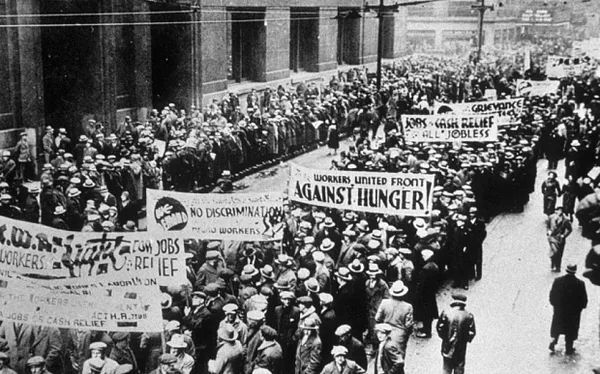
The much heralded “permanent prosperity” of American capitalism has collapsed. The country is in the throes of an economic crisis. Over seven million are jobless. Actual starvation is everywhere rampant. Rationalization in the shops and factories is being intensified at a brutal tempo. Wages are being cut. Hours are being lengthened. The bosses are attempting to force the workers to bear the burden of the crisis.
The workers have already replied to this offensive of the bosses with numerous strikes and demonstrations, only to be met by a strike-breaking, fascist united front of the bosses, the government, the A. F. of L. and Socialist Party bureaucracy, the American Legion, etc. The workers’ struggles have been brutally and bloodily crushed. Several workers have already been killed; hundreds have been viciously clubbed and beaten. But still the workers’ counter-offensive continues to gain strength and momentum.
The struggles take on a political character. Starting with demands for “Work or Wages,” for social insurance, or for the 7-hour day, 5-day week, the workers find themselves in struggle against the bosses’ state. They find the A. F. of L. and the Socialist Party fighting on the side of the bosses in alliance with the police. The workers more and more are becoming disillusioned; more clearly they understand the role of the State. They are breaking away from and fighting against the so-called “labor” organizations which serve only the bosses. They are accepting the leadership of and joining the Communist Party and the revolutionary Trade Union Unity League.
The demonstrations on March 6, in which a million and a quarter workers rallied in the streets and fought under our slogans and leadership is the most outstanding example of the new spirit rising among the American workers. These demonstrations, which were really national in scope, will themselves prove to be further factors in deepening the workers’ revolutionary determination and will to struggle. The fighting spirit of “86” is returning; the traditions of the 8-hour fight will be fully reclaimed by the American workers on May First, 1930. And in the present struggles, new fighting traditions will be established.
This sharp turn—this revolutionary upsurge on the part of the American workers comes primarily as a result of the development and constant deepening of the economic crisis in the United States and from the efforts of the bosses to place the burdens of the crisis on the backs of the workers.
The continuous increase in the productive capacity of American industries since the war and the actual surplus production already reached as early as May last year, on the one hand, and the continuous shrinking of the internal market, due to the agricultural crisis, to the large increase in the permanent army of the unemployed resulting from rationalization, to the constantly decreased buying power of the mass of unskilled and semi-skilled, etc. on the other hand, in a period when the possibility of securing foreign and colonial markets for American goods is sharply limited by all the contradictions and antagonisms within and between the various capitalist countries, is the primary cause for the development of the economic crisis. The various “solutions” for the crisis put forward by the Hoover administration have so far failed to “solve” the crisis. The propaganda statements about “returning prosperity” are regularly exposed as lies to deceive the masses and to increase the opportunities for the big capitalists to fleece the smaller ones.
The “Annalist” index of business activity shows a continuous, though irregular decline for the first three months of this year, contrary to Hoover’s promised business revival.
Because of America’s dominant position in the capitalist world (as banker and industrialist, as well as principal consumer of the products of many colonial countries), the economic crisis in the United States sharpens immeasurably all the contradictions of world capitalism in the present period, while at the same time the economic crisis itself spreads throughout the capitalist world effecting each country in varying forms and at varying tempo. In a number of countries (Germany, Japan, China and the colonies) an economic crisis is already maturing. In other countries (England and France) chronic depression is being accentuated or the first symptoms of the crisis are beginning to appear.
The spreading of the economic crisis thruout the capitalist world augments the permanent army of unemployed in all countries by millions which, together with rationalization and wage cuts still further impoverishes the toiling masses and also large sections of the agrarian population and even sections of the petty-bourgeoisie, thereby still further narrowing the market possibilities and sharpening the struggle between the imperialists for control and domination of the existing world markets.
American capitalism is therefore in the position today where it can and does produce more goods than can be consumed in its own internal market. The surplus production can not be marketed in the colonies or in other countries because the markets which it already controls are also too limited and the others are already “firmly” controlled by America’s imperialist rivals. The development of the crisis still further narrows what markets are available.
This, simply put, is the chief problem confronting the financiers and industrialists of the United States. The “solution” of this problem for American imperialism, which by the way, would only intensify the problem for the other capitalist countries and sharpen the imperialist antagonisms, can only be achieved by a combination of three principle methods (supplemented by tariffs, etc.) all of which are now being vigorously carried out with the aid of the Hoover regime.
The first method is an offensive directly against the workers with the objective of lowering greatly production costs, thus increasing America’s competitive power in the market at the expense of the workers and of destroying the workers resistance to the imperialist offensive as a whole. The throwing of thousands of workers out of the factories, mills and mines to join the permanent army of unemployed which is used as a club to force the workers still employed to accept the speed-up, wage cuts and longer hours; the introduction of new and faster machinery, the brutal intensification of the speed-up, wage cuts and longer hours; the utilization of reformist labor organizations (A. F. of L., S. P., Musteites, etc.) as tools to force or befuddle the workers into accepting this worsening of their conditions; the attacks against and efforts to crush the revolutionary organizations of the workers; and the use of fascist police terror to crush strikes and demonstrations, to destroy all workers’ resistance, all these are the principle forms of the bosses’ offensive now being vigorously carried thru. Gastonia, the Southern Illinois coalfields, the March 6 events are outstanding examples of the new and sharper methods of the bosses in this period.
The second method is an offensive against the colonial peoples with the objective of securing political domination in the colonial and semi-colonial countries, guaranteed sources of cheaper raw materials, fields for the investment of surplus capital with super-profits, and markets for American goods to the exclusion of the goods of other countries. The crushing of the recent revolts in Haiti and the open naming of a new president by Hoover satisfactory to Wall Street; the Wall Street manufactured revolt in Santo Domingo; the political domination of the present governments of Cuba, Nicaragua, Mexico and other South American countries; the ruthless cutting of wages on American owned plantations in these countries; the control exercised by American banks over their economic life; etc., etc., are all examples of increased aggressiveness on the part of American imperialism in the colonial world in an effort to solve the economic crisis and secure permanently America’s position in these countries.
The third method is that of imperialist war. America’s rise to power took place after other imperialist powers, notably England, had already secured economic and political domination over large sections of the world, over trade routes, sources of raw material, etc. Expanding American imperialism to continue to expand must wrest this control from these powers—must secure a re-division of the world. As Wall Street puts more and more money in European and colonial investments and to an increasing extent thereby attempts to dominate the financial policies of these countries, as American industrialists open up branch plants and unload more and more products into these countries, and as the deepening economic crisis in the United States makes a still more aggressive policy of foreign expansion necessary (as Owen D. Young put it, “the economic integration of the world”), the imperialist antagonisms leading to great increases in armaments and war are sharply increased. The London Naval Conference shows clearly the depth of these antagonisms and the closeness of war. After over three months of negotiation the only agreement reached is that armaments must be still further increased. America will now spend over a billion dollars for new cruisers and auxiliary craft. With the spreading and deepening of the world economic crisis these imperialist antagonisms will be still further sharpened. Another imperialist war is clearly on the order of the day.
In the forefront is the danger of imperialist war against the Soviet Union. The great need of the imperialists for markets, on one hand, and the great progress being made in the carrying thru of the 5-year plan, in the industrialization of the country and in the collectivization of agriculture, inspiring the toiling masses of both the imperialist and colonial countries to sharper and more determined struggles, makes the Soviet Union a special point of capitalist hatred.
So, arising from the general contradictions of capitalism, now accentuated by economic crisis and the need of America for greater expansion in a capitalist world already “closed” to expansion, the American bourgeoisie and their government, fully supported on all fronts by the A. F. of L. and the Socialist Party leadership, are waging an offensive against the workers, against the colonial peoples and against their imperialist rivals which must lead to still sharper class struggles in the United States and to an imperialist war in which the workers will also be the victors. In all events, the American, as well as the world bourgeoisie, in the last resort are expecting the toiling masses both of the imperialist countries and the colonies to be the sufferers in any and all “solutions” which they bring forth to overcome the shaky, tottering capitalist “stabilization.”
The “permanent prosperity,” the “golden era,” etc. of American imperialism, theories so militantly defended by the renegades Lovestone and Pepper, has passed. We are at the beginning of an era of sharp class battles. The strikes in mining, textile, shoe, auto and many other industries; the big demonstrations which have been held during the past few months, and especially the March 6 demonstrations are signs of the changing times—of determination of the American workers to resist the bosses attack. The significant feature is that to an increasing extent these fights are taking place among the unorganized, the unskilled and semi-skilled, independent of and against the A. F. of L. and to an increasing extent also against the government.
All this gives opportunities to our Party which we must energetically grasp. The struggle against unemployment, demands for “work or wages,” for social insurance, for the 7-hour day, 5-day week; against rationalization, against the vicious speed-up, for regular rest periods, against wage cuts and for higher wages; against the lengthening of hours and for the 7-hour day, must be kept in the foreground—made the starting point and at the present time receive the greatest emphasis in our campaigns. Closely linked with these demands, and brought forward in every struggle, must be the broader political slogans: Complete equality for the Negroes, against lynching and Jim Crowism; against the fascist terror of the government, the workers’ right to the streets, the right of workers’ self-defense, the release of class war prisoners; support for the struggle of the colonial masses, colonial independence; against imperialist war, the defeat and overthrow of “our own” bourgeoisie; the turning of imperialist war into civil war; the defense of the Soviet Union; for the overthrow of capitalism, for the proletarian revolution, for the proletarian dictatorship.
Our Party, because of its militant fighting leadership in the growing struggles of the workers, has won great mass influence. It is on the road to becoming a mass Party. But the increase in our influence is much greater than our direct organizational strength, and the strenght which we are able to mobilize organizationally thru other workers’ organizations (Trade Union Unity League, Workers International Relief, International Labor Defense, etc.). Because of the rapid tempo with which mass struggles are developing and the character of the period which insures the maturing of this struggle over a considerable period of time, the task of overcoming this disparity between our growing political influence and our lagging organizational abilities becomes a major political problem.
In carrying thru the preparations for May First (and after) the greatest attention must be given to strengthening the Party organizationally, and to setting up wide united fronts from below thru special committees, in the factories and thru existing workers’ organizations. The factory work of the Party, the building of shop nuclei, putting out of shop papers, the holding of shop conferences must occupy first place and linked up directly with this must go the building of the T.U.U.L. and the revolutionary unions.
There are already many indications of extreme fascist terror on May First. In New York, prohibition of the demonstration has been announced. In Chicago, a new set of arrests have been started. But the masses are ready to respond to our slogans and fight for their demands in the streets on May First. The new fighting spirit of the masses, already taking the form of a counter-offensive, is clearly shown. By exerting our maximum efforts in the organizational phase of the preparatory work monster demonstrations will be held May 1 which will equal all the traditional struggles of the workers on May First and give the workers a great impetus on the road to the revolutionary struggle for power in the United States.