Tactical Concessions, Preparation For The Next Assault
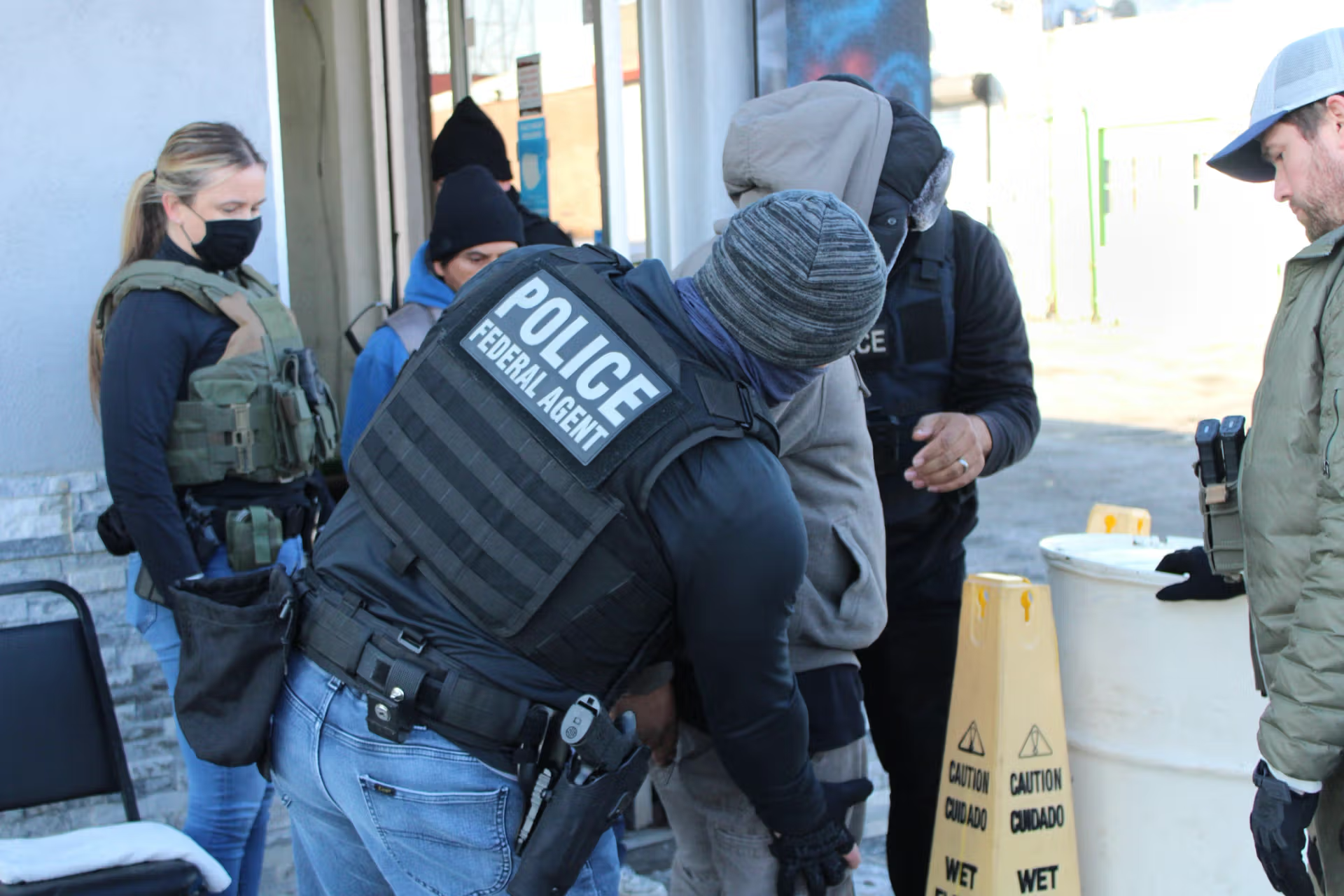
In the past seven months, U.S. Immigration and Customs Enforcement (ICE) and the Department of Homeland Security (DHS) have increasingly relied on short-term surges rather than routine operations to carry out the State’s reign of terror. These surges concentrate forces in one city or region for a limited period, increase raids and street detentions, and aim to raise arrest numbers quickly while spreading fear and compelling compliance.
In the months since these surges began, ICE has been forced into a posture of retreat in several key areas, most clearly after the Minnesota crisis, where the regime publicly drew down forces and slowed its tempo rather than sustaining the same level of visibility. That retreat, while partial and reversible, shows that mass backlash can make a surge politically costly enough to require adjustment and even tactical rout. For now, ICE’s retreat has largely taken the form of shifting from loud, concentrated surges to quieter, more dispersed operations, while continuing to build capacity.
What makes the surge model distinct is not only its scale, but its high pace and variable visibility. A surge compresses enforcement into a short window. It pushes agents to operate aggressively in public space, often with heavy presence near workplaces, apartment complexes, transit corridors, and community hubs. It also tends to rely on support infrastructure the regime can set up quickly. Agents are temporarily housed in hotels. Temporary command structures are raised. Local police are coordinated with, whether through information and equipment sharing, direct collaboration, or the weaponization of state and local government offices.
The surge model has been utilized across the country and is not confined to any single region or any type of city. Charlotte, North Carolina, experienced one of the first concentrated crackdowns in which heavy federal presence intimidated immigrant communities and arrested over 425 people. Ohio saw a similar escalation resulting in over 2,950 arrests statewide. Chicago has faced repeated blitz style enforcement campaigns, resulting in over 1,600 arrests, conducted through concentrated sweeps and coordinated enforcement in working class areas. As for the nation’s capital, nearly 20,000 arrests have been made by ICE in D.C., Maryland and Virginia since the beginning of the second Trump regime. None of these are isolated events. Together they show a portable playbook.
There is a geographic logic to this portability. The regime uses surges in places where it believes it can generate arrests quickly while testing the community’s ability to respond. Smaller states and smaller cities are useful as the enforcement footprint can overwhelm local capacity and media attention can be more easily managed. Major cities are useful because the regime can attempt to discipline broader layers through spectacle while utilizing urban infrastructure to their advantage. The surge model allows the regime to shift pressure away from places where resistance is consolidating and toward places where it hopes fear will do the work for it.
Minnesota serves as a key example because ICE and DHS chose Minneapolis as a showcase for their surge model, justifying it with false claims about public safety concerns and a fraud narrative aimed at Minnesota’s Somali community, then expanding the operation into a siege of the Twin Cities by more than 4,000 reactionary thugs. The backlash to this attack and the murders of Renée Good and Alex Pretti was a sustained explosion of protest and strike action, reaching a height of 50,000 participants, in minus 20℉ temperatures. From this eruption, wider actions and walkouts ensued. Makeshift barricades were erected, checkpoints were set up, and open conflict with state and city officials intensified.
Tom Homan, a longtime ICE official who served in senior enforcement roles under both Obama and the first Trump regime, was brought in to manage the debacle and soon announced a drawdown of agents, declaring the surge was ending. While this only amounted to a partial retreat, with just under 1,000 agents still stationed in Minnesota after the operation’s peak, what followed was a shakeup at the top of DHS itself: Kristi Noem was removed as Secretary of Homeland Security on March 5. Her transition to Special Envoy for the Shield of the Americas underscores how the ruling class treated Minnesota as an operational failure to manage and reorganize.
Minnesota matters because the operation’s violence and aggressiveness became impossible to hide behind normal bureaucratic language and ideological window-dressing. The surge did not remain a quiet enforcement operation. It became a public occupation. Masked agents, rapid seizures, and repeated confrontations forced the question of ICE onto the street and into the political sphere. Municipal officials were compelled to respond publicly, if insincerely. State officials were compelled to address the presence of thousands of federal agents operating within their jurisdiction. The regime’s own public declarations became part of the crisis: statements, threats, and claims about the operation’s purpose sharpened opposition.
The State rarely retreats by admitting error; it retreats by altering tactics while insisting its objectives were legitimate. In Minnesota, ICE stepped back because the surge became politically unaffordable in its existing form, as mass resistance widened the contradiction and conflict erupted where agents were housed and where they were operating. That same pattern holds nationally: when visibility becomes costly, the regime shifts from loud, concentrated operations to quieter and more dispersed ones, without abandoning the underlying goal of terrorizing migrant communities and disciplining the working class. This is why the State’s retreat, while a victory, must be read as one in form, not a reversal in purpose. After the murders and the anti-ICE upsurge in January and February, ICE arrests nationwide dropped nearly twelve percent. However, that drop is not demonstrative of a strategic defeat of the apparatus, but evidence the regime recalibrated under tactical duress.
The Enemy Retreats, We Pursue
“If you know the enemy and know yourself, you need not fear the result of a hundred battles.”
Sun Tzu, The Art of War, III. Attack by Stratagem
How revolutionaries interpret a retreat by the State is of urgent importance. A primary element to grasp is that the surge model has limits because it depends on passivity. The surge is built on speed, terror, and the assumption that the majority will stay silent while a targeted layer is hunted. When that assumption breaks down, the costs rise exponentially. The upsurge in Minnesota against ICE demonstrates that it is possible to make those costs unsustainable, to force the enemy to adjust, and to widen the contradiction beyond the immediate targets of enforcement.
At the same time, it is essential to grasp that the enemy adjusts in more than one direction. When a high visibility surge becomes politically costly, the State does not abandon repression. It seeks new terrain and new forms that are surreptitious, dispersed, and easier to normalize. The DHS shutdown crisis made this visible. While TSA workers went unpaid and staffing shortages produced chaos at airports, the regime stationed ICE agents in airports. Officials attempted to characterize the deployment as a practical measure to keep TSA lines moving and bolster airport security. In reality, a repression organ was embedded into routine public infrastructure, presented as administrative support.
The end of the shutdown exposed the same regrouping in budgetary form. DHS reopened after 76 days, stabilizing key agencies like TSA and the Secret Service while postponing immigration enforcement funding into a separate political battle. This mirrors the surge method: the State recalibrates and redistributes pressure, but the objective remains fixed. Elements of the state repression apparatus do not disappear because a particular bill excludes them for the moment; the ruling class will simply search for alternative routes.
Finally, the retreat teaches a lesson of integration with the masses. What forced ICE back was not outrage, but the transformation of outrage into organized activity that could move faster and mobilize more effectively than the State. The surge model is built on isolation: isolate the migrants, isolate the neighborhoods, isolate the workplaces, then overwhelm each one with sudden force. In Minnesota and elsewhere, the masses answered by breaking that isolation through rapid response networks, neighborhood defense formations, and practical organs of combative conflict against class enemies.
For revolutionaries, the decisive question is whether these living networks deepen and spread, or whether they remain improvised and episodic, rising during crisis and dissolving when the immediate wave subsides. Integration with the masses does not mean simply being present nor espousing the most correct ideas. It is the painstaking work of rooting leadership in real needs, learning the people’s methods of survival and resistance, and then raising those methods into more conscious and coordinated struggle.
A surge exposes who has roots and who has spectacle. When repression hits, those without mass integration are reduced to slogans and panic. Those with mass integration can turn fury into disciplined activity, seek truth from facts, and can maintain initiative in the defense of the masses. That is why retreat is never automatically an opening. It becomes an opening only if the people’s organs of resistance are consolidated, expanded, and sharpened through struggle, so that the next surge meets not a spontaneous crowd but a prepared, militant, and unified response. It will be that side who directs the scattered anger of the masses, into organized initiative or destitution, that will decide whether retreats become openings or dead ends.