The memorandum of understanding (MoU) reached this week between the United States and the Islamic Republic of Iran to end fighting, at least temporarily, has formally sealed a strategic military and political loss for the US. Even the capitalist press, both Republican- and Democrat-supporting, have noted how the MoU achieves none of the original American war goals and makes several concessions to the Iranian State that Trump himself once described as “weak” and “treasonous”. This defeat of US imperialism has served as a great source of inspiration for all oppressed people of the world. Just like in Vietnam, Iraq and Afghanistan, it is another example of how US imperialism is a “paper tiger” that can be defeated by the people. Furthermore, the course of the war and the current terms on which it is being ended represent a stark reminder of the decline of the United States in its role as the world’s main imperialist power, and the rise of the so-called “multipolar” world order championed by Russia, social-imperialist China, and their respective allies.
Taking the text of the MoU at face value, Iran essentially gives up nothing concrete other than a 60-day end to further military strikes and toll-gathering in the Strait of Hormuz and elsewhere, in exchange for an end to the war in Lebanon, sanctions relief, and a military draw down of US forces from the Iranian border regions. Much weight is placed on a 60-day negotiating window, during which either theoretically more concessions are to be gained from either the American or Iranian side on a variety of issues, or the deal would be extended or collapse. However, even putting this negotiating window aside, it is abundantly clear that the United States and its rabid puppet Israel were unable to achieve their initial major war goals, in particular “regime change” within Iran.
This outcome is a stark example of the decay and decline of US power. Politically, on a domestic level, it demonstrates that the Old State is unable to justify and sustain a protracted foreign war of aggression. Unlike with Afghanistan and both Iraq wars, Trump and Israel’s war on Iran began unpopular and only grew more so as the closing of the Strait of Hormuz disrupted global trade and caused price inflation due to rising fuel and raw materials coasts. Simply put, the Trump administration did not have the so-called “political capital” necessary to conduct its war, even without a ground invasion of Iran itself.
Internationally, the war has also intensified and highlighted the contradictions between the United States and its erstwhile allied and puppet states. It has worsened already fraught relations between the United States and various European Union member states, such as Spain, the United Kingdom and Italy, who have been unwilling to fully go along with Trump’s deranged war plans. Most notably however it has complicated the relationship between the United States and Israel, the latter being so rabid its genocidal and belligerent behavior that it is unwilling to commit to a ceasefire in a war it is clearly losing and unable to sustain without US support. This behavior has of course jeopardized the entire process for the United States, with the Strait of Hormuz being closed once again as of writing due to continued Israeli strikes and attacks within Lebanon.
Militarily the war exemplifies a failure of American doctrine and capability. In the modern era, the US military has relied upon massive air superiority to conduct “shock and awe” campaigns aimed at decapitating its enemies political-military leadership and rapidly overwhelming the opposing sides forces, causing capitulation and total defeat. While the initial “shock and awe” campaign did manage to assassinate significant members of the Iranian military and political establishment, most notably Ayatollah Ali Khameini himself, it did not achieve the full collapse of Iranian command and control that was anticipated. Instead, the new military doctrine of “decentralized mosaic defense” pioneered by Iran allowed military commanders on the ground to immediately retaliate and cause immense damage to US bases and their Gulf State allies through the use of cheap and mass produced missiles and drones. The United States was simply unable to cope with the political resilience of the Iranian State and the mosaic defense doctrine, and found itself stuck in a military quagmire where Iran held most of the cards.
The political-military defeat suffered by US imperialism thus also has a dual character, as it emphasizes and demonstrates the growing strength of Chinese and Russian imperialism which develops parallel to its own decline. Politically, Iran has re-doubled its emphasis on its alliance with China and Russia, in particular with China, who is already Iran’s largest trade partner. For example, on June 17, the speaker of the Iranian Parliament Mohammad Ghalibaf stated: “China is a unique country for us. We must, through our actions and approach, create the belief on the Chinese side (and they will believe) that Iran is not just a customer, but a full-fledged, reliable, and long-term partner for China… We need blocs; I am making it clear that these blocs must be formed and have been formed to some extent… In any bloc that emerges, there are two definitive and irreplaceable countries in all areas: China and Iran”.
Economically and militarily the conflict has also demonstrated the growing strength of China in various ways. Economically the conflict weakened the so-called “petrodollar” system, with Iran accepting payment for its Hormuz tolls and petroleum in Chinese Yuan and electronic currency such as Bitcoin. China remains the biggest buyer of Iranian oil, and is increasingly deepening its ties with Iran in all fields. Trump’s vain dream at weakening China’s position in the Middle East was crushed, as China achieved its strategic objectives with minimum direct involvement in the war effort. Militarily, the war demonstrates the strength of China’s own military doctrine in the run-up to any potential conflict over Taiwan, which would rely upon the mass use of missiles and drones stationed on the Chinese mainland to destroy American and Taiwanese naval and land-based military targets. The weakness of the US military is also on full display as it quickly exhausted its long-range weapon stockpile while falling behind in production and supply. The United States does not look like it can sustain protracted, high intensity conflict with Iran – much less a near-peer-adversary such as China.
On the one hand, the situation hearkens back to the perspective on US imperialism imposed by Chairman Mao in 1970:
“US imperialism, which looks like a huge monster, is in essence a paper tiger, now in the throes of its deathbed struggle. In the world of today, who actually fears whom? It is not the Vietnamese people, the Laotian people, the Cambodian people, the Palestinian people, the Arab people or the people of other countries who fear US imperialism; it is US imperialism which fears the people of the world. It becomes panic-stricken at the mere rustle of leaves in the wind. Innumerable facts prove that a just cause enjoys abundant support while an unjust cause finds little support. A weak nation can defeat a strong, a small nation can defeat a big. The people of a small country can certainly defeat aggression by a big country, if only they dare to rise in struggle, dare to take up arms and grasp in their own hands the destiny of their country. This is a law of history.”
Iran, a smaller and relatively weaker nation has defeated the United States, a bigger and relatively stronger nation, at least in the sense of having an on paper stronger military arsenal. The just victory won by Iran completely demolished those who worship US military might and modern technology as invincible, who claim that revolution is no longer possible in the 21st century. This result reminds us that the United States is an imperialist power in decay, a paper tiger which can be defeated by people united around a just cause, whether that cause be national liberation or socialist revolution.
On the other hand, the conflict also reminds of us as our duty as revolutionaries-in-formation to accomplish a “ruthless criticism of all that exists”, as Marx put it, and maintain a sharp and precise scientific framework for understanding the world. While their fight against US imperialism is just, the Islamic Republic of Iran is still a reactionary State that oppresses the workers, peasants, and minority nations, and does not fundamentally challenge the capitalist-imperialist system.
We must understand the new “multipolar” world for what it is: a world in which US imperialism is waning, and Chinese social-imperialism attempts to rise and take its place as the world’s main imperialist power, just as the British and Spanish empires before them. Meanwhile, just like in Iraq and Afghanistan, while more and more parts of the world are giving resounding defeats to imperialism with their valiant armed struggle, we note that these efforts do not lead to lasting genuine independence and democracy, owing to the lack of the leadership of the working class and its correct ideological-political line. Simultaneously, we are witnessing the decline of imperialism across the board through its last and general crisis, which in turn, produces more suffering for the people and more revolutionary upsurges.
All these contradictions and changes produce great openings and challenges for the international working class. To piece apart the developing revolutionary situation presented by this new international situation, to take leadership of the coming great upheavals, avoid unnecessary sacrifices of the masses without adequate leadership, and chart a revolutionary anti-imperialist road that leads us to the new socialist society, is one of the greatest challenges we as members of the international revolutionary movement face.
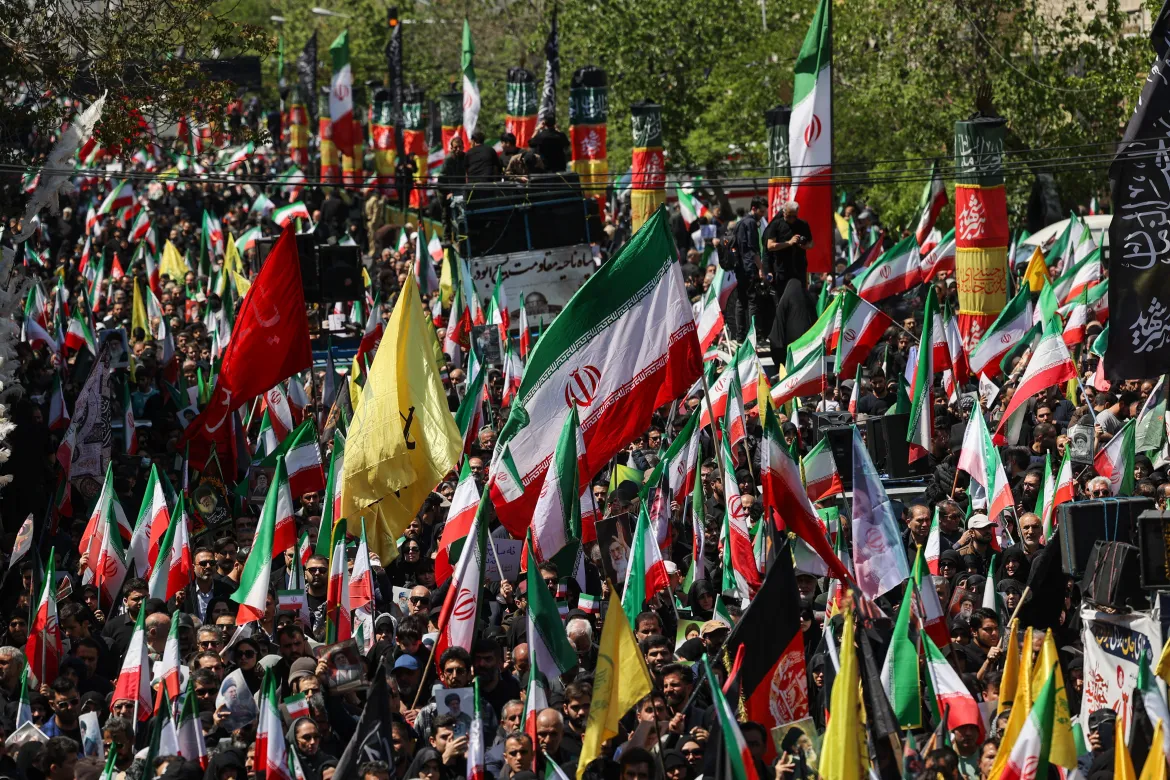
(Image: Iranian rally in commemoration of Ayatollah Khamenei, June 16. Credit: Al Jazeera)