[Editorial Note: The Partisan is republishing an article from The Gig Worker, a class-conscious workers’ publication.]
It has been over three months since the Strait of Hormuz closed due to the US imperialist war on Iran, which has resulted in gas hyperinflation upwards of 60% from a low of $2.78/gallon in January to the current average of $4.501. Although we haven’t been hit by this war as hard as the people of Iran or Asia in general, the livelihoods of US gig workers are negatively impacted by rising gas prices and the never-ending drive of US fuel monopolies to expand and consolidate their international markets. As a condition of our employment, app-based drivers must spend a substantial portion of our gross earnings on costs of production that are normally covered by the employer. While the cost of our services may increase as a result of gas inflation, the price given to our nominal wage, the proportion of gross earnings used to reproduce ourselves, remains stagnant or even decreases over time. Corporations like Uber and DoorDash may throw us temporary scraps of “gas relief2” to motivate us to keep working, but this does nothing to stop the devaluation of our wages, or the fact we have to choose between fueling ourselves, our family, or our vehicle in the first place
One of the worst aspects of app-based gig work is how we must acquire and pay for instruments of production while simultaneously having no control over how much we make. This is justified through our position as “independent contractors,” but the prices of insurance, fuel, car and phone payments, etc., all incessantly fluctuate quite independently of our gross earnings and nominal wage. Although a portion of gross earnings must cover our work expenses, employers like Uber and DoorDash do not make an accurate calculation of these costs for our pay. Instead, app-based service drivers are provided an absolute minimum of base pay/fare that an algorithm can increase based on metrics like “time, distance, and desirability”3. What this actually means in practice is that our company-pay is largely determined by the supply and demand for laborers rather than the actual expenses of our trips. Most of us spontaneously realize the discrepancy between costs of production, gross earnings, and nominal wages and attempt a sort of mental calculus every time we receive an order or ride to determine if its worth it (the “it” being our labor). This is the exact process that algorithms tail to determine base pay, whether or not we’re willing to accept a gig for the stated price, i.e., whether or not we’ll meet the demand for our labor. It is unlikely that we’ll accept longer-trips unless we get a substantially higher pay than shorter-trips, precisely because we understand the greater cost required, both from our labor-power (abilities) and our means of production. If a tip doesn’t cover this additional amount, base pay will increase so a worker meets the demand. Promotions behave in the same way, increasing pay in high-demand areas or times.
What is left after all of our expenditures, however, is only a small sum for our wage, the price of selling our labor-power piecemeal so corporations can profit. Any rise in costs of production without a corresponding rise in gross earnings will automatically result in a lesser proportion of wages for the same or greater work. Because gig corporations do not actually cover costs of production themselves, and do not make an accurate estimate of our expenditures, it is almost impossible for our nominal wage not to be diminished by rising costs of production. The result is an increased rate of exploitation as we are forced to accept less for the same or greater amount of labor. For us, gas inflation is a double whammy. It simultaneously decreases the proportion of gross earnings we get to spend on ourselves, our nominal wage, due to the inflation of work-expenses, while also decreasing our actual purchasing power in relation, our real wage, due to the inflation of living-expenses.
As a concrete example of the effect of gas prices on app-based driver earnings, a DoorDasher in one of our local committees, we’ll call them DD, recently made a trip of 60.5 miles for a gross earning of $54.02 or roughly $0.89/mile, including tips. After subtracting the more constant expenses of insurance (during hours worked) and self-employment tax (phone costs are negligible and DD doesn’t have a car payment), for 3.75 hours worked, they would be left with $51.82 to spend on working gas expenses and themselves. Recently in DD’s area, gas prices have ranged from $3.99 to $4.29 per gallon, compared to a 2025 average of $2.74. Even after applying the 10% DoorDash discount on gas, lowering the range to $3.59-$3.86 per gallon, gas prices would still be 31%-41% higher than last year’s average. With a gas mileage on their car of 23 miles/gallon, a more accurate nominal wage for DD, depending on where they bought gas, would be $41.67-$42.38 or $0.69-$0.70/mile, a 22-23% decrease from their gross earnings. That is yet to account for the income and sales tax that would need to be subtracted to calculate a real nominal wage. For comparison, DD made an average nominal wage of $0.72/mile last year after accounting for insurance (during hours worked), self-employment tax, and the $2.74/gallon gas price. If DD paid for their recent gas at the 2025 price, they would’ve made $0.74/mile. In other words, their recent wage has decreased upwards of $0.05/mile or 7% due to gas inflation, but if DoorDash paid their gas and insurance with no reduction in gross earnings, they would’ve made an additional $0.19/mile, the full $0.89. At the same time as DD and other Dashers like them are forced to work for less, DoorDash gets to charge even higher prices and has already netted a gross profit for Q1 2026 of $300 million greater than last year’s quarterly average4. Including the $50 million cost of their temporary gas relief program, they would still be making $250 million more in gross profits.
Instead of organizing the gig worker masses in militant struggle against exploitation and imperialist war, state unionists like the App Drivers Union (MA) and the California Gig Workers Union are more concerned with lobbying gig corporations and the imperialist state for recognition and partial-concessions56. While touting their recent certification and legislation wins, they do nothing to mobilize their rank-and-file for better working and living conditions in the face of rising gas prices and imperialist aggression. They prefer to engage in “good faith,” state-sanctioned negotiations with gig corporations behind closed doors. In order to maintain and expand their dues-extracting capabilities, and therefore the salaries of their bureaucrats, the establishment unions must toe the line and ensure the corporations responsible for this war and our increased exploitation are not retaliated against. The semi-independent unions tend to be no better. They too seek the cash rewards and dues-based salaries that class-collaborationism can provide, only they don’t want to share with the establishment bureaucracies. The state unions and centrists alike limit themselves to those issues they can readily collaborate with governments and corporations on: Waymo cars, pick-up zones, driver over-saturation, union legislation, and de-activation lawsuits. None of these demands actually impact the continuously increasing profits of the corporations exploiting us, much less resolve the fundamental issue of gig workers being forced to pay for costs of production ourselves. This just pushes us to keep working, to keep accepting less for more, all while the profits of gig corporations and the sanctity of US imperialism remain unchanged.
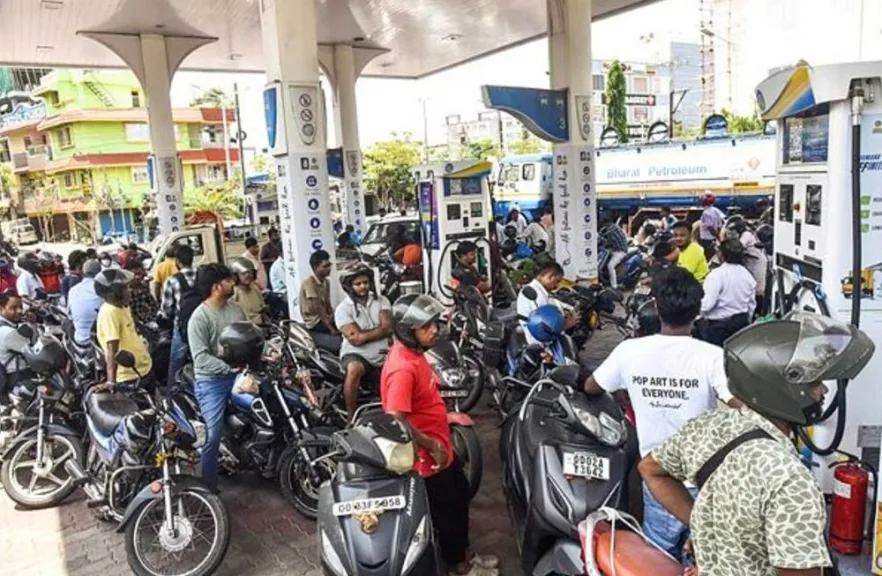
As a more positive example of the gig workers movement, the Gig and Platform Service Workers Union (GIPSWU) in India recently launched a 5-hour nationwide strike explicitly calling for higher pay to offset gas inflation7. Indian gig workers are not just being affected by rising gas costs, however. Unlike the US, India actually relies on the Strait of Hormuz to supply their oil, and its closing due to US-Israeli bombardments has caused severe shortages in cooking gas. As a result, many restaurants and street-vendors have been forced to close or reduce operations, leading to a 50-60% decline in order volume8. Therefore, Indian gig workers have also been rallying for greater social security in the form of living stipends and unemployment insurance. This shows that gig workers cannot limit our economic demands to what we get paid for doing gigs. We must fight for a living wage regardless of the hours we’re allowed to work.
Conclusion
If we are to raise ourselves out of poverty, we cannot simply tail the fluctuating prices of supply and demand, nor can we content ourselves with scraps of “relief” that don’t even catch up with inflation. Our gross earnings should not be dependent on an algorithmic pay that only increases when we accept less for more. Our nominal wage should not be determined by how much or how little we are forced to spend from our gross earnings just to keep working. It shouldn’t decrease due to factors entirely outside of our control, especially when said factor is a genocidal war of aggression. We must demand more: an earnings structure that not only reflects an accurate nominal wage, but actually increases that wage. If corporations covered our costs of production directly without any reduction in gross earnings, through gas and insurance stipends, free vehicle maintenance, etc., instead of being paid $15-$33/hr but only keeping $7.5-$15, or less, we could keep our entire gross earnings from a trip and potentially more than double our nominal wage. With a demand as simple as that, we should extend our fight even further to fulfill the NLOC’s demand for a $30/hr minimum wage after tax and work expenses9, regardless of what earnings-structure that may take.
To accomplish these demands, and more, gig workers require a militant trade-union that can professionalize and socialize our work. We must be wielded into one cohesive force across state-lines and craft-divisions so the ability to withhold our labor can be effectively leveraged against massive corporations like Uber and DoorDash. The collaborationist leadership of the gig workers movement arbitrarily limits itself to certain areas and sectors where the State is more likely to grant them partial-concessions, in exchange for enforcing the illegality of gig worker strikes and nation-wide unionization. Gig workers must break from this tendency so we can actually struggle with corporations head-on and establish a transparent earnings structure that permanently increases our living standards. Whether we seek to pool our resources together for better equipment pricing and professional spaces, or force the corporations to cover our more constant and day-to-day expenses without reducing our earnings, gig workers can and must unite under a trade-union program and structure to achieve our common demands. In addition to fighting for better economic conditions in the short-term, a genuine trade-union organization would allow us to oppose the effects of imperialist war and fascistization with material actions against the ruling class and its profit-making abilities. We must never forget the long-term horizon of the international working class: the abolition of all exploitation and oppression.
Down with the US Imperialist War on Iran!
Down with all imperialist aggression!
For victory against Uber, DoorDash, and all who exploit us!
Gig workers, unite!
- https://www.eia.gov/petroleum/gasdiesel/ ↩︎
- https://help.doordash.com/en-us/dashers/article/doordash-gas-price-relief-for-dashers ↩︎
- https://help.doordash.com/en-us/dashers/article/how-is-dasher-pay-calculated ↩︎
- https://ir.doordash.com/news/news-details/2026/DoorDash-Releases-First-Quarter-2026-Financial-Results/default.aspx ↩︎
- https://www.appdriversunion.org/latest-news/boston-globe-mass-rideshare-driversjust-became-the-first-in-the-nation-to-unionize ↩︎
- https://cagigunion.org/news/2026/05/12/major-update-california-gig-workers-union-takes-landmark-step/ ↩︎
- https://www.ndtv.com/india-news/gig-workers-union-calls-for-5-hour-nationwide-strike-amid-fuel-price-hike-11501571 ↩︎
- https://www.cnbctv18.com/india/indias-gig-workers-demand-govt-intervention-over-lpg-shortage-linked-to-west-asia-war-ws-l-19866767.htm ↩︎
- https://newlaborpress.org/wp-content/uploads/2025/08/nloc_draft_program_of_struggle_final.pdf ↩︎