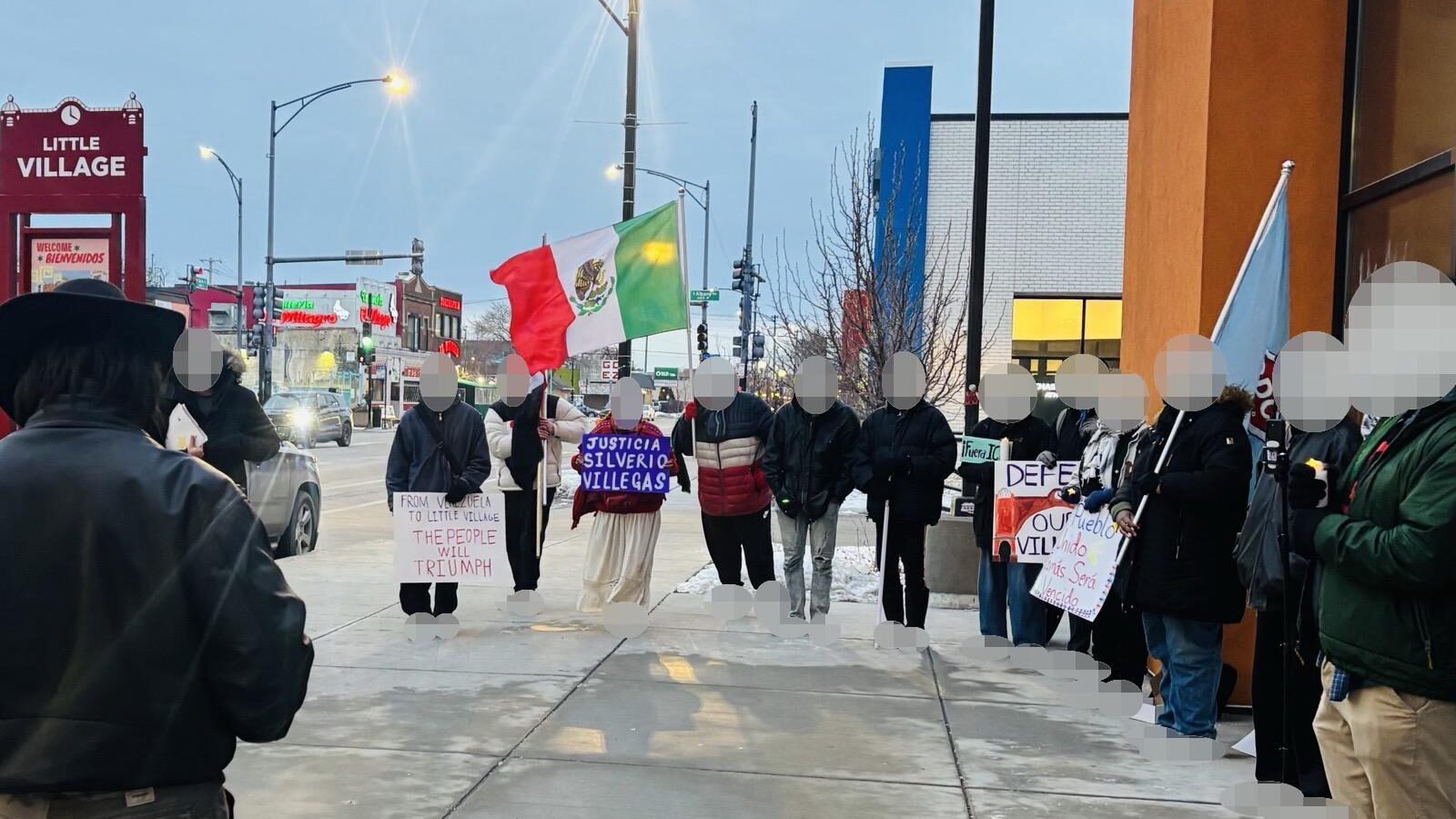
Editorial Note: The Partisan spoke with an activist of the Little Village Neighborhood Defense Unit, an effort by People’s Defense Committee and local community members in Chicago to struggle against ICE, police, and militarization. The Neighborhood Defense Unit (NDU) is built on the open platform of the People’s Defense Committee, and has been an active part of the struggle in Little Village for the last seven months. The activist discussed their local conditions, how they carry out this work, how this work relates to the struggle against militarization and fascistization, and how to build this work locally. They stressed the need to combat reformism and base ones work in the working and oppressed masses, and the need for sustained and solid organizing rather than spontaneous and eclectic organizing.
The Partisan: Who are you and what is your organization?
Little Village NDU: I’m an activist with the People’s Defense Committee in Chicago. I am very involved in the People’s Defense Committee and I love my comrades dearly. The NDU was created by the neighborhood and by PDC Chicago in Little Village in Chicago. We got started off of the basis of rapid response during the peak of Midway Blitz and quickly realized that more was needed than your standard like ICCR [Institute for Coordinated Community Response, an approach which collaborates with police and the Old State –Ed.], you know, record and standard distance response. We knew the rapid response networks that were popping up more spontaneously were good, but they were leaving people very burnt out and pursued this volunteerist approach with no structure to it. Alongside ICE and CBP being problems, the Chicago Police Department (CPD) was helping them despite the Illinois Trust Act, which said that they should not be. It was explicitly illegal for them. We looked at these things as People’s Defense Chicago, and we talked to our comrades across the country, and came to the conclusion that the next real step to this was launching a campaign of anti-militarization generally. I’ve lived in Little Village and generally on the west side of Chicago for the majority of the past five or six years now, and the militarization itself has engulfed everything. There is incredible fear of police because the police act like a gang, they roll up on whoever they want and they do whatever they want. The fear of surveillance is increasing with more and more cameras being installed and upgraded and more and more recording devices being placed on light poles and telephone poles and whatnot to make sure that they can catch every sound that happens, every car that backfires, every firework that goes off, right? And they use this to send CPD immediately in to do as they please with whatever information they may have concluded on based on these sound systems and surveillance devices.
When we saw ICE come in, it made these surveillance issues and these problems even worse. And so when people are already organizing around ICE, we were going out as People’s Defense Chicago and we were talking to people because we were doing the rapid response. This is something that if you’re an organizer, if you’re a serious organizer in Chicago, you started doing this rapid response, right? So we ended up talking to hundreds of people. You’d go to an anti-ICE response and you’d talk to at minimum three people and at maximum I talked to I think like 20 people at a scene one time after there was some tear gassing that went on. Everyone was huffing and puffing and coughing and wiping their eyes out and everything, but nonetheless people had time to talk about how this isn’t enough. Obviously, we really do need to be addressing these things and standing up against the general militarization of our neighborhoods. When I started asking, what do you think needs to happen for this, because obviously this isn’t working, they started saying, oh, we need to oust these city representatives. So we need to oust these CPD officers for capitulating and helping ICE.
That’s what we started out aiming to do. Since then we’ve gotten together a good group of people, very dedicated people here in Little Village. We have an ICE patrol program which is also an anti-militarization program. So we’re keeping track of surveillance so that rapid responders can take breaks when necessary, especially with the criminalization of things like rapid response now rapidly happening with the Prairieland case and the rapid response networks retreating and getting sucked into NGOs. People are wanting more safe places where they can get out of their cars or take off COVID masks and hats, and kind of step away from a protest or step away from doing a patrol to recuperate. We’ve begun doing counter-surveillance work and talking to our neighbors about this and then also cop watch. The police are pulling people over who are engaged in anti-ICE work. There’s been a string of rapid responder arrests. They’re detaining people and then when they don’t have their immigration papers on them, suddenly a CBP officer magically shows up. So we know blatantly from talking to people that this is the case but also there was supposedly a list of CPD officers who were dual carding as ICE agents that was released for about 24 hours and very quickly taken down.
The Partisan: So they’re covering up how the police are directly aiding ICE?
Little Village NDU: They’re covering it up, which is not good. But we understand that the cop watch is basically the same thing as ICE watch. If you see somebody experiencing brutality, if you see somebody being abducted, if you see somebody being harassed, you can do the same thing. If you can be a witness, you can make people in the area aware. You can draw attention to the fact that this is happening so that you can get together enough masses and enough of a crowd to stop what’s going on in some way.
The Partisan: Could you tell us a little bit more about how your neighborhood defense work got started, what inspired it, or what set the basis for your anti-militarization program?
Little Village NDU: Like I said it’s the direct ask of the people on the ground, but also something we figured out through investigation and analysis. There was a decent amount of investigation done outside of just rapid response. Most of it was done while doing rapid responding, but quite a bit of it was done by going out into the neighborhoods and discussing with people their experiences and what they think is going well and what they think isn’t going well. They brought up all these issues, the cops, the surveillance, ICE, all this stuff, and looking at what the NGOs were doing and what the kind of state-run ICE reporting systems are doing, they really are just kind of segregating ICE to this special corner as if it’s distinct from other forms of militarized repression. It’s very important to not do this because it’s part of a much larger trend. When we were looking at what to do, this trend wasn’t just happening here in Chicago, it was happening elsewhere. So we thought it would make the most sense to do a much wider campaign on this to start these kind of programs, these NDU programs wherever they could be started and whenever necessary.
So we moved to do that. We gathered contacts from the masses who already supported this. We already talked to you. We had a meeting, I think it was one of the very first, or maybe the second of these meetings to be held across the country. So we didn’t have a whole lot of information on how to run these meetings, but nonetheless, it was successful. We formed an NDU after discussion on exactly what needs to be done, what anti-militarization means, how in anti-militarization you really must combat revisionism and opportunism because you can’t use this for your personal gain. You can’t use this for a reformist gain or it just neuters the entire activity. It’s just going to make it into some ego trip for one person and make it ineffective. And you can’t work with the hydra that is actively trying to bite your arms and legs off, you can’t try to convince one head of the hydra that maybe can convince the other heads because at the end of the day, it’s still part of the same beast.
So reformists are always going to have some excuses to avoid actually building power for the masses, but everyone we talk to, they agree with what we’re doing. Whenever we go out and talk to people about what we’re doing, they’re in deep support, which is lovely, and the work has been going really well. We’ve doubled in size in just a couple months, despite struggling through the winter months here in Chicago. So I’m very happy with where it’s at right now, and I’m excited to see it continue to grow.
The Partisan: How does a normal day of NDU work in Chicago, and your neighborhood in specific, look like?
Little Village NDU: It’s a little bit better to take a step back and look at it from a weekly perspective to start off with. Every week, there’s a schedule that’s sent out and you fill out the free time that you can put into the NDU and the schedule, and from there, you’re going to be paired with a partner. When you’re assigned to a partner, you talk amongst yourselves and pick a place to meet. You go there. In our NDU, we try to make sure that everybody attends a medic training street medic training for Stop The Bleed. One or the other of you should have a tourniquet and basically a stop the bleed kit on you when you go out, if possible. Just in case you need it because you never know what’s going to happen. Then from there, you’re going to meet up and if you’re on foot, you’re going to take a walk, you’re going to pick an area that’s about half mile wide by about half mile tall and you’re going to walk all throughout it. In our neighborhood defense unit we have the neighborhood of Little Village, which is about six miles long by two miles tall. We split up into two halves, section A and section B. And from there, depending on where you live, you are designated to a section. Kind of split clean down the middle so three by two on one side and three by two on the other side. And when you’re patrolling in those areas you’re responsible for either A or B, not both. And this way people don’t get pulled from one side to the other, leaving the other side exposed. If you’re in section A, for example, and you’re going on foot, you’re going to go through whatever streets, go to the hotspots, and check in on them at the beginning and end of the shift. Normally the shifts are roughly an hour and a half to maybe three hours long. You are given material to pass out to people who are interested and people are implored to talk to their neighbors as much as possible because at the end of the day, you must talk to your neighbors about what’s going on, and try to get them as involved as possible, especially if we’re going to hit a goal like having somebody in the NDU every half mile of the neighborhood.
It’s going to need a lot of people, so we have to find people who are interested in the work that we’re doing. So while you’re walking around you talk to people, you you give them pamphlets, or you get their contact information if they’re interested. And you can track surveillance in the area, checking out how has the city put up new shot spotter, take note of that and similar things. This isn’t something that’s required necessarily, but it’s something that can give people a secondary activity, or really a tertiary activity which both avoids tedium while also building up our information on state surveillance.
It’s important to stay engaged with these things. Especially when we do have people on foot patrol, having that tertiary activity does keep people more involved, which is nice. And then if you come upon a scene happening, or you see an ICE vehicle or cop car that’s parked nearby you can you report it with how many agents or officers are in it, and you know where it was located, or if they were responding to something. Then if they are responding to something, you stop and keep an eye out. If it’s CPD, make sure they aren’t harassing somebody or hassling a homeless person or holding someone getting a speeding ticket at gunpoint for whatever reason. If it’s CBP or ICE, it’s much different, it’s much more engaged. At that point, people have designated roles in each team that are decided at the beginning of the shift. One person’s role is to record and get information from the victim. Another person’s role is to get as much information as possible to the surrounding areas could be yelling La Migra! this could be blowing whistles could be stopping passerbys on the street trying to get them to help by making a bunch of noise or, even, you’ve had people block vehicles in their vehicles and stuff like that. Then the third person’s job is to act as kind of a polling agent for the person recording. Because sometimes the people who are recording, they’ll get a little too close and whatnot. So it’s this person’s job to keep an eye out for what’s going on around and make sure that the person recording doesn’t get too close or doesn’t get in trouble anyway, and then also act as a medic in case anyone on the scene needs a medic. So if you come upon a scene and, someone’s been hit by an ice car or something, the medic’s job is to go over and obviously, be the medic, make sure they don’t bleed out.
I think that gives a good overview.
The Partisan: What are y’all’s plans for the future or going forwards?
Little Village NDU: Obviously the growth of membership is very important. You want to make sure that this is as well staffed as possible. But there’s also other goals, like we want to be able to hold more training events for the public. We want to be able to hold more educational events for the public about cop watch and neighborhood watch and what that means, and how this is separate from the kind of Fed behavior that you see a lot of neighborhood defense kind of evolve into at some point due to reformism, and how to stay away from that. And generally just kind of like other working class problems, because everyone involved in this is a working class individual, whether they’re proletarian or semi proletarian. Everyone in this is working.
Additionally, this is something that we keep rather secure. So we make sure this is something that’s vetted, if you may. We do vetting to make sure cops or federal agents don’t get in because we want to keep our neighborhoods safe and it’s about giving this working class neighborhood room to breathe when it’s being pounded in upon by the imperialist machine. So I would say holding more public events would be really nice. We’ve held a good few now, but becoming more involved with the community and generally with these public events would be cool. This could involve trainings, obviously, but also studies and then growing membership widely would be good. And these are pretty broad and universal goals, though.
The Partisan: Speaking broadly, how would you say that this neighborhood defense work relates to or works in response to fascistization?
Little Village NDU: I mean, when the fascists come knocking on your door, who can you rely on? During Midway Blitz specifically, and even just as recently as two weeks ago, I had CBP on my block. We had somewhere between four and six different people in a matter of two months at one point, who were longtime residents of my neighborhood, who were just disappeared out of their front yards. For multiple of them, we still don’t know where they are. We have hundreds of people who have died in ICE custody over the past five years, and the majority of them have been over the past year, and generally directly at the hands of ICE.
—don’t get me started on CPD. You know, CPD are the ones who blocks a man in traffic, and then screams at him that they’re going to kill him until he’s so scared that he tries to slam into traffic, and then they do just that, they empty an entire clip directly into his head through his driver’s side window. These are not, these are not normal. The taking over of neighborhoods with these militarized forces in order to further strip them of any sort of nationally oppressed people and any sort of culture outside of the “good” white American culture that is being imposed so heavily is part of fascistization.
It was the most pure form, the manufactured consent for quite literally work camps. Having one of said work camps with videos of people chained together being marched in circles within the facility, less than 10 miles from my home, makes one ask what else is there to do other than try to make sure that my neighbors—and to be honest myself—can defend ourselves and defend the people we care about. As militarization ramps up, it’s not because of some magical other cause. It’s because the imperialist nation of America is fascistizing, that is moving towards fascism bit by bit. Alongside that, they have to retain control through more and more military force. If something starts to slip, they have to make sure they have their hand on it, and then when that handle screws too tight, then they’ll have to back off and back and forth and back and forth. But the trend is towards increased militarization and increased repression and increased fascistization. It’s the classic playbook of how this kind of goes. They’re going to go for these minority and immigrant communities who are being defended with anti-ICE response and whatnot, and then they’re going to start going for other people. So, when it comes to anti-militarization this is addressing everybody in the long run and not just not just people affected by ICE right now.
The Partisan: Would you have any advice for people in other cities who are trying to build neighborhood defense work?
Little Village NDU: I feel like it’s really particular to each neighborhood. It sounds very broad and very much like you could really just kind of put the gas on anywhere and the truck will drive, which is true to some extent, but there’s still particularities. The platform is made to be as universal as possible, but there’s still going to be places where it’s more applicable and places where it’s less so. The real ticket is finding those places where it’s more applicable, where you want a healthy balance of people. You don’t want to go to a very well off area, with mainly petty bourgeois or even labor aristocratic people, generally.
If I were starting out, I’d be going to working class neighborhoods. I’m going to be talking to people who are going to be either already involved in spontaneous action against ICE or cops or other militarization. It’s either been started by the masses spontaneously, or if that’s not the case, you’d want to talk to people who are going to be affected by things like ICE, or people who are being affected by the rise in surveillance via cameras and drones, or the rise and military or police involvement and day to day activities. If there’s a data center, for example, surveillance is going to triple or quadruple in the area, and there’s going to be more and more security around that data center. This is something that’s applicable for an anti militarization group to be formed, for an NDU to be formed. Or, you don’t want flock in your neighborhood. You don’t want the city putting up more shot spotters, more sound detection devices, more speeding cameras, and so on. Finding those really effective neighborhoods, which you should not do by checking crime rates or bourgeois statistics, even if those have their use, is the first step.
Once you find that effective neighborhood, you should go to areas that you have contacts who say it’s an effective neighborhood, and talk to people, take some pamphlets with you, ask people questions, give them a pamphlet. Give them something that you know that they will like or support that is applicable to the work that you’re doing. Things like this that are good for just starting conversation. Ask them what they agree with or disagree with, tell them your goals and what issues you’re spreading the word about, ask them what they know about it, talk about their own background and class background, and just generally have a good conversation with them. That was not nearly as difficult as people make it out to be. I think that a lot of people get caught up in the social anxiety and it really just stops the work from happening, but pretty much as soon as you start doing social investigation, you’re going to make contacts who are interested in doing the work. It might take a week, but it’s a week, you know? People across the US, generally, are pretty against ICE, and if they aren’t against ICE, then you’re most likely not in the right neighborhood to be agitating for anti-militarization. You know, if you’re walking up to people and they’re saying, “oh no, I’m actually pro-ICE,” you should try organizing somewhere else, my friend.
The Partisan: Would you say that the best way to get started could be summed up as basing oneself in the masses or going to the lowest and deepest sections of the masses?
Little Village NDU: Something like that. Going to the lowest and deepest, just making sure that it maintains a proletarian line, and a broad proletarian character, first and foremost. The lowest and deepest masses. I think that also something to keep in mind is that when you’re starting this kind of thing, be willing to start small. I think there’s a lot of fear of starting small, because if you start small, it means you have to do a lot of work later, but we started pretty small. But we do a lot with a few, especially for such a focused group. So even if you have three or four other people than yourself, pull the trigger and get started. The worst that happens is that you stay small for a little while and then you all go out together and you talk to more people and you get them interested.
The Partisan: Would you say that people should just get started rather than waiting around for the most opportune situation?
Little Village NDU: Because it’s never going to come. The most opportune situation is that there is perfect timing of a huge wave of ICE coming into town and no other organizations knowing about this or acting on it, and then you are the very first ones to act on it and call a mass meeting around it. Suddenly you have 50 people, right, and also all these people could somehow go through a vetting process in less than a week’s time, and none of them are feds, cops, or active military or in city politics. It’s just not going to happen. The likelihood of that happening properly is incredibly small. So yeah, I think that you should go for it now rather than waiting. I think that it’s good to start groups as long as the character of said groups lines up with the character of the area you’re in, and has a proletarian and mass character. If you’re in a primarily Black neighborhood and everyone who’s coming to the first meeting is white, you probably need to figure out what you’re doing wrong. You want the people to be truly representative of the people in the area who are being affected and not kind of the savior activist types. To answer your question, any group I would say that’s bigger than five people from the masses and then whatever members of the organization, I think that that’s a good starting point.
The Partisan: Are there any words that you would want to say to people wanting to start this work generally?
Little Village NDU: Remember that this isn’t a short-term thing. Building an anti-militarization platform and then running a neighborhood defense program should be seen as running a neighborhood defense program until it can really stand on its own two feet and then maybe it can do so. It’s up in the air if that’s going to be necessary or something that is really wanted by these programs for a while. So when starting this kind of thing, this is going to become a major part of your life. You’re going to be known for this in your neighborhood when you start doing it and it’s important to keep that in mind. This is not a short-term campaign. If we’re getting started, prepare to be in it for the long haul.
The Partisan: That’s everything we wanted to ask, so thank you again for taking the time to talk with us!