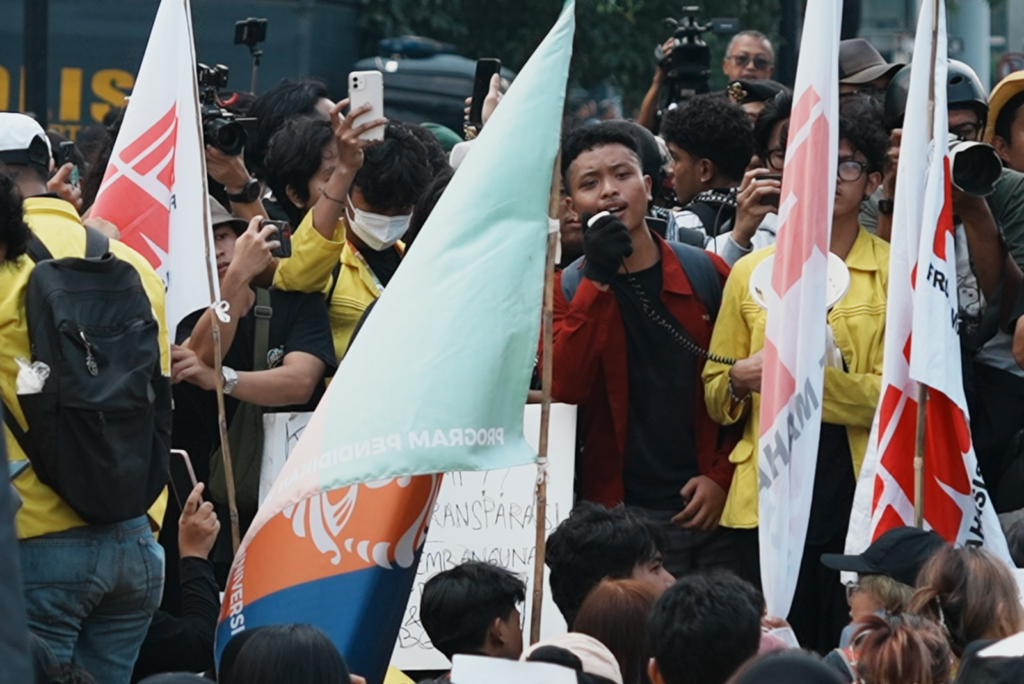
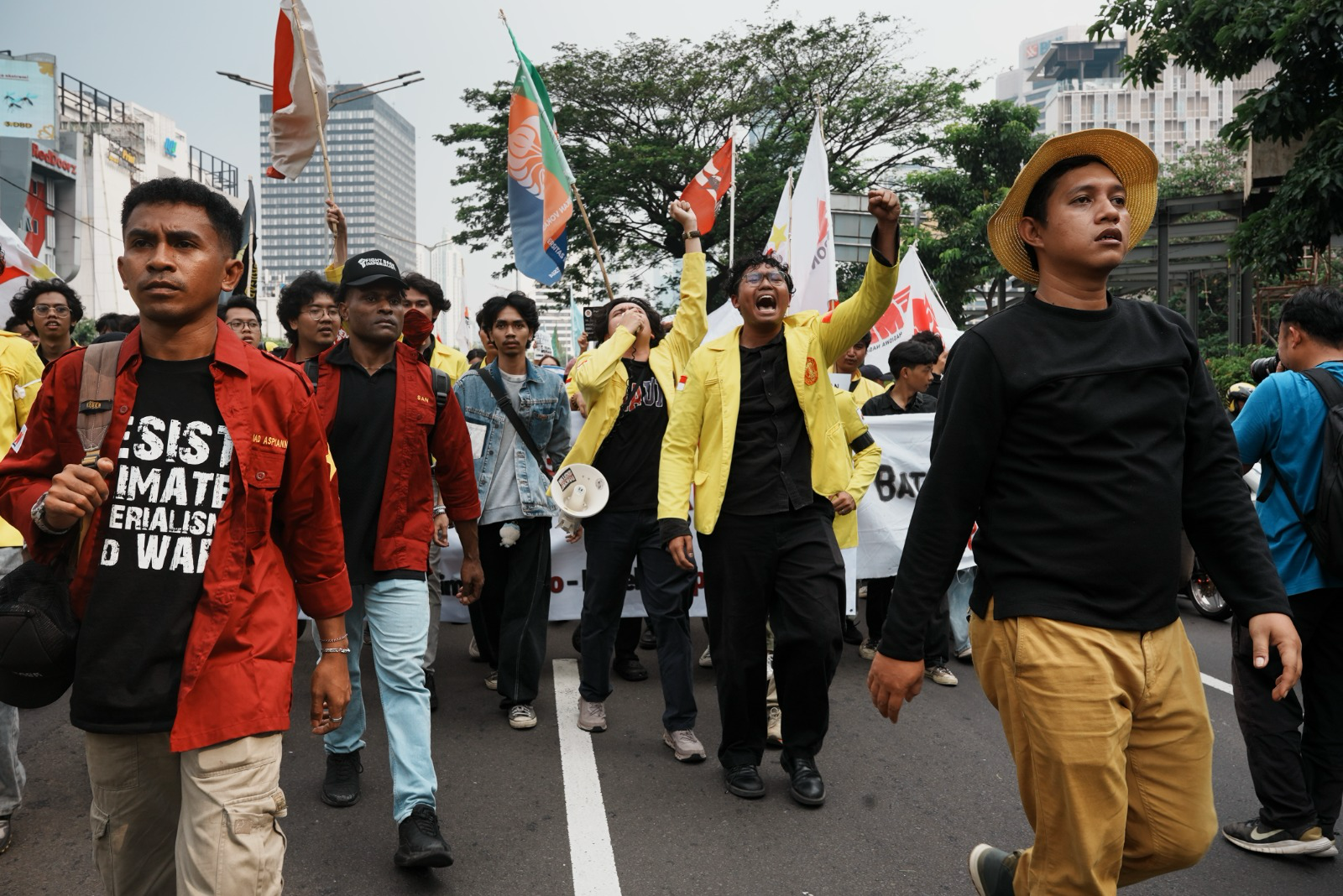
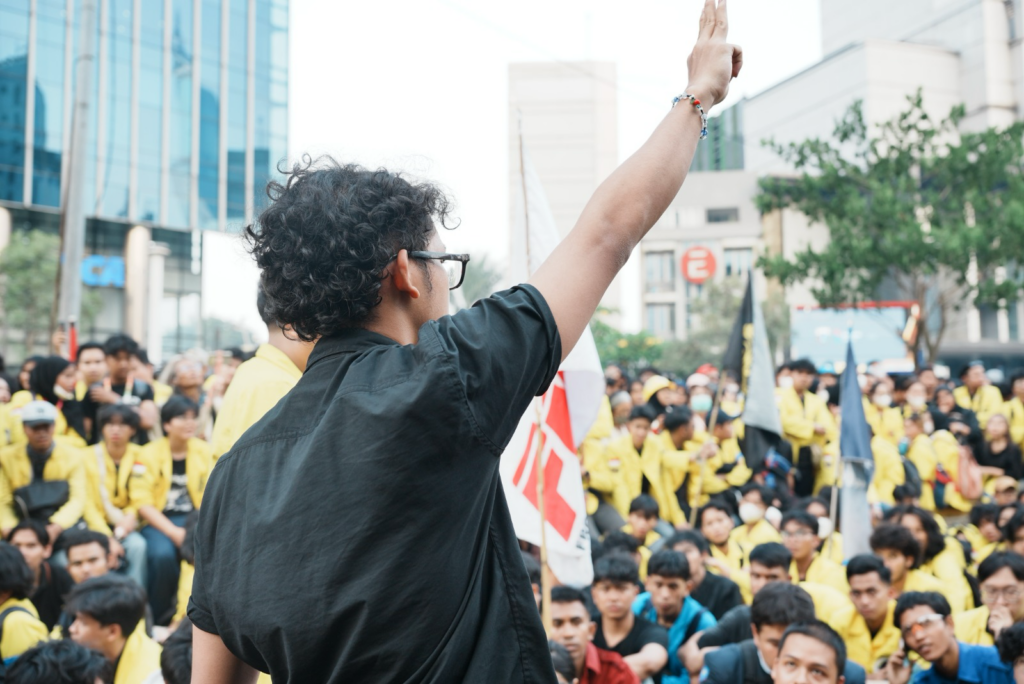
On June 12, thousands of students and activists gathered at Jakarta’s Hotel Indonesia Roundabout on Friday as part of a nationwide mobilization criticizing the policies of President Prabowo Subianto’s administration and expressing opposition to recent international conflicts involving Iran, Gaza, and Lebanon.
The demonstration was organized by the National Student Front (FMN) and supported by a coalition of student, labor, women’s, and people’s organizations, including the People’s Struggle Front (FPR) and the Indonesian chapter of the International League of Peoples’ Struggle (ILPS). Participants came from several universities in the capital region, including the University of Indonesia, Bogor Agricultural Institute, Jakarta State Polytechnic, UIN Syarif Hidayatullah, and Pancasila University.
In a statement released ahead of the action, FPR and ILPS Indonesia linked Indonesia’s domestic economic challenges to the domination of US imperialism and the semi-feudal, semi-colonial reality of the country. Similarly, the organizations sharply criticized US and Israeli military actions in the Middle East and accused the Indonesian government of failing to take a sufficiently strong position against them.
The organizations argued that Indonesia’s economy remains vulnerable to international pressures, particularly fluctuations in global energy markets and the value of the US dollar. They contended that recent increases in fuel prices and rising living costs have placed additional burdens on ordinary Indonesians, especially workers, small producers, and those employed in the informal sector.
A central focus of the protest was the reported increase in the price of Pertamax gasoline. Revolutionary activists claimed that higher fuel costs would further strain household finances and small businesses already coping with economic uncertainty. Demonstrators also criticized a number of government initiatives, including the Free Nutritious Food Program (MBG), the Red and White Cooperative Program, and plans related to territorial development battalions, arguing that public funds should instead be directed toward subsidies and measures aimed at reducing living costs.
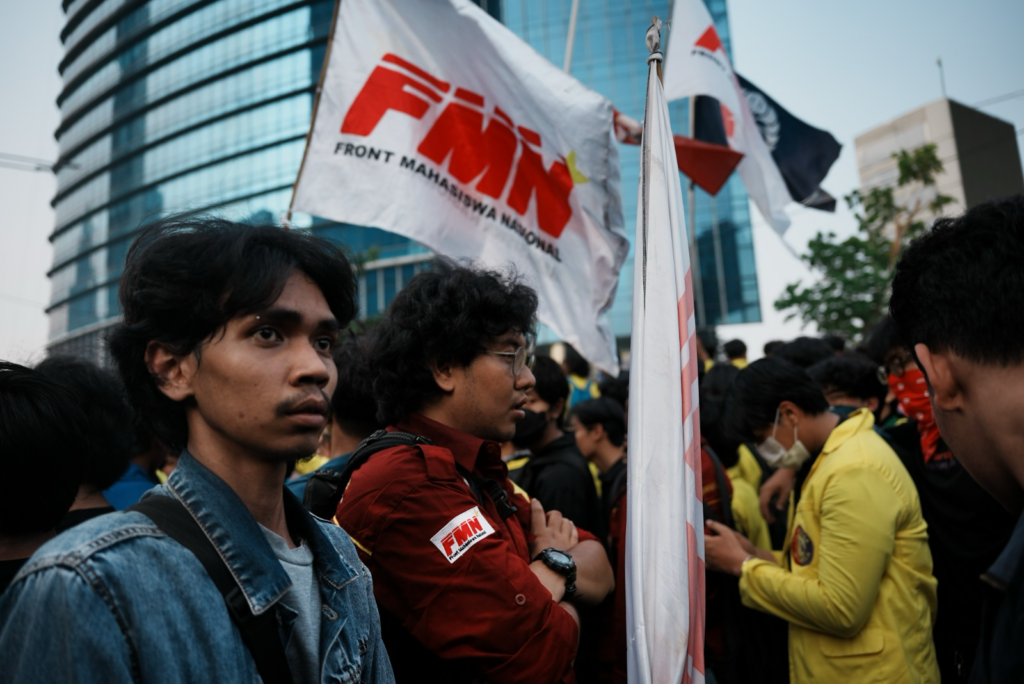
Throughout the demonstration, speakers called for a range of policy changes, including lower fuel prices, increased support for peasants, expanded investment in rural infrastructure, and stronger action against corruption. Protest organizers also voiced opposition to the appointment of active and retired military and police personnel to strategic civilian positions within government institutions and state-owned enterprises. These economic and political demands were linked to the overall struggle against the rule of imperialism, semi-feudalism, and bureaucrat capitalism.
“Once again, Indonesia is not an industrial nation. It is merely a semi-colonial and semi-feudal country. Despite its significant impact, layoffs of formal and industrial workers do not represent the majority of production relations existing in Indonesia. The majority of the population is shackled within semi-feudal production relations in rural areas. They depend on their livelihoods as producers in small-scale agriculture in rural areas and various production activities, trade, services, small- and medium-scale finance, and various other odd jobs in urban areas, commonly known as the informal sector. Therefore, the purchasing power and livelihoods of the Indonesian people are highly dependent on the availability of cheap energy for mobility, raw materials, and low prices for basic necessities. Unfortunately, all of needs of the Indonesian people is increasingly dependent on the capital export-import system, in the form of money and merchants, dominated by international monopoly capitalists,” the organizations analyzed with clarity.
The Worker-Peasant Alliance
The statement issued by FPR and ILPS further emphasized the importance of cooperation between workers, peasants, students, and intellectuals in addressing the country’s economic and political challenges. While acknowledging the prominent role of students in public demonstrations, the organizations reaffirmed that the leadership of the working class, with the peasantry as the main force, would be necessary to resolve the semi-feudal, semi-colonial reality of Indonesia through a national democratic revolution of a new type.
“Students cannot and will never be a fundamental force for change in the chronic semi-colonial-semi-feudal crisis in Indonesia. Peasants and workers, as well as Indonesia’s democratic intellectuals, must work together inseparably, expressing their political views and attitudes,participating directly and indirectly according to their abilities and awareness, and without hesitation providing any support for the collective liberation of the Indonesian nation and people,” the organizations affirmed.
The June 12 mobilization was one of the largest coordinated student-led demonstrations in recent months and reflected growing debate over economic conditions, government priorities, and Indonesia’s response to international developments.