As the crisis of US imperialism intensifies, every day more and more activists and interested new people join the ranks of the revolutionary movement. Navigating the US revolutionary movement can be a very difficult task, for veteran and amateur comrades alike, especially when it comes to burning questions of Our Revolution. How do we organize for victory? Who are our friends, and who are our enemies? What is to be done? In order to begin to approach these burning questions, comrades in any area or organization need to build a solid foundation on which to construct their theoretical and practical attempts at addressing these questions. In addition to the new Our Principles series, to help provide guidance on how to go about laying this foundation, in this multi-part series we at The Partisan will be providing basic points that we feel are universal for all revolutionaries and revolutionaries-in-formation in the United States. We use the term “revolutionaries-in-formation” in our title for the series because of the reality that most comrades nationally are not yet fully formed revolutionaries of our class, but still must be forged as such through education, collective action, and class struggle. For the first installment in this new series, The Partisan explores the question of how revolutionary theory, in particular the philosophy of our class, should be approached within the revolutionary movement in the United States:
- Materialism and Dialectics Are Your Frameworks.
Marxism has three components: philosophy, political economy, and scientific socialism. It is not uncommon for many comrades to view philosophy as the last thing they think about studying when they dive into the revolutionary movement. Usually the first major pieces comrades read are classics of scientific socialism like What Is To Be Done? or the General Political Line of the Communist Party of Peru, or famous works of political economy like Imperialism, the Highest Stage of Capitalism or Capital. Other times comrades don’t touch any major texts, and dive straight into the work without any formal or informal study component prior to or during their practice. On a simple level, the problem with both of these cases is that in order to really grasp revolutionary theory as a weapon for revolutionary change we cannot just understand the what of theorists like Marx or Lenin or Mao (their conclusions, their proposals, their slogans). In order to really study and apply revolutionary theory we must understand the why and how behind it, and to do this we must study and apply the philosophy of Marxism.
Proletarian philosophy is not bourgeois philosophy. It is not supposed to be overly abstract, and does not exist just to make people feel smart about themselves. The philosophy of our class is sharp and precise. It is a powerful tool of knowledge that allows us to correctly approach the questions of our society, our world, our struggle and our revolution that we encounter in our day-to-day.
This is why we encourage all of our readers, newer and older comrades alike, to place a special importance on studying and grasping Marxist philosophy, in particular the two key concepts of materialism and dialectics. Materialism, on a basic level, is the recognition that the world is real and our concepts are reflections of this objectively existing world. To paraphrase Lenin: whether or not you are or I have interacted with coal, or have a word for it or an abstract concept for it, doesn’t change the objective reality that coal is an actual thing that exists hundreds of feet below the earth. Dialectical materialism is contrasted with idealism (i.e. the view that ideas are the engine of history and that our concepts exist independent of the material world), and mechanical materialism (e.g. bourgeois scientists who ignore the social and dialectical aspects of our world and the role of practice), which both serve as the basic philosophical framework for all reactionary and capitalist philosophies. Both idealism and mechanical materialism are actually very commonplace in and around the revolutionary movement, once you know how to look for them.
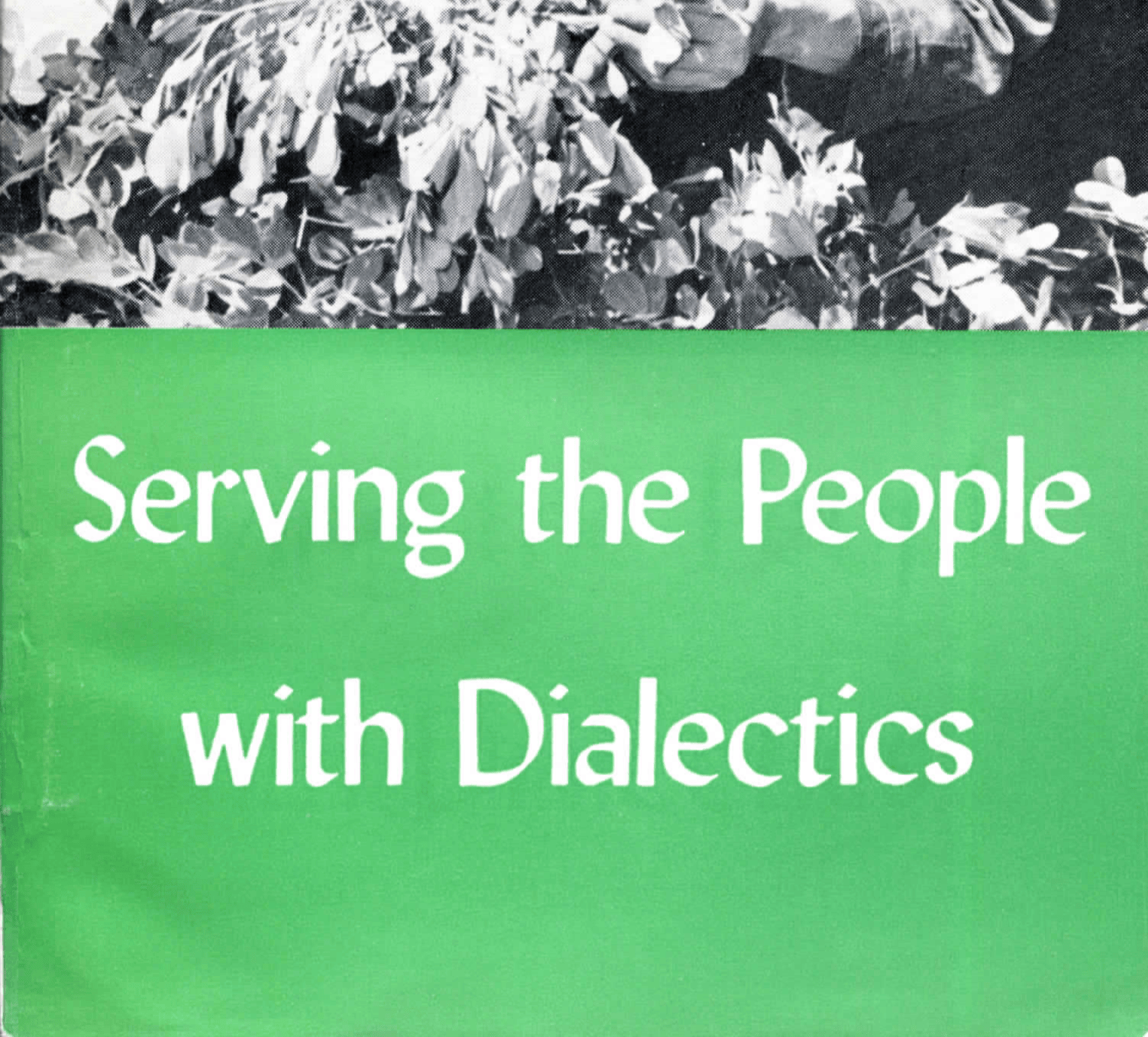
Dialectics, on the other hand, is the framework by which materialists study the development and existence of what are called the “contradictions” within things. Contradictions are relationships between two opposing forces that drive a thing’s development. Such “unities of opposites” exist within anything and everything, and being able to identify the most relevant ones is crucial for analyzing reality. For example, if we take modern US society as a materially real thing which exists objectively in the world, dialectics allows us to study the contradictions within our society. We could examine the contradiction between the working class and the owning class, the contradiction between US imperialism and the oppressed nations of the world, the contradiction between the American oppressor nation and oppressed nations and national minorities within US territory, et cetera. These contradictions we analyze in our conditions can be aspects of the more particular object of the United States, or universal contradictions of the more all-encompassing object that is modern global capitalism. Dialectics can also be applied on a much smaller scale, for example during a strike action, revolutionary leadership might use dialectics to analyze the flow, motion, the development of the different forces, and the contradictions at play in order to map a path of victory for their strike.
Mistakes are inevitable in our work. What generations of revolutionaries have learned the hard way is that if you do not really grasp things like materialism or dialectics, as well as other essential frameworks of revolutionary theory, little mistakes snowball into major errors and can quite quickly become fully formed opportunism and revisionism, especially in an imperialist country like the United States.
While philosophy can be really intimidating for a lot of comrades at first, there is a lot of great material on the subject written precisely for training up workers, peasants, and other comrades from normal everyday backgrounds who have a very limited background in the philosophy surrounding these important concepts. In particular, four relatively straightforward but also very important works we suggest starting out with are Stalin’s Dialectical and Historical Materialism, Mao’s On Contradiction and On Practice, and Marx’s Theses On Feuerbach. All organizations of our class, regardless of their purpose, must figure out creative ways to explicitly incorporate proletarian philosophy into their work and political education, and apply the lessons drawn from it in an organized systematic way that allows comrades to learn from each other, and then sharpen their practice collectively in the course of their class struggles and shared political and organizational life.