Today Juneteenth is celebrated as a federal holiday and one of the most well-known holidays of the New Afrikan people. Behind the glamorous commercialization of Juneteenth, however, is the reality of national oppression. Just earlier this week, on June 14, police officers in Senatobia, Mississippi murdered a New Afrikan infant, Kohen Wiley. As of writing, none of the murderers have received any meaningful punishment.
Juneteenth is often called the “second Independence Day”. Despite this, it is also the yearly reminder that the New Afrikan people are not yet free, 161 years after the formal end of slavery. While lynchings and race riots have become less common, they are accompanied by disproportional rates of maternal death, poverty, and incarceration. Following the examples of Langston Hughes and W.E.B. DuBois, today, we still charge genocide: a systematic genocide by US imperialism against the New Afrikan nation continues to this day only in a more hidden form. And like nationalist leader James “Yaki” Sayles had said, to charge genocide is to combat it, to replace colonial, reactionary violence with revolutionary violence of the working class.
Nonetheless, we must not forget the primary aspect of Juneteenth as a conquest by the people, for which it is rightly celebrated. Juneteenth, a day of victory, is a day of hope that represents the New Afrikan people’s yearning and tireless struggle for freedom. To celebrate Juneteenth today is to remember the valuable lessons and experience it has taught us for new and future battles, and to ascribe to this day the place it deserves in history.
Firstly, Juneteenth taught us that “seizure of power by armed force, the settlement of the issue by war, is the central task and the highest form of revolution.” The formal end of slavery in the United States was not won by peaceful protests or by legislative actions: it was won by the people with guns in hand, watered by the blood of the martyrs.
Just like how dust in a room will not go away without a broom, the Confederacy and the system of slavery it upheld did not go away without a harsh life-and-death struggle. The history of Juneteenth shows that every advance of the working class and the oppressed people is gained through struggle, the highest form being war “where one will overpowers the other.”
Secondly, Juneteenth taught us that the struggle for liberation is a struggle of the people and not of a few leaders. While the Union was not led by the working people, it only won through their participation in the millions in different forms: whether in the army proper, in slave rebellions, or through logistical and support efforts in the rear. The Emancipation Proclamation itself, too, was not granted in the benevolence of Abraham Lincoln. Instead, it existed as the capitalists realized the dynamism and potential of the New Afrikan people in winning the war.
“What is the true bastion of iron? It is the masses. The millions upon millions of people who genuinely and sincerely support the revolution.” This is a historical law that was repeatedly proven. Both with the Civil War, and with every other milestone in the New Afrikan nation’s fight for freedom.
Thirdly, Juneteenth reaffirmed the watchwords of “may actions speak”. Any struggle of the people, in order to achieve final victory, is protracted: it will grow from weak to strong, from simple, lower forms to complex and higher ones. It does so only through letting the actions speak for themselves, by changing reality through action. The Union Army destroyed the slavery relations of production everywhere it went. On the one hand, this weakened the Confederacy bit by bit, undermining its economic and social systems. On the other hand, it brought concrete changes to the lives of the people, which inspired them to join the fight better than any empty declaration.
As the struggle advances, it develops the fighting capacity of the people, from making small gains all the way to changing the society as a whole, replacing the rotten, outdated system that represents the few with another that represents the majority.
Fourthly, Juneteenth taught us that the struggle must be carried out to the end without compromise. Bourgeois democratic revolutions merely transform one form of exploitation into another. After the Civil War, slavery was transformed into sharecropping and capitalist exploitation, as New Afrikan liberation remains a pending task until this very day.
This struggle can only be led by the working class, the class which, by virtue of its position at the point of production, develops the organizational discipline, collective consciousness, and material interest necessary to overthrow capitalist relations entirely and lay the foundation for a society free from all exploitation.
Finally, Juneteenth taught us that the New Afrikan nation, like all oppressed and exploited people of the world, has never bent its knees in the face of oppression. It has never given up its noble desire for freedom. 161 years later, despite the failures, betrayals, and misery, this day of jubilee continues to be remembered and celebrated, not only in Texas but throughout the Black Belt and the United States. Its story is passed from town to town, from tongue to tongue, from generation to generation. It materializes in many forms, from food, art, culture, to story-telling and struggle.
To remember what this day symbolizes – freedom – is to give impetus to the future. The past is seized as an image which flashes up at the instant when it can be recognized: to remember freedom is to remember all the struggles for freedom encapsulated in the word. “History is made by men possessed and enlightened by a higher belief, by a superhuman hope.” The capitalists, who have long lost the ability to imagine something new and have forgotten their own history, sink down in their hopelessness. The oppressed and exploited are the hopeful ones. And like this, they are destined to make history according to their own will.
“We are condemned to triumph; it is a beautiful condemnation.”
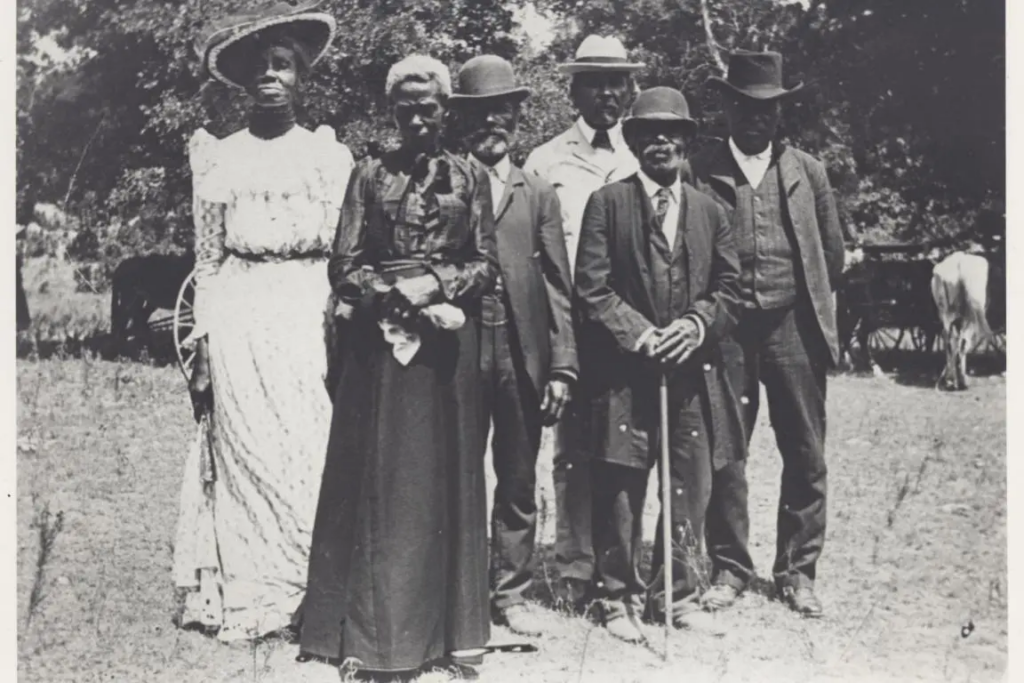
(Image: Emancipation Day celebration, June 19, 1900 held in “East Woods” on East 24th Street in Austin. Credit: Austin History Center.)