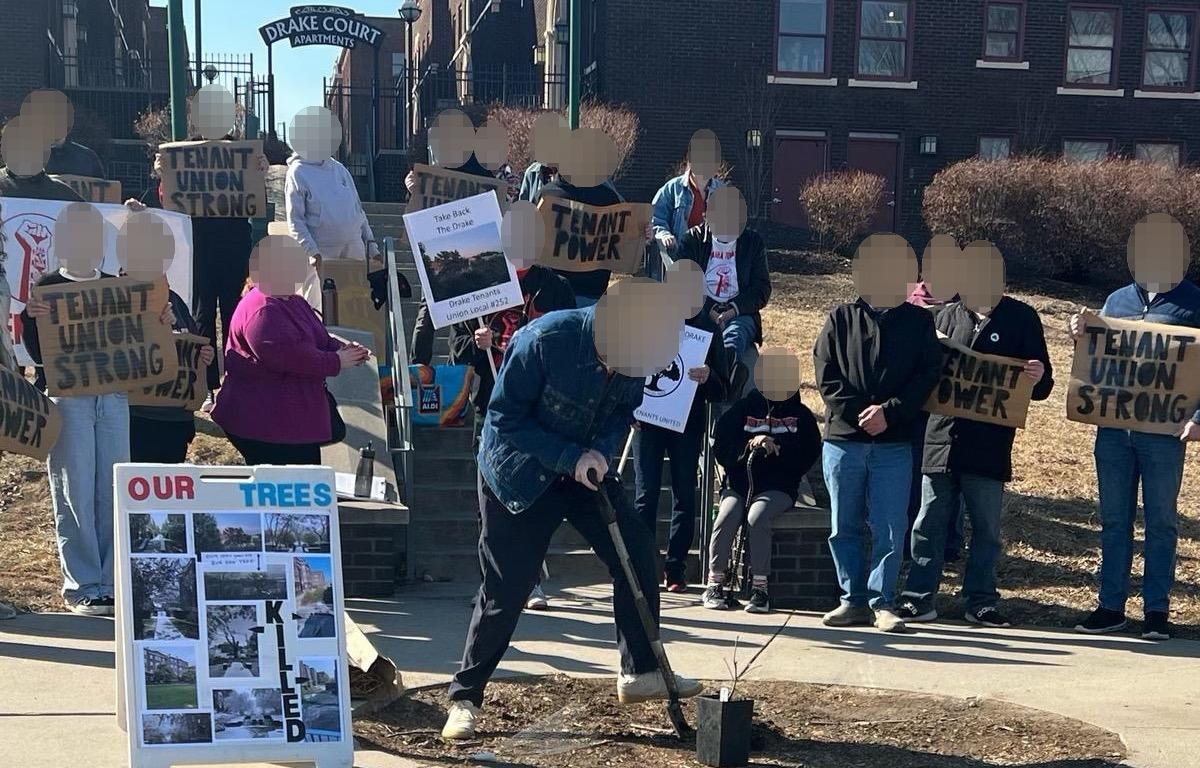
Editorial Note: The Partisan spoke with an activist of Omaha Tenants United (OTU), an organization of tenants and working people struggling collectively against landlords in Omaha, Nebraska. The activist discussed their origins in mutual aid work in 2018, and their development towards a revolutionary tenants organization today. They outline the two lines in the tenants movement, with many groups falling into either anarchist or opportunist conceptions of organizing. They reaffirm the need for a united tenants movement based on solid principles, and to unite working-class tenants to seize power in class struggle.
The Partisan: What is Omaha Tenants United?
Omaha Tenants United: Omaha Tenants United is an organization of working class tenants that fights alongside and organizes other tenants in order to fight back against their landlord when they aren’t making appropriate repairs, attempting to steal money from the tenant, or in some other form or fashion that harms tenants. The vast majority of us are all renters as well, so we view it not only as an organization that does things for tenants, but an organization of fellow tenants that attempts to get other tenants organized, because we view a win for tenants in one place as a win for tenants everywhere.
The Partisan: How was OTU founded, and what has its development looked like since then? What adjustments and rectifications have been necessary along the way?
Omaha Tenants United: So Omaha Tenants United got started in late 2018. It actually grew out of the For The People [FTP –Ed.] movement. We in Omaha had actually established what we called a Feed The People mass organization here in Omaha, which was to later end up being the first chapter of what would become For The People, which was of course a network of organizations across the US that largely engaged in food distribution work. This isn’t the place for a sweeping critique of FTP by any means, but I would say those organizations were really mired in economism, and really had no strategy for not just building power, but also taking any political action whatsoever beyond this simple one-way delivering of goods.
Despite the fact that we were technically the first FTP chapter, those problems for us prior to becoming affiliated with that larger network, was always front and center. We always viewed FTP as not an end to itself, but as a means by which to identify opportunities for political struggle to get the masses engaged and organized for demands. We admittedly didn’t always do the best or most consistent job with this, but we always tried to make it a point to as much as possible really engage with the people who were coming to get food, conduct social investigation and class analysis, ask them about their lives, and what other issues they were facing in an attempt to identify those other political struggles. And OTU came directly out of that process.
At its peak, I think our local FTP was feeding 50–75 people each month. And just time and time again people who were coming to get food, when we asked them what other issues they had going on, would talk about their landlord screwing them over in some way or another.
What should also be noted, which is pretty crazy, is that food insecurity is not just something that homeless people deal with, but working class people who have roofs over their heads, are able to rent, but nonetheless have such intense financial difficulties. Its worth it to bear that in mind.
In any case, we had numerous people that were coming, talking about issues with their landlord, and we felt we need to do something about this, and organize around it. Due to the political conditions in Omaha at the time, and what became increasingly clear in the limits of the For The People model, we felt it necessary to establish an organization that was dedicated to organizing tenants.
So that founding process, we reached out to several contacts within the movement here, tried to get a wide swath of people. At that time there was a number of “left” organizations in Omaha. To try to establish OTU as a strong pole in and of itself, we tried to get both mass contacts and already existing activists from a wide swath of places, particularly people who were not already organized in particular organizations. In any case, we knew we needed to do something, but we wanted to not just rush into trying to organizing tenants, but to lay the basis for a strong and long-standing organization. With that initial crew of maybe seven or eight people, we drafted some points of unity making it clear that we are a revolutionary anti-capitalist tenants organization. And of course, that the points of unity of a mass organization are necessarily going to be much broader than other political forms. So we wanted to convey that sense of revolutionary class-conscious politics while still being broad enough that we can bring in a wide swath of people, particularly the uninitiated masses who, for many of them maybe had never thought about things like socialism and whatnot before. So that process was a balancing act of trying to both be politically rigorous but in such a way that makes it an accessible organization.
Our work kind of really got off the ground as far as actual organizing went, there was this one dude who had been attending For The People things pretty regularly, and he had an issue with his landlord, where he had not had hot water for six months. The landlord told him that the hot water could not be fixed because it would require taking out an entire wall, and that it just wouldn’t be worth it, whatever the hell that means. I mean not only is that brazenly illegal – not that we should base our sense what of is right and wrong on bourgeois law – but even beyond that it’s clearly unacceptable for anyone to have to live like that.
We had no experience doing this before, right? We were aware of certain organizations such as LA Tenants Union, but I’ll be honest, we hadn’t really studied their tactics and strategy a bunch at that point, we kinda just dove in.
In that particular circumstance, what we did, it turned out this dude lived just a couple blocks away from where I was living at that time, in a working class neighborhood in South Omaha, and so did the landlord. He had his office/home in that very same neighborhood as well. So what we did was we had a group of people, both OTU activists as well as contacts from outside the organization. And we drafted a demand letter with tenant basically saying you need to provide hot water immediately, and we marched to his house together to deliver the letter in an attempt to confront the landlord right then and there. Unfortunately the landlord was not home, so we didn’t get quite the same desire that we wanted immediately. However, luckily he had a very nosy neighbor who was apparently observing all of this, and took pictures of us with this tenant in his yard and sent them to the landlord. The landlord then proceeds to send these pictures to the tenant and is cussing him out and all this stuff. He’s like, you know, “what the hell are you doing with all these people at my house, blah, blah, blah.” And in response, the tenant didn’t say anything but simply took a picture of the demand letter and sent it to the landlord, and the hot water was fixed the very next morning, less than 24 hours later. It turned out that it had just been a faulty gasket the entire time. No walls needed to be removed for this to be accomplished. So we got the results really quickly with that one.
Now, you’ll notice here we’re talking about a situation involving an individual, right? Not yet collectively organizing tenants. This is important to understand the process of our development and where we’re at now. First of all, I’d say what did we learn from that experience? It’s that landlords are really fucking scared of their tenants getting organized and having the support of an organization, even if it is on an individual basis. It showed to us that these people can be pressured. They can be forced to meet demands. We didn’t even need to actually talk to the guy. We just showed up, sent him a copy of this demand letter, and this thing that he had been refusing to do for six months was handled in a matter of hours.
That showed us that there is a lot of potential here, that tenants can possess a great deal of power when we get organized and when we attempt to confront our class enemies directly. Given that, and the fact that prior to Omaha Tenants Unitedto our knowledge there was no real history of tenant organizing in Omaha in any meaningful fashion, as far as we can tell. So we felt like we had to show people that directly confronting your landlord and organizing around demands can work. Because people didn’t even think of this as an option at all here. It was either go call the city inspector who will do nothing, or get a lawyer if you can afford one, which, good luck with that, because until recently there was quite literally no lawyers besides legal aid that would accept tenant cases because so many lawyers in Omaha defended landlords. So there was literally no lawyers, and certainly no good ones. So tenants didn’t really have any options.
Certainly scaling up to collective stuff might have proven difficult at first. So in our initial days we did kind of focus on similar situations like that: individuals having grievances and attempting to directly confront the landlord into making those changes. You know, whenever we get a win like that we would just highly publicize it, and it had the desired effect of showing people this is something you can do. Eventually we were able to leverage that into taking on more collective cases.
Largely the way that we would go about finding these things prior to having much of a social media presence was by simply picking landlords that we knew sucked. Dave Paladino was a big one at the time. He was very notorious slumlord here in Omaha. He actually had a reality show called “The Super” where it was just absurd, it actually got taken off of Netflix shortly after we started going after this dude really hard – but it’s basically this documentary series of him just evicting tenants, and finding it very funny. He would evict terminally ill people on camera, and that was the basis of the whole reality show. So, I say that to mean that he was a very notorious figure that everyone in Omaha knew. So, early on, we really focused on him. We would just go knock on as many of his tenants’ doors as we could, and almost universally there’d be at least a couple people that were having some insane problem and wanted to do something about it.
It was difficult to get collective struggles at first, in part because there was no reference point for this thing in Omaha. It was hard to even properly explain what is a tenants union. Of course we can share stories from other metropolises. Places like New York and LA have long histories of tenant union organizing, but it was pretty foreign concept to most people here in Omaha, so it was difficult to get people to want to take that leap at first, particularly when many of Dave Paladino’s tenants were dealing with extremely dire situations that needed to be addressed really quickly. So we made, right or wrong, the decision to accept many of these individual cases because it helped us show that you don’t have to go to the inspector, you don’t have to get a lawyer, you can get these things yourself by just fighting back. It let us do that. It let us show that tenants that fighting works, and built up our reputation among the masses and our online platforms, where now tenants are much more likely to want to do the patient hard work of collective organizing because we developed that degree of trust and good reputation amongst people.
I would say that certainly led us to issues of economism at times. I don’t think there’s any denying that. But I think at the time, particularly when we ourselves were so inexperienced, it was an initial, necessary step to be able to get where we are now of engaging in collective struggles.
And I don’t think that needs to be the pattern of development got anybody starting a tenant union, right? I don’t think that’s the case at all. I think it was a combination of our local conditions and the circumstances in which we formed that kind of led to that. But, you know, that’s certainly not, nor should it be, the case for everybody everywhere.
We definitely felt the effects of those kind of individual cases, that created a lot of busy work, a lot of dead-ends that would go nowhere. Particularly when our social media started popping more, people were seeing these success stories. We would have people reaching out constantly. We didn’t have to go cold canvassing anymore to find places. We just had so many people coming to us that we didn’t have to do that type of outreach as much. But, it certainly became a problem because by doing all this busy work, going through a lot of situations that are just roads to nowhere, took up a lot of time that could have been spent trying to really organize people on a more collective basis.
That’s certainly a hard sell to a lot of tenants at first. Like I said, when people do have dire circumstances, they want to see their problem fixed immediately. And when you tell them there’s not really a good way to do that except by taking a lot of time, really doing the careful, patient work of organizing your building collectively, a lot of people – and you know, this is also just a crime of the highly individualist mindset that the United States generates at the ideological level – a lot of people, once they hear that, they just kind of give up. They don’t want to put in that work. They view us as supposed to be providing a service to them, as opposed to it being a process of organizing, right? And that’s definitely reinforced by the fact that Omaha has a huge non-profit sector that takes up a lot of the work that would otherwise be done by state institutions or activists in the past. So people have this very deeply ingrained sense of “I just go sign up for this service and they solve this problem for me.” Not that this can’t be overcome. I think we’ve come a long way in overcoming that, but that kind of attitude was definitely kind of a barrier for us engaging in more collective-based struggles. Luckily, like I said, though, I think we’ve been able to do a lot of work to break that down. Because people’s minds can be changed, especially the masses. When they engage in real struggle, when they get organized, not only do they learn al these new skills and methods of fighting, but it increases their consciousness too, and their desire to get organized. And other people see that, and it goes a long ways towards transforming some of those mindsets.
But all of that said, we did for too long place too much of an emphasis and spend too much time on individual struggles like that. And some of that, too, was a product of internal two-line struggle. Given that it is a mass organization, there are going to be a lot of different ideologies, a lot of competing views on what the best way to change the world is, and there were certainly people within OTU who simply wanted to reinforce that service-based sort of NGO, non-profit mindset. So it took a while for us to conduct the appropriate amount of political struggle necessary to say we’re not only pursuing individual campaigns.
That was a process of struggle, but a couple of years ago we did vote to no longer do individual stuff. If we’re going to take something on, a tenant needs to be willing to struggle collectively. And to be clear, that’s not just an ideological imposition, although that certainly is part of it, but there’s also just the plain fact that collective organizing is what actually gets victories. So many demands that tenants have, their rightful complaints, can’t really be addressed unless everyone works together to do it, so there’s also a practical component to it, too. That’s part of how we sell that idea to tenants, is that we’ve found this is the most effective way – it’s going to take time, it’s going to take work, it’s not going to be easy – but this is how we get these demands met is when we unite as a collective to fight back against the landlords.
The Partisan: You mentioned that there was an amount of necessary political and two-line struggle to win people in OTU over to this line that collective struggle should be the main focus over individual cases. Can you elaborate on what this struggle looked like in practice.
Omaha Tenants United: So I would first say a large source of that attitude regarding individual stuff was because, being an open mass organization, the political standards are not as rigorous. Because of Omaha’s large non-profit sector, there would be a lot of people from non-profits who would correctly realize that what they’re doing in their non-profit isn’t really doing a whole lot, and want to find an outlet to do more meaningful organizing. However, that often meant they would carry with them these attitudes that have been ingrained in them in their non-profit work. So it was tough. I mean, it took a lot of patient and careful debate.
I would say the vast majority was on board with transitioning to collective only stuff, but due to internal political processes it made it difficult to really get every single person on board, and part of the compromise that we initially made was, we’ll give some of these people some individual cases to keep them busy, and live out whatever it is they want to do while more and more of us focus solely on collective organizing. And I think a lot of it was just through, not just a lot of debate, but also just through practice. I think a lot of the people that held on to that view were increasingly seeing that as we developed more coherent strategies surrounding these things, that style of work was increasingly incompatible with what the organization as a whole as attempting to do. Furthermore, bu seeing the results of collective organizing. On the one hand, that practical demonstration of the superiority of collective organizing both won people who were on the fence or opposed to going that route, or some people just left. And frankly, that’s fine. If their desire to engage in this kind of service based work was so great that they no longer felt like that were in an organization that was correct for them, then that probably means they’re no longer in an an organization that’s correct for them. That’s kind of the inevitability of two-line struggle.
So there’s both the ideological component of having these open debates at our meetings, and presenting proposals surrounding these things, but also that practical element of testing those lines out in practice and demonstrating which one was superior. And that did cause us to dwindle slightly in membership at first, but since then, we’ve only grown stronger, our numbers have gotten bigger, and I think that’s precisely because we chose this more correct strategy of focusing on collective struggles, showing that they work and making a much more durable organization in the process. So it necessarily did result in a little bit of downsizing at first, but in the long run is clear that through that process of political and ideological struggle that we came out much stronger.
The Partisan: Many new tenant organizers find it difficult to grow the union beyond an initial core group of activists. What has OTU’s approach been to developing a mass base in the complexes?
Omaha Tenants United: First and foremost, just publicizing any and all wins, and writing robust analyses of how we did them. If you scroll through some of our Facebook page, going back to the very beginning, we were always writing these pretty long form posts detailing exactly what we did to accomplish these things and what was won. I think that went a long way towards developing the level of reputation and trust that we needed from people to have an initial base of support. That’s obviously on a larger scale.
On the smaller part of directly organizing tenants and getting, for example, a whole building engaged more than just a simple initial two tenants that might have reached out and wanted to get their building organized, that’s a constant struggle, That is definitely one of the biggest challenges in tenant organizing anywhere. We spend a lot of time knocking on doors, having one-on-one conversations with tenants, and we’ve had a lot of success in being able to get large numbers of tenants to show up to meetings at their buildings. The bigger challenge is sustaining that to getting all those people to really feel like they are an organizer themselves and contribute in an appropriate manner. Its still kind of a reflection, kind of a different form of that sort of non-profit, service-based attitude that people have that we see expressed in a different way. So often times a lot of tenants, they’ll see the initial group of, let’s say, five tenants who would reach out who are doing a lot of the day-to-day work, and a lot of times they might try to sit in the background. They’ll show up to meetings, but it an be difficult to get them to take on organizational tasks themselves at times. And of course, to have a successful union struggle, that’s what you need to do. You can’t just have two or five people in a building of 50 do all the work, then it’s collective in name only.
So I think some of the ways that we’ve attempted to address that and improve that issue include, first of all, having basic forms of political education at each of these tenant meetings. A lot of that is stuff that we’ve generated ourselves. Just short, accessible, agitational pieces, or some summary and analysis of prior tenant struggles. I think that goes a long way for people better understanding both what we’re fighting against, and what needs to be done to win, as well as the day-to-day organizing process. I think by laying that stuff out there via political education helps generate a lot more buy-in and sustainability. It doesn’t seem like this kind of amorphous, unspecified organizing process, but here’s who we’re fighting against and here’s the things we can do to actually win. Think just being very upfront about that stuff, including that political education element really drives home a deeper level of commitment and willingness to be engaged and take active roles in organizing.
Additionally, the other thing is just because people are so atomized and demobilized in the United States, a lot of people don’t think of themselves as organizers. They think, “that’s not something I can do, that’s something left to other people to do,” and I think just by providing people with small meaningful tasks to do, and ensuring everybody has a next step that they’re going to be working on, I think that goes a long way. It shows that, “hey, I can do this.” It’s not that hard. It just takes a little bit of time and a little bit of effort.
I think those are the two main things, but certainly it’s a constant battle in that regard. I’m not going to pretend like we have that all figured out by any stretch of the imagination. That’s something we’ve got to be constantly working to build and maintain.
The other difficulty, too, is that its oftentimes easier for people to just move. Unfortunately, some people don’t want to stay and struggle. Especially if they’re not getting immediate results, they’re just like “well, screw it, I’m just going to move somewhere else.” And that’s a difficult barrier to overcome. I mean, we can’t tell people they can’t leave their apartment.
So it’s an ongoing difficulty, but those two things I outlined are pretty easy steps that have improved our situation, and certainly can help avoid some of those issues for anybody trying to organize out there.
The Partisan: What methods have you found to be most effective in applying pressure to landlords and winning demands?
Omaha Tenants United: Show up to their fucking office, their homes, whatever. We’ve occupied officers with a bunch of people. We’ve showed up at their houses. Just make life kind of uncomfortable for them, really.
Being willing to commit to those more direct, more militant tactics is absolutely essential. Not just from a practical standpoint, but also when you get tenants engaging on that level, again, that’s a transformative process of their political consciousness and their ability to see themselves as a force of change in the world. When they engage in those more direct confrontations, it kind of demystifies the landlord. Everybody has this idea of a the landlord in their heads as this unseen boogeyman who has all the power, and I think when you show people that you can reach out and touch these assholes, make it real, and you can scare them, I think that foes a long way in people’s political development, too.
Other things that we’ve done, I think phone zaps are great. That’s definitely one that’s a legal gray area a bit, but we’ve had a lot of success with this. It pisses landlords off and they get really shook by it. There was one situation when we were still doing more individual cases where this landlord just straight up stole three months of rent from this lady. He was just like “no, you didn’t pay it,” when she obviously had. Due to a variety of circumstances, it was difficult to get a collective struggle off the ground here, but this dude was also a major notorious asshole, so we were wanted to try to put the gears on this guy. So we called for a phone zap of just having supporters, other tenants, organizers, blow up this dude’s phone and email saying return this stolen money. And that phone zap got shared by a couple podcasts, so we ended up having from not only across the U.S., but even some people from overseas, like in China, that were calling this guy telling him to fuck off, which was really funny. It took about half a day of that before the landlord was like “ok here’s your money.” so little things like that. You can get creative with stuff.
Also having a media strategy, too. Here in Omaha, where there isn’t nearly as much of a history of tenant organizing, local media finds these stories quite novel and they’re very interested in them. Furthermore, being more of a mid-sized city, a lot of landlords are very sensitive to public pressure, because most of these people, these landlords, think of themselves as good social servants who are providing some sort of great benefit to the community, and that they’re helping people by being landlord. It’s insane, but that’s really how they think. So if you can contact, when you’re initiating a struggle, and you know, you have to be strategic about this, because sometimes where you want to get media eyes on it right away. There’s gonna be times when you kind of want to hold that in your back pocket for later escalation. But drafting a press release, sending it out to just any and every local news that you can find, even if it’s just some small street paper. And you need to have a corresponding strong plan for what your talking points are going to be, coach tenants on what those talking points are going to be because obviously they want to talk to as many tenants as they can. When done correctly that can be a really powerful tool, because negative publicity for landlords is something that many of them are quite sensitive to.
Beyond those kinds of direct confrontation, any kind of creative ways, whether it be through media, phone zapping, whatever can be tactics for pressuring landlords, or at the very least annoying them so much that they are forced to do something. Those are some things we’ve experimented with.
I will say, in our most recent unionization campaign that’s really kind of blown up, we’re in the process of organizing several of the same landlords other buildings. One idea that a brand new member came up with which was great: he had been organizing for three weeks and addition to just confronting the landlord at his home, putting up a bunch of fliers in his neighborhood, in front of all of his neighbors, these kind of wanted posters, “slumlord alert,” that sort of deal. It’s another interesting way to provide some pressure, so we’re going to be experimenting with that in the near future as well. Just canvassing his neighborhood, like “your neighbor is this really rich asshole that’s making tenants live in these horrible conditions, just want to let you know.”
Obviously in a neighborhood like his, we’re probably not going to find a lot of people that want to organize with us because, you know, they’re obviously wealthier folks themselves. But that kind of social shaming pressure, I think, can be really effective. Doing that kind of door-to-door name and shame in their own neighborhood is another thing we’re going to experiment with that I think could be good.
The Partisan: How does OTU assess the current state of tenant movement in the U.S.?
Omaha Tenants United: Good question. So right now there are two major wings of the tenant movement. That being the pole represented by the Autonomous Tenant Union Network, and that of the Tenant Union Federation, which grew out of KC Tenants. They’re a non-profit in Kansas City that took on a lot of organizing, and they’re backed by the SEIU, I think is important to mention.
These are the two poles. I’ll describe them briefly before giving our general assessment. On the one hand you have the Autonomous Tenant Union Network, which was started out of Los Angeles Tenant Union, who’s done a ton of great work. There’s a lot to be learned from their stuff, I think. And basically, they set up this loose coalition of various other tenant organizations in the United States. As the name implies, the keyword here is “autonomous,” so there’s not, to my knowledge there’s not a lot of unity of action or political line, I would say. But it’s a place where these various tenant organizations come together to share advice and experiences. On the other hand, we have the Tenant Union Federation, which is, as I said, SEIU. They are pursuing a similar sort of strategy of this kind of loose network, but I would say it’s probably more organizationally rigorous. I think they have a bit higher standards for what kind of organizations are admitted. But they also do a lot of just astro-turfing organizations, to be quite honest. They also engage in a great deal of public education events. They have a lot of seminars for prospective tenant organizers and stuff where they have their whole rundown of exactly how to organize and whatnot. These are the two major forces right now.
I don’t want to sit and just relentlessly criticize, so I’ll start with what I’ll say is the good of those things before moving on to some criticisms.
I’d say with Autonomous Tenant Union Network, it is certainly much more left in nature. To my knowledge, just about every organization in there is nominally socialist of some sort. Many of them grow out of DSA chapters. That process of sharing experience can certainly be beneficial, although I don’t know how much of a systematic level that’s done. LA Tenants Union in particular has launched a lot of really impressive tenants struggles, particularly with the most oppressed masses in Latino neighborhoods in LA, and so they’ve done a lot of pioneering work both on the tenant and neighborhood level that I think there’s a lot to learn from. That being said, I think the issue with ATUN is, again, because of that emphasis on autonomy there’s no shared strategy; there’s no sort of expectations for what it means to be a member of the organization. There’s not really a coherent shared political line, there’s not unity of action, and there’s not a systematic method of summing up and engaging in criticism and self-criticism, to my knowledge. They put such great emphasis on autonomy and being decentralized that it appears to us that it’s kind of just a paper organization that doesn’t behave as an organization. It’s kind of just, do what you want and let us know if you need advice. That’s the impression that we’ve gotten.
On the other hand, we have the Tenant Union Federation. What I will say that’s good about them is that they do have very rigorous standards for organizing tenants. For example, one of their policies is that if you can’t get a building to be 80% strike ready – so super-majority rent-strike ready tenant union – you just need to pull out. They have very robust methods of organizing that I think they’ve put a lot of time and detail into elaborating on. Whether those are correct or not is a different question. But I will say, unlike ATUN, I think they do a good job of trying to say exactly what needs to be done, and how it needs to be done. So there’s a greater level of practical unity among its constituent organizations. That being said, I will say that I think as admirable as having a building 80% strike ready is I think that is almost too high of a standard at times that can result in pulling out of situations that may have otherwise had a lot of promise for collective organizing. I’m not saying that having a building 80% strike ready is a bad thing. That’s awesome if you can do it, but that is extremely difficult. Just because something is difficult doesn’t mean that it’s wrong! But I think what those types of standards ignore is that people can become strike ready through the process of organizing. If we pulled out of every building where we didn’t have those type of people willing to hit that nuclear option in tenant organizing, we probably wouldn’t have ever organized a tenant union. We haven’t been able to successfully organize a rent strike, to be fair. But we see tenants beginning to talk about a rent strike in our collective struggles after they’ve participated in other forms of escalation, and they see start to see that there’s fewer and fewer options. So, I think getting to that level of consciousness and commitment is something that’s developed through the collective struggle, and shouldn’t necessarily be the standard by which to choose to engage in collective struggle, if that makes sense. So I think there’s some good and some bad there. But I think the biggest problem is that they are definitely the right wing of the tenants movement. Politics does not really enter the equation whatsoever. Again, they are funded by the SEIU, a notorious state union. They rely upon a very professionalized sense of organizing, and not professionalized in the good way, but in the way of “we need to have paid staff.” We had a phone call with them one time when they launched because they were trying to pull us in, and they were just shocked that we did not have any paid organizers. They literally said “your movement’s not going to go anywhere unless you have people that are paid to do this full time.” We all have 9 to 5 jobs and we’re just working class tenants like anybody else. We do this as a means to develop the class struggle, not because we want it to be our careers.
So there is that very non-profit, NGO attitude towards things that I think brings with it a bit of elitism, and certainly because they don’t have any sort of political line, and I would guess would probably be hostile to have any sort of political line, they just simply view tenant organizing in a vacuum as a thing that’s done in and for itself, and not as part of a broader political movement that’s one part of a larger strategy. So they very much represent what I would say is the right wing of the tenant movement as it exists. I can’t speak for their individual members. It’s not to say there aren’t people in there that have good politics and see this as a vehicle for expressing that, but by basically adopting outright economism with no process of criticism about that, I don’t see that as having sustainable or meaningful returns and developing the local struggle. Of course, I’m sure they see that differently. I’m sure that some of their leadership probably are self-described socialists or leftists! But these are those type of rightist, tailist errors that lead us to organizational dead ends. Instead of viewing tenant organizing as a constituent part of a broader class struggle, viewing it in a vacuum in such a way that doesn’t seek to build power.
That would be overall assessment of the tenant movement as it exists. It’s wholly inadequate. Both of these poles – again, despite doing some commendable work in certain areas – fail to do the things necessary to make this a meaningful struggle capable of assisting us in building and winning power.
The Partisan: You’ve laid out what seems to be a relative left-wing and relative right-wing of the tenant movement at this moment. How does OTU approach the left wing versus the right wing, and how should revolutionary tenant organizers around the country orient themselves to these two lines?
Omaha Tenants United: We were nominally members of ATUN, to be fully transparent about that. They asked us to join when it got off the ground. Of course, like I said, that doesn’t mean a whole lot because there’s no real organizational or political unity to speak of. We attempted to engage with them, but it really wasn’t like there were collective events since it was mainly a couple general ATUN meetings and a couple social events over the past several years. So on the one hand, we did attempt to engage with ATUN.
Now, I’d say we really don’t engage with either, honestly. I think what needs to happen is that there does need to be a national revolutionary tenants movement established. I think through that organization, we should seek to win over some of these organizations, which I think is entirely possible. Certainly there’s going to be some elements that just just can’t be united with. That’s to be expected. But I think particularly when it comes to ATUN, there could be organizations within that that could be won over, given that they are already much more left-leaning; given that their presence in ATUN doesn’t really mean a whole lot organizationally, I think seeing a more disciplined, organized, and united revolutionary tenant movement could really appeal to some of those people. I certainly think that’s a possibility.
As far as TUF goes, I frankly don’t know. I think they’re kind of doing their own thing, and I think they’d be quite reticent to being won over. That’s not to say it’s not possible, but I think, first thing first, what we need to do is set up an alternative of like-minded tenant unionists who view this as a component in the struggle for power, who have shared revolutionary principles, and who seek to use their tenant organizing not as an end to itself, but as a way to strengthen the revolutionary movement and build revolution. That’s the first major task we need to accomplish. And then from there, having established a revolutionary pole is how we can effectively go about attempting to win some of these other groupings over.
The Partisan: In what ways do you find your approach to tenant organizing to be similar or different from the other major trends in the tenant movement nationally?
Omaha Tenants United: I kind of touched on some of that. We don’t have the same pullout standards that TUF does, for example. We see the process of collective organizing as being a transformational one for people’s consciousness to begin with, and therefore it’s by sincerely and resolutely engaging in these struggles that we are able to develop the level of consciousness and commitment needed to do things like rent strikes in the first place.
Second of all, I can’t say who these apply to specifically without knowing more about organizations, but just like a couple things that I’ve noticed, I think there’s, on the one hand, a tendency for organizers to reproduce that sort of nonprofit service method of work by just simply trying to do things for tenants. I think that’s not only just a bad way to approach political organizing, but is also wholly ineffectual. You can’t change things from the outside. We can certainly provide insights and advice and support, but without tenants taking on an active role in the organizing process, it’s never going to get anywhere.
That should go without saying. So I do think there’s people that view this as something that’s just done for people and don’t really try to engage the masses appropriately and involve them in the organizing process. We view it as we organize with tenants. We don’t organize for tenants. We don’t advocate for tenants. We organize with them. That’s by really engaging in that groundwork alongside tenants, you know, helping them get off the ground with talking to their neighbors, sharing our experiences, and helping grow their tenant union.
With that bearing in mind, they’re organizers too, right? It’s their buildings. They need to take a part in that process. So we view it as organizing with tenants, it’s going to be extremely rare that tenants just spontaneously by themselves figure out how to fight back appropriately, not to say that it doesn’t happen. That component of having a tenant organization to provide leadership, experience, and organizing skills is absolutely necessary, but the goal should be to turn the tenants into organizers themselves.
You can’t have one without the other, but I think sometimes people think that you can. So on the one hand, we have people who think you can just do things for tenants without really trying to engage them appropriately, generate the buy-in and organizational structure amongst themselves that’s needed. On the other hand, you have people who are so autonomous, for lack of a better word, that they think that you can only do whatever the tenants are already willing to do and are doing currently.
It’s kind of this rightist interpretation of the mass line, or this sort of populist, tailist error, we might call it, where just like whatever the tenants already want to do is fine, and we just have to stand on the sidelines and support that. Which if you did that, we know from practical experience, many tenants think, “oh, well, let’s just call the city inspector.” We know that’s not going to work. We know that’s going to get people nowhere. If we’re not willing to step in, provide initial organizing leadership, and, you know, see to, through applying the mass line, take people’s real demands and come up with revolutionary solutions for them that they themselves buy into, nothing’s going to change, right?
You need organizers that are able to provide leadership and make deliberate interventions and strategy and stuff. Otherwise, people would just, in Omaha, do nothing but call the city inspector, maybe call their city council person, and then be surprised when that inevitably does not work at all.
I think there is a tendency amongst some tenant organizers to have a so hands-off approach, a sort of like populist, tailist approach that nothing meaningful ever gets done. People don’t actually get organized. We don’t elevate people’s political consciousness or grow their fighting skills. I think those are two of the big errors that I see, and those are things that we try to actively combat, both through our external political education that we do with tenants when we have meetings, but also our internal political education.
We have our general OTU meeting once a month, and we’re always starting that with political education of some sort, whether that’s talking, reading pieces regarding the mass line and the potential errors that people can make when trying to apply it so that we hopefully avoid some of these issues, such as I’ve just described. Or learning lessons from previous revolutionary tenant organizers and trying to use those as ways to inform and enhance our practice. I think at the end of the day, that’s another really key thing, is both that internal and external political education. It’s not something that you can shy away from. I think that’s something that a lot of people want to cut corners on because it doesn’t, for a lot of people out there it seems like, “what’s the point of that?” We’re just here to help tenants.
If you don’t do that, you’re not going to have unity as an organization. You’re not going to be able to agitate tenants appropriately, and you’re not going to be able to develop your own internal level of organization and political unity that’s necessarily for having a coherent strategy and being able to engage in honest criticism and self-criticism. If we just didn’t have that component, we would never learn anything. Maybe we’d learn something, but certainly not to the level of quality that doing this in a more systematic, deliberate form will.
So those are some of the errors that I see, and those are a couple of my thoughts on how they can be combated both within our organizations and when engaging with tenants.
The Partisan: Is there any additional advice you would give a new activist looking to form a tenants union?
Omaha Tenants United: First of all, don’t be afraid to try particularly when you’re first starting out, and you don’t really have a presence or reputation amongst the masses, that’s not going to build itself, right? You need to actively go to the masses, talk with them, and try to identify these sites of struggle.
In an OTU situation, we’ve grown enough, we’ve developed enough of a reputation that largely speaking, not to say that we don’t still do deliver on their own outreach, because we do do that all the time, particularly like when a tenant from one building reaches out and we’ve got a good struggle going, we’ll go out to other landlords’ properties and be like, “yo, like, your fellow tenants who also rent from this dude, have been having all these problems. They’ve been doing this to fight back, what do you think about it? What type of issues are you having? Do you want to get organized?” So we still do that, but especially at the very beginning, you really got to put in the effort to go out, meet people where they’re at, and learn from them, and try to identify these sites of struggle.
That means just knocking on doors, dude, it’s patient, slow work, it’s not always particularly glamorous, but if you’re doing that in a systematic and deliberate fashion, you are eventually going to find tenants that want to get organized and want to fight back. I have no doubt about it. It might take a while, it could be that for every 100 doors that you knock on, you get two people that are down at the very beginning, but that’s the type of work that we got to do to build these movements and make them successful and identify struggles that we can organize around.
Not only that, but like returning to people too, you shouldn’t just write somebody off just because they weren’t interested in talking that day, or it didn’t seem appealing to them at first. Once you’ve generated some interest in a particular building or with a label or whatever, go back to those people. Keep trying to reengage, keep trying to agitate them and learn from them, share your success stories with them to build that trust and reputation, because that’s how we get the masses on our side is by taking their thoughts seriously and trying to come up with ways to get them agitated, and mobilize to engage in revolutionary work. You’re not going to figure that out over a five minute front door conversation that requires sustained engagement.
So cast a wide net. Go to the tenants where they’re likely to be, of the deepest and lowest masses, where they’re probably are having a lot of problems because anywhere where there’s people struggling, there’s going to be people that want to do something about it. So just starting out, come up with a list of piece of shit landlords in your community, attempt to identify all of their buildings, and just on a regular basis, go out and try to talk to those people who are renting from them and see if you can get a struggle going. That just requires really sustained and patient work to be able to do that, but that’s what makes these things possible, they’re not just going to fall in our lap, we have to go find these things and get people organized.
The Partisan: Finally, what plans does OTU have for the future, and what hopes do you have for the future of the US tenant movement?
Omaha Tenants United: Right now our time is really taken up organizing against a local landlord where we recently established a tenant union at one building, and we have a strong plan for going after his other buildings. We were able to get a lot of his tenants to come to our monthly general meeting last week and develop plans with them to go canvas their buildings a few times to try to talk to other tenants and get things organized in their buildings using that initial tenant union as a strong example of how this can be done. So that’s what we’re working on in the immediate future.
Going forward, you know, we’d like to be able to develop robust sustainable tenants unions, such that they can be welded together to form a citywide tenants union that consists of various different tenant union locals. That is challenging to do, even on the collective scale. We still see some of these sort of individualistic and an economistic tendencies come out in the masses even if they’ve had a successful union struggle and won a lot of demands.
Oftentimes people are like “well we did it, there’s no need to keep organizing,” but what makes a tenant union a real source of power, is that it’s a permanent institution even in “peacetime,” because even if the landlord gives gives in to all of our demands, eventually things are going to backslide and unless tenants remain organized and ready to confront those issues on a permanent basis, you’re not going to be prepared for when that happens and you kind of have to start back at square one. Developing really durable long standing unions that have an organizational and social life that extends beyond just the immediate struggle that they initially take on, and using that as a basis to unite various tenant locals into a broader city wide union as such, I think is a big goal of ours.
I hope that this current struggle that we’re waging, where we’ve had tenants from around five or six of his buildings, reach out and work with us and come up with game plans of organizing neighbors, I’m hoping that that will be provide a basis to accomplish that goal and plant the seeds for what can be a larger tenant union that doesn’t just represent tenants of one property or one landlords investment portfolio, but tenants across various different landlords and all parts of the city.
It’s going to be difficult. It’s going to be a challenge. That’s big work and a big scaling up but I’m hoping that through this recent struggle against this local landlord that we can establish the germs of that through that just given how good of a response across his buildings and different parts of the city that we’ve seen, you know, well, I guess we’ll we’ll see.
Beyond that, I really hope to see the establishment of a revolutionary pole within the tenants movement nationally, and I know that’s something that here in Omaha, we would have a lot of enthusiasm for, and there’s a lot of people out there that would be very into that as well, but I think it’s just a matter of establishing that national center that rectifies all those areas that we kind of talked about with the existing situation of the tenants movement. but it establishes shared political lines and more systematically reports back on their successes and failures for us all to learn from that, because so many apartments now are owned by huge corporations that have hundreds of properties in different states.
Imagine if we could have a shared strategy for how to get those buildings organized in different states, because that’s one of the big challenges now going up against these corporate people, is they might be based in New York or Florida and it’s harder to apply pressure to them on a local basis. If they have like a barely staffed office here, you know what I mean? I think such an organization would have the ability to pursue things like that and apply a higher level of pressure on these corporate landlords that were previously a bit more inaccessible.
I think that would go a long ways to heightening the level of struggle, but that organization is very much needed and I hope that as more and more activists get involved in the tenants movement, that that’s something that people start having serious conversations about. Another component of that too is being deliberate about how we view tenant work as fitting into a broader revolutionary strategy, and whether we’re making meaningful contributions to accomplishing that, and if we’re not, what needs to be done to fix that so that we’re not just tenant organizing for the sake of tenant organizing, but that we’re tenant organizing for the sake of building working class power.
The Partisan: Thank you again for taking the time to talk with us!