Within the United States there is a remarkable unity of opportunist and revisionist forces, as demonstrated through their politics, their practice, and their positions on real burning questions of making revolution in our country. A majority of forces on the “US Left,” despite their self-proclaimed labels of “Leninists,” “Maoists,” “Trotskyists,” etc., practically and theoretically are variations on the same revisionist theme. Their differing rhetoric and slogans cover up a common essence: the rejection of revolution, revolutionary violence, and the dictatorship of the proletariat. Identifying and breaking out of this mold, which has condemned all past sequences of the movement in our country to failure, and charting a new revolutionary path, is one of our key tasks as modern-day revolutionaries within the United States.
The unity of American opportunism originates in the rightist factions of the original Communist Party of the United States of America (CPUSA) that dominated the Party’s leadership for almost its entire existence. These factions, who competed amongst each other while all representing the same basic political line, were lead by figures such as J. Lovestone, James P. Cannon, William Z. Foster, and Earl Browder. It was under Browder that the dysfunction and degeneration of Communist political leadership reached its logical conclusion with the notorious liquidation of the Communist Party in 1944. This degeneration of Communist forces within the United States was reinforced by the CPUSA’s false “reconstitution” under leadership of long-time right-opportunist William Z. Foster in 1945. While revolutionary forces within the United States had been lead by right-opportunist and eclectic forces prior to the 1944 liquidation, and 1945 false reconstitution, of the CPUSA, both of these moments marked a turning point that our revolutionary movement has not been able to overcome.
As revolutionaries we understand that the main cause of something’s transformation is its internal development, and thus we can see how the internal victory of the capitalist road within the US revolutionary movement resulted in these events. All modern revisionists, such as Bob Avakian, have built upon the original revisionist foundation laid by the right-wing of the CPUSA. Therefore, in order to characterize and make a clean break with revisionism in the United States, we must start by striking at its heart beginning with Fosterism and Browderism.
The majority of self-proclaimed “revolutionary” or socialist organizations in the United States still follow the teachings and positions laid down by Browder and Foster. To begin drawing our line in the sand, we identify three shared characteristics of US revisionism and opportunism, of our domestic “capitalist road”, that stem from the original CPUSA right-wing: American Exceptionalism, anti-Leninist party-building, and a tailist approach to the Democratic Party, and thus, American imperialism itself. While the US revisionists and opportunists cover for themselves – sometimes even cynically using imagery of armed struggle – in reality, they deny the principle that “political power grows out the barrel of the gun,” replacing it with reformism ideologically, politically, and organizationally.
American Exceptionalism
All of our domestic opportunists are united in some form on what has become known as “American Exceptionalism.” This is the idea that the United States is unique such that universal components of Marxism do not apply in our country. American exceptionalism has been become so pervasive and common sense in our movement that it now even comes in various flavors suited to the taste of our different shades of revisionism. Comrade Stalin, in a speech to the Communist International in 1929, described the problem well:
“… it has become evident during the course of the discussion that both groups [the Lovestoneites and the Fosterites –Ed.] are guilty of the fundamental error of exaggerating the specific features of American capitalism… Specific features are only supplementary to the general features. The error of both groups is that they exaggerate the significance of the specific features of American capitalism and thereby overlook the basic features of American capitalism which are characteristic of world capitalism as a whole… Owing to these conditions, at times one section, at others, the other section, fails to realize the full extent of reformism in America, underestimates the leftward swing of the working class, and, in general, is inclined to regard American capitalism as something apart from and above world capitalism.”
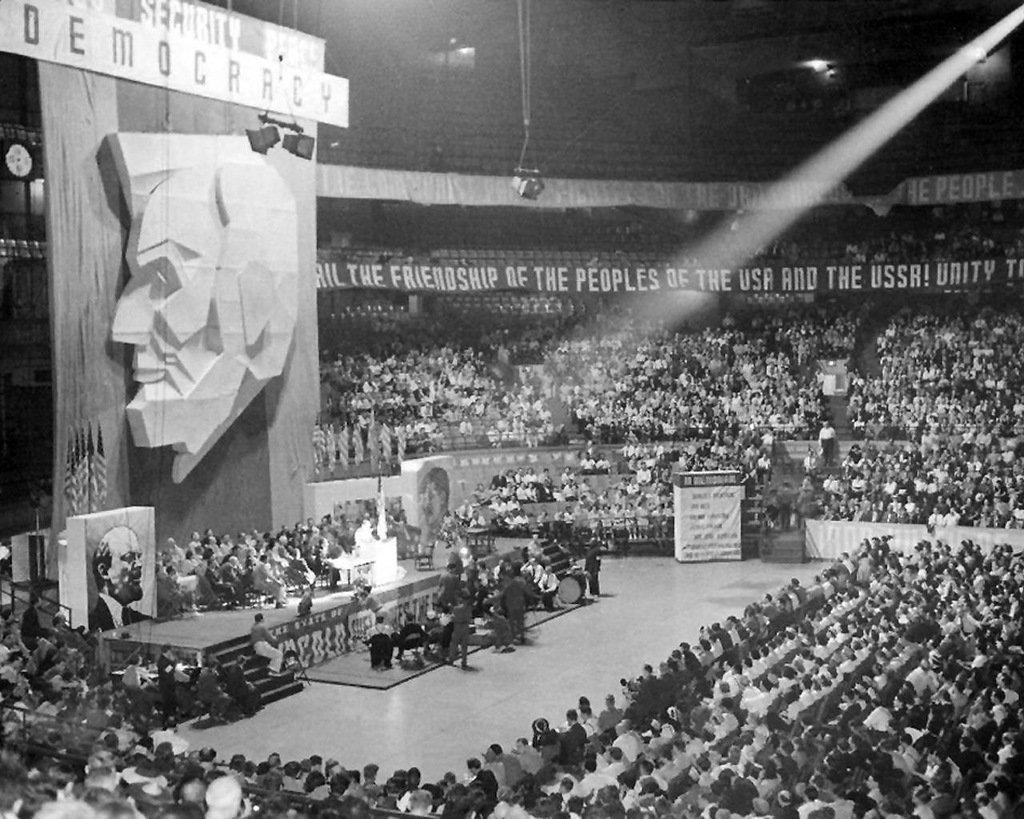
The most well-known and straightforward form of American Exceptionalism is the “patriotic,” “Americanist,” or “constitutionalist” variety. This was originally expressed by the CPUSA right-wing with the slogans like “Communism is the Americanism of the 20th Century” and the smuggling in of American national chauvinism into the Party’s line, with presidents like Abraham Lincoln being cast as revolutionary proletarian heroes. It is also sometimes referred to as “Bill of Rights socialism.” The basic thesis of the original form of American Exceptionalism is that because the United States was founded as a relatively wealthy settler colony with liberal democracy, the universal Marxist-Leninist path of a clandestine Party which leads a violent revolution was not applicable to the United States, even if it was elsewhere. According to the CPUSA right-wing, in the United States, elections and embracing aspects of the American State and American nationalism should be used to achieve a peaceful transition to socialism.
This line can be found expressed today in the programs and positions of a wide variety of organizations on the US Left. Among the false “communist parties” examples abound, such as the modern “cpusa’s” explicit support for Gus Hall’s “Bill of Rights socialism,” the PSL’s 10-Point Program based on expanding and amending the US constitution, FRSO’s support for Democratic politicians and promotion of “class-struggle” state unions long incorporated into the structures of imperialism, or the American Communist Party’s support for “Promotion of American Civilization” and the “Reconstitution of the United States of America Into One United Republic.” The Democratic Socialists of America as a whole lends its entire existence, and all of its caucuses’ existence, to the premise that an electoral path to socialism is possible within the framework of US bourgeois democracy because of our “constitutional protections.” All of these organizations owe their political legacy to Browder and Foster (read Browder’s The People’s Front for an excellent example of this) and the pre-Leninist Second International tradition the CPUSA right-wing were based on, a tradition which did not uphold the Militarized Communist Party. Some, like the “cpusa” and DSA, openly deny the principle of revolutionary violence; still, there are others who claim to uphold this criteria, but in reality, they create a false equivalence between the tailing of state unions and elections with the militant struggle of the working class, while putting revolution on the back burner as a distant myth of imagery.
Since the original trend of “Bill of Rights socialism” developed out of the CPUSA right-wing, in the following decades there has emerged a new flavor of American Exceptionalism. This trend flips “Bill of Rights socialism” on its head on paper, but maintains the same essence and basic conclusions. This trend is commonly known as either “Third-Worldist Maoism” or “Sakaism” after J. Sakai, one of its most prominent proponents. This trend argues that a typical violent socialist revolution lead by the multinational proletariat through its Party is impossible in the United States not because the history and class composition of the country is uniquely “positive,” (as the “patriotic” or “constitutionalist” variety of the Exceptionalists hold) but because it is uniquely “negative.” In this sense the two trends have the same basic diagnosis or analysis, derived from exaggerating the specific features of American capitalism, but diverging drastically in terms of their rhetoric and judgment of these “specific features.”
The most committed Third Worldists, for lack of a better term, often argue that settler colonialism and the parasitic and large labor aristocracy created by the super-profits of US imperialism make violent socialist revolution lead by the multinational working-class an impossibility or even something undesirable. Their theorists instead argue, variably, that either the prison population or only the poorest Black and Brown people (often misnamed “the lumpenproletariat” based on an incorrect interpretation of Marx) are potential revolutionary agents within the United States. In the most extreme of cases, some argue that no one in the United States is revolutionary – except for those who have opened their eyes to their status as parasites. While many would-be Third Worldists once took up “left”-opportunist methods in the past, (some courageously raising the flag of armed struggle) they quickly changed course after the failure of these struggles, instead focusing on prisoner support work and mutual aid distributions among the rural and urban poor, elevating important auxiliary activities to primary activity and neglecting struggle at the point of production. Cynically, the natural conclusion for this ultra-revolutionism ends up being pushing for reformist programs that supposedly alleviate the plight of the “poorest,” which then are ironically only possible through electoral means.
Where Browder argued that the legacy of Jeffersonian settler democracy was a moral positive that made violent revolution impossible and the peaceful transition to socialism possible in the US, the Third Worldists argue that the legacy of US settler-colonialism and chattel slavery forecloses any transition to socialism lead by the proletariat. The Third Worldists of course are correct insofar as American settler-colonialism and chattel slavery were genocidal and serve as the historical foundation and origin of our country’s character as a prison-house of nations with a particularly large labor aristocracy. However, they “exaggerate the significance of the specific features of American capitalism and thereby overlook the basic features of American capitalism which are characteristic of world capitalism as a whole,” as Stalin put it. This is why many Third Worldists begin to eschew even the capitalist/wage-laborer class distinction, and instead write class analyses based on the “consumer aristocracy” and other non-scientific class categories. Ever since the mid-20th century, many workers in the US and Western Europe have enjoyed relatively comfortable living standards, accompanying the development of technology and the super-exploitation of the colonial countries by the capitalists. This phenomenon is also developing in social-imperialist China, South Korea, and Japan, which include more than a quarter of the world’s population. In any case, this doesn’t mean exploitation has come to an end: on the contrary, it is accompanied by the unprecedented increase in physical and psychological strain on the back of the workers, summed up in the term alienation. It has been accompanied by pervasive mass surveillance and repression, especially for oppressed nations and immigrant worker populations, making daily life unbearable. These circumstances do not negate the need for a proletarian revolution. They call for militant and uncompromising struggles to rupture the everyday life of modern capitalism and in developing new proletarian forms that replace old rotten bourgeois forms (including, eventually, new Political Power of the proletariat) in the course of these struggles.
While the “Bill of Rights socialism” trend is more common and prominent among the US Left as a whole, the ideas of “Third Worldists” are very influential among many groups and comrades within the revolutionary movement itself, and thus the latter trend also works to smuggle American Exceptionalism into the US Maoist movement. American Exceptionalism, in its “patriotic” and “Third-Worldist” forms, functions as our own country’s peculiar form of Narodism. Narodism was a major and widespread current in the pre-October-Revolution Russian socialist movement, which held that the specific features of Russian feudalism made proletarian revolution impossible or undesirable in Russia. Instead they pursued agrarian socialism and vacillated between committing ultra-left acts of isolated political violence or collaborated with Czarist and liberal forces. By exaggerating the specific features of Russian capitalism they obscured a path to socialist revolution that took into consideration these specific features without negating the universal theses and principles of Marxism. Our own “Narodniks” do much the same, and struggling against this tendency means doing as Lenin and Stalin did: imposing and educating comrades on a line of socialist revolution that takes into account the specific features of US imperialism, such as the labor aristocracy and National Question, without negating the universal path of proletarian revolution. And just like the historical Narodniks who swung from the ultra-“left” to the ultra-right in defense of the bourgeois order, the American Exceptionalists deny the principle of revolutionary violence and instead channel the masses’ energy into reformist and electoral solutions under this or that cover.
The Anti-Leninist “Party”
Because of the dominance of the rightist line within the CPUSA’s leadership throughout its entire pre-liquidation existence, the Communist Party USA was never completely Bolshevized, and therefore never fulfilled all the principles of Leninist Party construction laid out by Lenin and Stalin. Instead the CPUSA was torn apart by factional infighting during the 1920s, based on what were known at the time as the “left” and right oppositions within the Communist International. The theory and practice of these “oppositions,” particularly the “left” opposition, eventually become synthesized in what we now know as Trotskyism.
A Trotskyite, and thus anti-Marxist-Leninist, model of the Communist Party has become the default mode of Party formation and construction in the United States. This model is the political-organizational consequence of the dominance of “middle-class” (i.e., petty-bourgeois and labor aristocratic) revolutionaries and their lines within the US movement. In works such as the Comintern’s Guidelines on the Organizational Structure of Communist Parties, on the Methods and Content of their Work and in Foundations of Leninism, Stalin and the International Communist Movement more defined the Marxist-Leninist Party with principles such as:
- Far-sighted leadership of the class while still being of the class and deeply involved in both the day-to-day struggles and demands of the class as well as its historic political aspirations (the dictatorship of the proletariat)
- Based on democratic centralism (lower bodies submit to high bodies, minority submits to majority, freedom of discussion with unity of action, dialectical relationship between democracy and centralism)
- Clandestine structure composed of “professional revolutionaries” who devoted their lives to organizing work, in comparison to the “mass party” model of the Second International
Instead of a model based on Communist principles of Party construction, a Trotskyite model of Party building dominates the US Communist movement, with Leninism never taking a firm hold in our country. This can be seen in how the Bolshevization of the CPUSA was never completed, and in how the New Communist Movement was unable to produce either a reconstituted Communist Party or a Party embryo which really grasped Marxism-Leninism-Maoism as the path towards a modern Party of a New Type.
We have instead been left with a set of sectarian groups, some bigger and some smaller, some older and some newer, largely composed of students and intellectuals rather than workers and the deepest, lowest masses. These sects operate on amateurish “mass party” lines rather than professional revolutionary lines. To join, for example, the modern “communist party,” or the PSL, or the RCP, one simply has to pay dues, agree with their program, and fill out a few forms and attend a few meetings. The Marxist theory of knowledge argues that a Communist can only be trained through social practice led by the Party, in the form of scientific experiment, class struggle, and struggle for production, while these “parties” replaced these criteria with the subjective level of comprehension of texts, a favorite past time of the petit-bourgeoisie. This common criterion for “party” membership among opportunists in the US throws the Leninist principle of a clandestine Party composed of a select few professional revolutionaries, of “Party workers” conducting legal and illegal work out the window.
Similarly all of our US opportunists embrace factionalism and petty-bourgeois individualism and eschew or distort collective leadership and democratic centralism. In his speeches on the CPUSA in 1929, Comrade Stalin spoken extensively on the characteristics of American factionalism:
“What are the main defects in the practice of the leaders of the majority and the minority?
Firstly, that in their day-to-day work they, and particularly the leaders of the majority, are guided by motives of unprincipled factionalism and place the interests of their faction higher than the interests of the Party…
An end must be put to the present situation in the Communist Party of America, in which the questions of positive work, the questions of the struggle of the working class against the capitalists, questions of wages, working hours, work in the trade unions, the fight against reformism, the fight against the Right deviation — when all these questions are kept in the shade, and are replaced by petty questions of the factional struggle between the Lovestone group and the Foster group….
[The proposal of the Comintern] is based on the idea of maintaining the line of the Comintern within the ranks of the Communist Party of America, on the idea of bolshevizing the American Communist Party, on the idea of fighting the deviation from the Marxist line, and, above all, the Right deviation, on the idea of Leninist Party unity, and finally, and above all, on the idea of completely liquidating factionalism. For it must after all be realized, comrades, that factionalism is the fundamental evil of the American Communist Party.”
Stalin connected the pervasiveness of US factionalism to pre-Leninist and pre-Bolshevization practices of the International Communist Movement, which he said had also manifested in Russia with the factional struggles between the Mensheviks and Bolsheviks within the rather loose and decentralized RSDLP of the time. He identified how factionalism allowed for rightism to fester and distracted Communists in the US from major pressing questions of revolution. He described the need for a Bolshevized Vanguard Party which leads a united revolutionary movement that has “liquidated” factions and factional struggle, in service of the interests of the working class, of focusing on “positive work,” and struggling against Right deviations. The struggle against factionalism is a key dividing line between revisionism and anti-revisionism.
Despite the work of the International Communist Movement, factionalism and factionalist methods have remained the norm for revolutionary organizing in the United States. Foster and Browder engaged in endless factionalist struggles during their time in leadership, and Lovestone and his followers produced some of the first Trotskyite organizations in the United States after his expulsion from the CPUSA. Cliques, sects, and organized and unorganized factions based on personal disputes and different gradations of revisionism abound in our country. The split between the false “cpusa” and the American Communist Party, the split between Workers World Party and the Party for Socialism and Liberation, the organized caucuses and factions within the DSA, and the idea of “joint” versus “parallel” and “side-by-side” unity expounded upon by The Worker, all represent the characteristic factionalism of US opportunists. They do not represent Chairman Mao’s idea of the “clean split” that is sometimes necessary for anti-revisionists members to break with a revisionist dominated organization, maintaining correct leadership under correct ideological and political line, and instead represent opportunists splitting from other opportunists to maintain their faction or sect.
This is also why, in terms of activity, the false “revolutionary organizations” of our country are not built through militant independent class struggle, but instead are mainly built through Trotskyite methods of newspaper publication and distribution, fractional work, reading groups, and ambulance-chasing street theater. Newspapers, fractional work, reading groups, and even flashy presentations are not wrong on their own, but when they become the focus, the center of your practical work, in place of class struggles lead by the working-class and its organizations, you are no longer building through Marxism. The Marxist-Leninist-Maoist Party is a war machine, a Party of a New Type aimed at the conquest of political Power by and for the proletariat. To reduce this to study groups and newspaper distributions is to make the role of the revolutionary that of a bookseller, and to reduce class struggle to mainly winning influence within organizations lead by the bourgeoisie, like the state unions and NGOs, is to make the activity of the revolutionary that of an unsuspecting lackey or puppet.
These trends – which together amount to the creation of organizations that are entirely exposed in the view of the class enemy, filled with revolutionaries (while with good intentions) incapable of weathering the storms of class struggle, separated from one another on subjective and sectarian criteria, and isolated from the life and struggle of the proletariat – lead to the same conclusion: the rejection of revolutionary violence in deed, if not in words. This is in line with the historical Trotskyism and the personality of Trotsky himself, who never led a revolution despite their revolutionary pretenses. Chairman Mao once said: “if there is to be revolution, there must be a revolutionary party. Without a revolutionary party, without a party built on the Marxist-Leninist revolutionary theory and in the Marxist-Leninist revolutionary style, it is impossible to lead the working class and the broad masses of the people in defeating imperialism and its running dogs.” [Emphasis ours –Ed.]
So mainstream is Trotskyism in the United States that many of these practices are considered synonymous with Leninism and Maoism, representing the need to clarify, impose, and apply a revolutionary road within our movement.
Tailing the Democrats
Maybe the most destructive and pervasive legacy of the counter-revolutionary leadership of the Communist Party was that they cemented a policy of tailing the Democratic Party, politically, organizationally, and even ideologically. The naked tailism of US opportunists has been commented on extensively for decades – some have even argued that the vast majority of the US Left can be understood as an appendage of the Democratic Party – but many forget that this relationship was only solidified in the mid-to-late 1930s by the CPUSA right-wing. Through a revisionist interpretation of the anti-fascist Popular Front strategy propagated by the Comintern’s 7th Congress, the right-wing of the CPUSA argued that a United Front had to be forged between the CPUSA and the “progressive” wing of the Democratic Party, denying the consistent leadership of the Communists. Under this policy different CPUSA “Farmer-Labor” electoral fronts were merged with this supposed Democratic “left-wing” and the formerly CPUSA-organized workers and trade unions were put under the leadership of Democratic trade unionists like Henry Lewis, crushed by the Second Red Scare, and eventually joined with conglomerated AFL-CIO.
This decision to practically merge the CPUSA with the Democratic Party, both electorally and within the labor movement, meant the liquidation of independent Communist politics and organization, reducing the CPUSA to a husk focused on debates within the ICM and empty theoretical pronouncements. Beyond the CPUSA itself, and its false “reconstituted” post-1945 version, this pivot towards the Democratic Party has had repercussions for generations of US revolutionaries. It has meant the default approach among has been tailing of the Democratic establishment, through its co-optative “left-wing,” for decades.
On the National Question it has meant an embrace of the politics of “racial equality” rather than national liberation, with the Black National Question being liquidated by Browder and Foster in part as a ploy to deepen their alliance with Roosevelt’s New Deal coalition, which encompassed the Jim Crow system also. Under the illusion of the gradual improvement of imperialism, which is “reaction all along the line,” militant struggle against racism, national oppression, and police brutality have been replaced by reformist demands of “oversight” and “community control” that reject the conquest of Power, and eventually, empty acts and proclamations passed in the city hall all the way to Congress. Within the workers movement it has meant the endless decades-long dance outside of and within the AFL-CIO, with thousands of would-be revolutionaries entering into establishment unions under pretenses of “conquering them” only to either be expelled, blacklisted, or become the very union bureaucrats they originally sought to drive out. In local, state and national politics it has meant hundreds of shaky endorsements of “progressive” Democratic politicians, with these endorsements batting a 100% failure and betrayal rate.
There was a common social basis between the CPUSA right-wing historically and the “left-wing” of the Democratic Party: the labor aristocracy and lower petite-bourgeoisie of the American oppressor nation. It was the union bureaucrats and those who sympathized with them, along with intellectual “middle-class” types who had undue influence in the Communist movement during the CPUSA’s formative years and Popular Front period, who were the first to push for the weakening, splitting and eventually liquidation of the Party’s mechanisms. They then went on to either reconstitute the Party on a false basis, in the case of Foster, or outright turned to anti-Communism and during the Second Red Scare, like Jay Lovestone, Benjamin Gitlow, and others.
This is not a fluke: Lenin explained how ideological and political vacillations are introduced into the working-class movement by non-proletarian elements. The New Revisionism of Bob Avakian found its political home among the “radicalized” college students of the 1960s and 1970s. Modern revisionism/opportunism also relies upon those with a non-proletarian class stand for its social basis of support, and politically represents these non-proletarian class interests. These false communists often play “radical” in their youth, only to return to the Democratic Party fold later in life. The tailing of the Democrats is the ultimate destination of all trends of US opportunism and revisionism that come to reject revolution, revolutionary violence, and the proletarian dictatorship.
Identify and Defeat the Legacy of the CPUSA Right
We must understand our past in order to overcome it. The ideological-political problem posed by the legacy of the CPUSA right-wing (Foster, Browder, Cannon, and Lovestone, principally) was not fully understood for decades. For example, within the New Communist Movement, Foster was viewed by many as a positive figure who represented the anti-Browder left within the CPUSA. Actual CPUSA left-wingers such as William Dunne and Harrison George wrote important tracts after their expulsion from the CPUSA that began to describe and diagnose the problem (see The Struggle Against Opportunism in the Labor Movement and The Crisis in the C.P.U.S.A), but they were unable to centralize and unite the remnants of the CPUSA left-wing into a new reconstituted center that could struggle against and overcome Foster’s falsely reconstituted post-1945 “cpusa.” This allowed the CPUSA right-wing to set the foundation upon which the 1960s/1970s NCM was formed, leading to a generalized unity of opportunism in the United States where seemingly diverse groups such PSL, FRSO, RCP, SAlt, DSA, ACP, and of course the “cpusa” all have the same basic revisionist political line.
The history, practice, and ideology of the International Communist Movement, ideology which is today Marxism-Leninism-Maoism, principally Maoism, provide us with a powerful guide by which to understand our own country’s movement and overcome its challenges. To identify, demarcate with, and defeat revisionism and opportunism within the United States is an essential task for revolutionaries-in-formation and their organizations. While this first entry in The Partisan’s new series on US Communism explores some of its worst aspects, the legacy of the CPUSA right-wing, the second entry will discuss some of its most important victories. Understanding both our peaks and our valleys is necessary on the way to forging a revolutionary path in the United States.